KPEERI Exam Questions With Complete Solutions
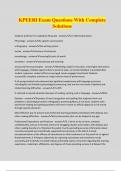
KPEERI Exam Questions With Complete Solutions Students proficient in reading by 4th grade - answer1/3 (32% below basic) Phonology - answerthe speech sound system orthography - answerthe writing system syntax - answerstructure of sentences morphology - answermeaningful parts of words semantics - answerword phrase and meaning structured literacy principles - answerModeling, explicit instruction, meaningful interactions with language, multiple opportunities to practice tasks, corrective feedback is provided after student responses, student effort encouraged, lesson engaged monitored, Students successfully complete activities at a high criterion level of performance. % of young students who demonstrate significant weaknesses with language processes, including,but not limited to,phonological processing, that are the root cause of dyslexia and related learning difficulties - answer15-20% % referred to special education because of reading, writing, and or language - answer85% Dyslexia - answerDisorders of word recognition and spelling that originate from core problems in phonological and/or orthographic processing.Many, if not most, students with word-level reading and spelling problems will never receive an official diagnosis or be served through special education Most effective way to prevent and ameliorate learning problems,individuals with dyslexia and other reading difficulties - answerEarly Intervention (but can be helped at any age Professional Dispositions and Practices - answer5.1 Strive to do no harm, maintain confidentiality, and act in the best interest of struggling readers and readers with dyslexia and other reading disorders.5.2 Maintain the public trust by providing accurate information about currently accepted and scientifically supported best practices in the field.5.3 Avoid misrepresentation of the efficacy of educational or other treatments or the proof for or against thosetreatments.5.4 Respect objectivity by reporting assessment and treatment results accurately,and truthfully.5.5 Avoid making unfounded claims of any kind regarding the training, experience, credentials, affiliations, and degrees of those providing services.5.6 Respect the training requirements of established credentialing andaccreditation organizations supported byCERI and IDA.5.7 Avoid conflicts of interest when possible and acknowledge conflicts of interest when they occur.5.8 Support just treatment of individuals with dyslexia and related learning difficulties.5.9 Respect confidentiality of students or clients.5.10 Respect the intellectual property of others. Five Knowledge and Practice Standards - answer1. Foundations of Literacy Aquistion 2. Knowledge of Diverse Reading Profiles Including Dyslexia 3. Assessment 4. Structured Literacy Instruction 5. Professional Dispositions and Practices Phonological Sensitivity - answerawareness of rhyme, alliteration, syllables, and larger chunks of words 5 language processing requirements of proficient reading and writing - answerphonological, orthographic, semantic, syntactic, discourse Acquired Dyslexia - answerrefers to persons who have learned to read and write with no difficulty who subsequently experience some type of brain damange and who as a result encounter some type of brain damage and wo as a result encounter problems of varying severity with reading and or other langauge processing skills Affix - answera grapheme or group of graphemes added to the beginning of end of a base word or root Alphabetic Principle - answerthe understanding that letters represent sunds which form words Analytical phonics - answerstudents are taught to reognize groups of whole words before learning grapheme/phonemeic relationships. They typically analyze selected sight words later in order to deduce certain grapheme phoneme relationships. Places much greater emphasis on visual memory and deductive reasoning. It assumes students are able to learn and apply phonological knolwedge inferentially with little need of direct instruction. Aphasia - answerimpairment or loss of the faculty to use or understand spoken or written language due to brain damnage Auditory Discriminiation - answerability to hear likenesses and differences in phonemes and words, sometimes referred to as "auditory perception" Those with poor auditory discrimination typically have normal hearing acuity but may exhibit differently distinguishing certain
Geschreven voor
- Instelling
- KPEERI
- Vak
- KPEERI
Documentinformatie
- Geüpload op
- 8 april 2024
- Aantal pagina's
- 9
- Geschreven in
- 2023/2024
- Type
- Tentamen (uitwerkingen)
- Bevat
- Vragen en antwoorden
Onderwerpen
-
kpeeri exam questions with complete solutions

Ook beschikbaar in voordeelbundel