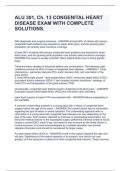
ALU 301, Ch. 13 CONGENITAL HEART DISEASE EXAM WITH COMPLETE SOLUTIONS.
With diagnostic and surgical advances - ANSWER-at least 90% of infants with serious congenital heart problems are expected to reach adult years, and this growing adult population can actively seek insurance coverage at least 90% of infants with serious congenital heart problems are expected to reach adult years, and this growing adult population can actively seek insurance coverage - ANSWER-The cause is usually uncertain. Many defects likely have a strong genetic basis There are many varieties of structural defects and combinations. The following eight conditions account for 80% of cases of congenital heart disease: - ANSWER-1. three obstructions - pulmonary stenosis (PS), aortic stenosis (AS), and coarctation of the aorta (COA) 2. three left-to-right shunts - atrial septal defect (ASD), ventricular septal defect (VSD), and patent ductus arteriosus (PDA) 3. two complex cyanotic conditions - tetralogy of Fallot (TF) and transposition of the great arteries (TGA). Occasionally, congenital heart defects remain undetected until adult years. - ANSWER-Examples include atrial septal defect (ASD) and mild aortic valve disorders. open heart surgery to repair COA was replaced with - ANSWER-balloon angioplasty in the mid1990s A common underwriting scenario is a young adult with a history of congenital heart surgery before the age of five years. - ANSWER-The current doctor has no information regarding the type of lesion or where operated. The underwriting approach with no information in a young adult with congenital heart disease can vary depending on the size of the case. Scar location obtained by interview or paramedical examination can direct the medical director to the associated surgery performed. Minimal evidence would include a current EKG, chest X-ray, and report of any murmurs by the family doctor or routine examiner. A current echocardiogram by a reliable laboratory can provide valuable information and should be considered for larger cases. An atrial septal defect (ASD) is - ANSWER-a hole in the septum between the right and left atria. Significance of the defect depends on its location, size (which can vary greatly), and the presence or absence of other congenital heart lesions. These common defects can occur in different areas of the interatrial septum and include secundum, primum, and sinus venosus defects. Secundum ASD is - ANSWER-the most common ASD, occurring in the center of the septum. Some small-sized lesions with small shunts eventually are closed by surgery or catheter intervention. Risk of complications is less than 1% with catheter technique. - ANSWER-If not closed, there is a small, increased risk of atrial fibrillation. With or without atrial fibrillation, the presence of a small right-to-left shunt can increase the risk of stroke. The mortality ratio is likely to be close to 100%. F
Geschreven voor
- Instelling
- ALU 301, Ch. 13
- Vak
- ALU 301, Ch. 13
Documentinformatie
- Geüpload op
- 8 april 2024
- Aantal pagina's
- 11
- Geschreven in
- 2023/2024
- Type
- Tentamen (uitwerkingen)
- Bevat
- Vragen en antwoorden
Onderwerpen
-
alu 301 ch 13 congenital heart disease exam with
-
alu 301 ch 13 congenital heart stuvia

Ook beschikbaar in voordeelbundel