contemporary issues in nutrition spring 2022 final exam study guide
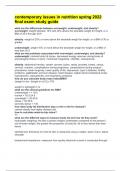
contemporary issues in nutrition spring 2022 final exam study guide what are the differences between overweight, underweight, and obesity? overweight: weight between 10% and 20% above the desirable weight for height, or a BMI of 25.0 through 29.9 obesity: weight of 20% or more above the desirable weight for height, or a BMI of 30 or greater underweight: weight 10% or more below the desirable weight for height, or a BMI of less than 18.5 what are the problems associated with overweight, underweight, and obesity? underweight: minimal body fat stores, decreased energy reserves during times of physiological stress or injury, menstrual irregularity, infertility, osteoporosis obesity: abdominal hernias, certain cancers (colon, rectal, prostate, breast, uterus, cervical, ovarian), complications during pregnancy, complications during surgical procedures, lower longevity, lower quality of life, depression, type 2 diabetes, fertility problems, gallbladder and liver disease, heart disease, higher blood cholesterol levels, hypertension, osteoarthritis, and respiratory problems how do you calculate body mass index(BMI)? (weight in lbs / (height in in)^2) x 703 weight in kg/height in m what are the clinical guidelines for BMI? underweight = 18.5 normal = 18.5-24.9 overweight = 25-29.9 obese = 30-39.9 severely obese = 40 how does body fat distribution play a role in risk for disease? central obesity has higher disease risk how to calculate waist-to-hip ratios? ?? what are the different ways to measure body fat and how do they work? hydrostatic weighing: the less a person weighs underwater compared to the person's out-of-water weight, the greater the proportion of body fat, fat is less dense than lean tissue skinfold test: thickness of a fold of skin is measured using a caliper, back of arm, below shoulder bioelectrical impedance: measures how quickly electrical current is conducted through the body, estimates the amount of: body water, non-fat components of the body, and degree of body fat how do you use waist circumference, waist-to-hip ratios, and total body fat percentage to determine disease risk? waist for men 40 waist for women 35 waist to hip ratio men 1.0 waist to hip ratio women 0.8 total body fat % men 25% total body fat % women 33% how many calories make up 1 lb of fat? 3500 name and describe the 3 components of energy expenditure. BMR (60-65%): rate body expends energy to support vital functions at rest: heart beat, breathing, blood pressure. does not include voluntary activities physical activity (25-35%): most variable part of energy expenditure equation, varies according to body size, type of activity, volume/intensity of activity, most effective way to increase "energy out" thermic effect of food (5-10%): production of heat that occurs after eating, contributes to a rise in metabolic rate, supports ingestion, digestion absorption, transport of food, argument for frequent meals/snacks to increase thermic effect of food what factors increase BMR? caffeine, fever, growth, height, high thyroid hormone, male gender, muscle mass, smoking, stress what factors decrease BMR? age, low thyroid hormone, reduced energy intake(fasting, starvation, low calorie diet), sleep describe the 2 causes of obesity related to genetics (as discussed in lecture notes). ob gene: - produces a hormone (leptin) that tells the body to stop eating - fat stores up: higher leptin(lower appetite, higher energy expenditure) - fat stores down: lower leptin (higher appetite, lower energy expenditure) - overweight: ? defective ob gene (lower leptin production) or unresponsive to leptin fat cell theory: - overweight child has higher # of fat cells - weight loss in adulthood only decreases size of fat cells, not # of fat cells - fat cells have enzyme LPL which enables cells to store body fat, the more LPL, the more the body can pull triglycerides into fat cells for storage what are vitamins?
Written for
- Institution
- Nutrition
- Course
- Nutrition
Document information
- Uploaded on
- April 6, 2024
- Number of pages
- 13
- Written in
- 2023/2024
- Type
- Exam (elaborations)
- Contains
- Questions & answers
Subjects
-
contemporary issues in nutrition spring 2022 final

Also available in package deal