PYS 101 MIDTERM 2. | VERIFIED SOLUTION
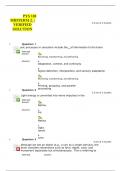
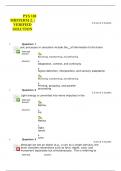
PYS 101 MIDTERM 2. | VERIFIED SOLUTION • Question 1 2.5 out of 2.5 points Basic processes in sensation include the of information to the brain. Selected Answer: c. Receiving, transforming, and delivering Answers: a. Adaptation, context, and continuity b. Signal detection, interposition, and sensory adaptation • Question 2 c. Receiving, transforming, and delivering d. Priming, grouping, and parallel processing 2.5 out of 2.5 points Light energy is converted into nerve impulses in the Selected Answer: b. Retina Answers: a. Iris • Question 3 b. Retina c. Optic nerve d. Lens 0 out of 2.5 points Although we see an object (e.g., a car) as a single stimulus, the brain considers dimensions such as form, depth, color, and movement separately but simultaneously. This is referring to Selected Answer: a. Feature detection Answers: a. Feature detection b. Parallel processing • Question 4 c. Accommodation d. Opponent processing 2.5 out of 2.5 points The last time your nasal passage was congested, you noticed that the food you consumed tasted bland. This illustrates the principle of Selected Answer: d. Sensory interaction Answers: a. Transduction b. Gate-control theory c. Kinesthesis • Question 5 d. Sensory interaction 2.5 out of 2.5 points The 2006 movie Children of Men initially puts the audience on edge when the main character gets tinnitus and the audience hear the high-pitched ringing in his ears. After a while, the audience doesn’t even notice that it’s still there, this acclimation is due to Selected Answer: c. Sensory adaptation Answers: a. Transduction b. Difference threshold • Question 6 c. Sensory adaptation d. Signal detection theory 0 out of 2.5 points Tucked up by our midbrain, olfactory bulb, amygdala, and hippocampus is a brain structure called the uncus. The uncus integrates emotion, smell, and memory information. This is why when you smell the type of cookies your grandma made, you immediately remember your grandma and feel a rush of happy emotion. This sensation is an example of Selected Answer: d. Olfaction Answers: a. Sensory interaction • Question 7 b. Embodied cognition c. The McGurk effect d. Olfaction 0 out of 2.5 points Sensory input from muscles and organs are sent to whereas sensation one gets from holding a cup of hot coffee is sent to . Selected Answer: b. Somatosensory cortex, Cerebellum Answers: a. Cerebellum, somatosensory cortex b. Somatosensory cortex, Cerebellum c. Temporal lobe, somatosensory cortex d. Motor cortex, frontal lobe • Question 8 2.5 out of 2.5 points Physical punishment is a controversial way of controlling someone’s behavior because Selected Answer: d. All of the above Answers: a. It induces fear of the person giving punishment, via classical conditioning. b. The target/preceding behavior is not necessarily eliminated. c. It encourages aggressive behavior, via modeling. • Question 9 d. All of the above 2.5 out of 2.5 points From a very young age animals learn to anticipate that events and stimuli can be paired together. That fire means hot and a bark comes from a dog. This is Selected Answer: b. Associative learning Answers: a. Operant behavior • Question 10 b. Associative learning c. Respondent behavior d. Cognitive learning 2.5 out of 2.5 points In school children learn to associate the ring of a bell with class being dismissed and leaving the room. Originally the ringing noise was a Selected Answer: c. Neutral stimulus Answers: a. Conditioned stimulus b. Unconditioned stimulus c. Neutral stimulus d. Rewarding stimulus • Question 11 0 out of 2.5 points Shelly is working in her home office while the baby is in his/her crib (it’s bedtime). The baby is crying but Shelly ignores the crying baby and continues to work. 15 minutes have passed and the baby is still crying. Shelly decides to attend to her baby. Shelly coming over to her baby is a for baby’s crying and subsequently, the baby stopping to cry is a for Shelly appearing to tend to her baby. Selected Answer: c. Negative punishment, negative reinforcement Answers: a. Negative reinforcement, negative punishment b. Positive reinforcement, positive reinforcement c. Negative punishment, negative reinforcement • Question 12 d. Positive reinforcement, negative reinforcement 0 out of 2.5 points In the case of Shelly, what will she likely do when her baby cries the next time she is working at home during bedtime? Selected Answer: b. Let the baby cry for 15 minutes and then go to the baby Answers: a. Go to the baby b. Let the baby cry for 15 minutes and then go to the baby c. Keep ignoring the baby d. Speak to the baby through baby-cam • Question 13 2.5 out of 2.5 points In the case of Shelly’s baby, what will he/she likely do when in need of mom’s attention? Selected Answer: a. Cry continuously
Written for
- Institution
- PYS 101
- Course
- PYS 101
Document information
- Uploaded on
- April 6, 2024
- Number of pages
- 19
- Written in
- 2023/2024
- Type
- Exam (elaborations)
- Contains
- Questions & answers
Subjects
-
pys 101 midterm 2 verified solution que