NBDE Part II Exam with Guaranteed Accurate Answers
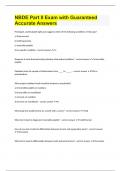
Prolonged, unstimulated night pain suggests which of the following conditions of the pulp? a) Pulp necrosis b) mild hyperemia c) reversible pulpitis d) no specific condition - correct answer a Response to heat thermal testing indicates what pulpal condition? - correct answer Irreversible pulpitis Palpation tests the spread of inflammation from ____ to _____. - correct answer PDL to periodontium What pulpal condition/tooth would be hardest to anesthetize? a) irreversible pulpitis on maxillary b) irreversible on mandibular c) necrosis on maxillary d) necrosis on mandibular - correct answer b What pulp test would be best on a tooth with a crown? - correct answer Cold What test is best to diagnosis irreversible pulpitis? - correct answer Cold/thermal How do you test a tooth to differentiate between chronic and supperative perio? - correct answer Percussion What test is used to differentiate between endo and perio lesions? - correct answer Percussion What does a RL at the furc of a primary first molar in a 5 y/o usually indicate? a) erupting perm first premolar b) necrotic pulp c) normal anatomy - correct answer b Apexification is done on a vital/nonvital tooth with a incomplete/open apex. - correct answer Nonvital, incomplete Apexogensis is done on a vital/nonvital tooth with a incomplete/open apex. - correct answer Vital, open 13 y/o pt has a non-vital maxillary central. The apex is still open. What should be done? - correct answer Apexification What is the most common reason for failure of replantation of avulsed teeth? - correct answer External resorption Which is most damaging to the PDL? a) extrusion b) intrusion c) lateral luxation d) avulsion - correct answer b What tx should be done to a perm central that experienced trauma resulting in intrusion of 5 mm? What if it is primary? - correct answer Pull to normal position and splint; observe to let it re-erupt What is the primary purpose of sodium hypochlorite? - correct answer Dissolve necrotic tissue Soidum hy
Written for
- Institution
- NBDE Part II
- Course
- NBDE Part II
Document information
- Uploaded on
- April 5, 2024
- Number of pages
- 24
- Written in
- 2023/2024
- Type
- Exam (elaborations)
- Contains
- Questions & answers
Subjects
- nbde part ii
-
nbde part ii exam with guaranteed accurate answers

Also available in package deal