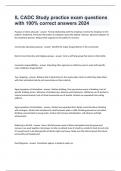
IL CADC Study practice exam questions with 100% correct answers 2024.
Trust is an essential component of a productive counseling relationship. Which of the following is NOT a key counselor contribution to the development of trust: A.) Ongoing commitment to client success B.) Greater latitude in boundary setting C.) Nonjudgmental attitude D.) Unconditional positive regard B.) Greater latitude in boundary setting Substance-abusing clients can be clinically and personally challenging. Of what is compassion fatigue a key symptom? A.) Clients with multimodal issues B.) Counselor apathy C.) Clients with high-abuse histories D.) Counselor burnout D.) Counselor burnout Working with substance-abusing clients can result in a variety of emotive experiences. What does the term "secondary trauma" refer to? A.) Symptoms in the counselor emerging from high exposure to client traumas B.) Entering a relationship with abusive features like those experienced before C.) The medical sequelae that may arise after years of emotional abuse D.) The overlay of emotional abuse in a physically abusive relationship A.) Symptoms in the counselor emerging from high exposure to client traumas Treatment plans should refer to the types of program service modality being offered. Which of the following is NOT a common modality? A.) Perinatal B.) Scholastic C.) Outpatient D.) Residential B.) Scholastic Tracking client progress longitudinally is important to measure progress and document program effectiveness. How often is client data typically reviewed? A.) Quarterly B.) Semi-annually C.) Bi-annually D.) Annually D.) Annually (yearly) Sooner or later, all treatment programs end, and a discharge summary and continuing care plan will then be required. What is the key difference between a discharge summary and a continuing care plan? A.) A discharge plan provides a theoretical orientation to a client's presentation, while a continuing care plan offers a model for further intervention. B.) A discharge plan provides a roster of prior professionals involved, while the continuing care plan proposes further professionals to engage in the treatment process. C.) A discharge plan provides an overview of treatment and outcomes, while the continuing care plan addresses aftercare options based on the client's response to treatment. D.) A discharge plan provides directions for further treatment, while the continuing care plan addresses the client's clinical presentation at discharge. C.) A discharge plan provides an overview of treatment and outcomes, while the continuing care plan addresses aftercare options based on the client's response to treatment. The racial mix of the United States continues to shift substantially. What is the fastest-growing minority group in the nation? A.) Native Americans B.) African Americans C.) Asians and Pacific Islanders D.) Hispanics and Latinxs C.) Asians and Pacific Islanders Native Americans (American Indians and Alaska natives) have distinct cultures, particularly among those living on reservations or trust lands. What percentage report alcohol use? A.) 20 percent B.) 35 percent C.) 25 percent D.) 15 percent A.) 20 percent African Americans have a significant presence in the United States. What is the percentage of the population that identifies themselves as black? A.) 16 percent B.) 13 percent C.) 11 percent D.) 8 percent B.) 13 percent
Written for
- Institution
- CADC - Certified Drug and Alcohol Counselor
- Course
- CADC - Certified Drug and Alcohol Counselor
Document information
- Uploaded on
- April 5, 2024
- Number of pages
- 60
- Written in
- 2023/2024
- Type
- Exam (elaborations)
- Contains
- Questions & answers
Subjects
-
il cadc study practice exam questions

Also available in package deal