CTL.SC1x - Supply Chain & Logistics Fundamentals
Economic Order Quantity
(EOQ)
MIT Center for
Transportation & Logistics
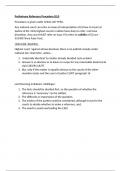
, Replenishment Model Assumptions
• Demand • Discounts
n Constant vs Variable n None
n Known vs Random n All Units vs Incremental vs One Time
n Continuous vs Discrete • Excess Demand
• Lead Time n None
n Instantaneous n All orders are backordered
n Constant vs Variable n Lost orders
n Deterministic vs Stochastic n Substitution
n Internally Replenished • Perishability
• Dependence of Items n None
n Independent n Uniform with time
n Correlated n Non-linear with time
n Indentured • Planning Horizon
• Review Time n Single Period
n Continuous vs Periodic n Finite Period
• Number of Locations n Infinite
n One vs Multi vs Multi-Echelon • Number of Items
• Capacity / Resources n One vs Many
n Unlimited • Form of Product
n Limited / Constrained n Single Stage
n Multi-Stage
CTL.SC1x - Supply Chain and Logistics Fundamentals Lesson: Economic Order Quantity (EOQ) 2
, Model Assumptions: EOQ
• Demand • Discounts
n Constant vs Variable n None
n Known vs Random n All Units vs Incremental vs One Time
n Continuous vs Discrete • Excess Demand
• Lead Time n None
n Instantaneous n All orders are backordered
n Constant vs Variable n Lost orders
n Deterministic vs Stochastic n Substitution
n Internally Replenished • Perishability
• Dependence of Items n None
n Independent n Uniform with time
n Correlated n Non-linear with time
n Indentured • Planning Horizon
• Review Time n Single Period
n Continuous vs Periodic n Finite Period
• Number of Locations n Infinite
n One vs Multi vs Multi-Echelon • Number of Items
• Capacity / Resources n One vs Many
n Unlimited • Form of Product
n Limited / Constrained n Single Stage
n Multi-Stage
CTL.SC1x - Supply Chain and Logistics Fundamentals Lesson: Economic Order Quantity (EOQ) 3
, Notation
D = Average Demand (units/time)
c = Variable (Purchase) Cost ($/unit)
ct = Fixed Ordering Cost ($/order)
h = Carrying or Holding Charge ($/inventory $/time)
ce = ch = Excess Holding Cost ($/unit/time)
Q = Replenishment Order Quantity (units/order)
T = Order Cycle Time (time/order)
N = 1/T = Orders per Time (order/time)
TRC(Q) = Total Relevant Cost ($/time)
TC(Q) = Total Cost ($/time)
CTL.SC1x - Supply Chain and Logistics Fundamentals Lesson: Economic Order Quantity (EOQ) 4
Economic Order Quantity
(EOQ)
MIT Center for
Transportation & Logistics
, Replenishment Model Assumptions
• Demand • Discounts
n Constant vs Variable n None
n Known vs Random n All Units vs Incremental vs One Time
n Continuous vs Discrete • Excess Demand
• Lead Time n None
n Instantaneous n All orders are backordered
n Constant vs Variable n Lost orders
n Deterministic vs Stochastic n Substitution
n Internally Replenished • Perishability
• Dependence of Items n None
n Independent n Uniform with time
n Correlated n Non-linear with time
n Indentured • Planning Horizon
• Review Time n Single Period
n Continuous vs Periodic n Finite Period
• Number of Locations n Infinite
n One vs Multi vs Multi-Echelon • Number of Items
• Capacity / Resources n One vs Many
n Unlimited • Form of Product
n Limited / Constrained n Single Stage
n Multi-Stage
CTL.SC1x - Supply Chain and Logistics Fundamentals Lesson: Economic Order Quantity (EOQ) 2
, Model Assumptions: EOQ
• Demand • Discounts
n Constant vs Variable n None
n Known vs Random n All Units vs Incremental vs One Time
n Continuous vs Discrete • Excess Demand
• Lead Time n None
n Instantaneous n All orders are backordered
n Constant vs Variable n Lost orders
n Deterministic vs Stochastic n Substitution
n Internally Replenished • Perishability
• Dependence of Items n None
n Independent n Uniform with time
n Correlated n Non-linear with time
n Indentured • Planning Horizon
• Review Time n Single Period
n Continuous vs Periodic n Finite Period
• Number of Locations n Infinite
n One vs Multi vs Multi-Echelon • Number of Items
• Capacity / Resources n One vs Many
n Unlimited • Form of Product
n Limited / Constrained n Single Stage
n Multi-Stage
CTL.SC1x - Supply Chain and Logistics Fundamentals Lesson: Economic Order Quantity (EOQ) 3
, Notation
D = Average Demand (units/time)
c = Variable (Purchase) Cost ($/unit)
ct = Fixed Ordering Cost ($/order)
h = Carrying or Holding Charge ($/inventory $/time)
ce = ch = Excess Holding Cost ($/unit/time)
Q = Replenishment Order Quantity (units/order)
T = Order Cycle Time (time/order)
N = 1/T = Orders per Time (order/time)
TRC(Q) = Total Relevant Cost ($/time)
TC(Q) = Total Cost ($/time)
CTL.SC1x - Supply Chain and Logistics Fundamentals Lesson: Economic Order Quantity (EOQ) 4