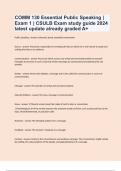
COMM 130 Essential Public Speaking Exam 1 CSULB Exam study guide 2024 latest update
Public Speaking A planned, timed, extended conversation. Source The person responsible for inventing the idea on which he or she intends to speak and crafting that idea to an audience Communication Process by which sources use verbal and nonverbal symbols to transmit messages to receivers in such a way that similar meanings are constructed and understood by one another. Sender Person who initiates a message and is also called the communicator or source of communication. Message The selection of verbal and nonverbal symbols. Channel/Medium The way a message is communicated. Noise 1) Physical: actual noise that makes it hard to hear or concentrate 2) Psychological: all of the mental reasons why someone would not listen, such as personal bias on the topic, tired/disinterested, or just plain rude! Recievers The intended audience for a message. Feedback The receiver's response to a message. Context Context is the circumstances surrounding a message. The circumstances might include the setting, the value positions of the people, and appropriateness of a message. Culture A complex whole which includes knowledge, beliefs, art, law, morals, custom and any habits acquired by [people] as a member of society. Co-culture Specialized ways of living, speaking, thinking etc. that characterize people into particular groups (such as race, ethnicity, religion, etc.) Manuscript When a speaker has an entire speech written out word-for-word in front of them as they speak. Impromptu A presentation done with little or no preparation. Extemporaneous A speech based on research and analysis (delivered with notes but without the entire speech). Memorized Whole speech is recited without notes or text. Encoding The selection of verbal and nonverbal symbols. Decoding How the receiver transforms the message into his/her own symbolic understandings. Transaction The process of simultaneous encoding and decoding. State-Like CA Type of anxiety that is derived from the external situation which individuals find themselves (Place or State they are in; certain situations) Trait-Like CA Type of anxiety that is aligned with an individual's personality (A trait of the person; all situations). Systematic Desensitization Process whereby a person is slowly introduced to a fear such that each time he or she overcomes the fear the intensity is decreased (Focus on physical responses, learn to relax). Cognitive Restructuring How you label a situation can cause fear. (Identify the negativity and errors in the negativity). Skills Training A. Focus on the audience in 2 ways: 1) remember that this is a supportive environment; 2) remember that your instructor will not degrade you, embarrass you, etc B. Over-prepare C. Practice in front of an audience D. Positive visualization Linear Logic Straight forward method of way of speaking. From thesis, body, and conclusion using various transitions and signposts Configural Logic Not straight forward, the speaker does not provide any preview or the main points nor spell out a specific conclusion. Transitions 1) Internal: words, or short phrases "internal" within the minor points of the speech. (EXAMPLES: "this leads me to..." "first, second..." "my next point is...") 2) External: 2-3 sentences between major points. These are essentially mini-conclusions, and mini-introductions. Signposts Key words that signal to the audience that you are moving from one part of the speech to another (first, second, third, to begin with, to preview, but first let me begin by, in review, to recapit
École, étude et sujet
- Établissement
- CSULB
- Cours
- CSULB
Infos sur le Document
- Publié le
- 2 avril 2024
- Nombre de pages
- 4
- Écrit en
- 2023/2024
- Type
- Examen
- Contenu
- Questions et réponses
Sujets
-
comm 130 essential public speaking exam

Document également disponible en groupe