,This page intentionally left blank
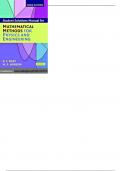
, Student Solutions Manual for Mathematical Methods for Physics
and Engineering, third edition
Mathematical Methods for Physics and Engineering, third edition, is a highly ac-
claimed undergraduate textbook that teaches all the mathematics needed for
an undergraduate course in any of the physical sciences. As well as lucid
descriptions of the topics and many worked examples, it contains over 800
exercises. New stand-alone chapters give a systematic account of the ‘special
functions’ of physical science, cover an extended range of practical applica-
tions of complex variables, and give an introduction to quantum operators.
This solutions manual accompanies the third edition of Mathematical Meth-
ods for Physics and Engineering. It contains complete worked solutions to over
400 exercises in the main textbook, the odd-numbered exercises that are pro-
vided with hints and answers. The even-numbered exercises have no hints,
answers or worked solutions and are intended for unaided homework prob-
lems; full solutions are available to instructors on a password-protected website,
www.cambridge.org/9780521679718.
K e n R i l e y read mathematics at the University of Cambridge and proceeded
to a Ph.D. there in theoretical and experimental nuclear physics. He became a
research associate in elementary particle physics at Brookhaven, and then, having
taken up a lectureship at the Cavendish Laboratory, Cambridge, continued this
research at the Rutherford Laboratory and Stanford; in particular he was involved
in the experimental discovery of a number of the early baryonic resonances. As
well as having been Senior Tutor at Clare College, where he has taught physics
and mathematics for over 40 years, he has served on many committees concerned
with the teaching and examining of these subjects at all levels of tertiary and
undergraduate education. He is also one of the authors of 200 Puzzling Physics
Problems.
M i c h a e l H o b s o n read natural sciences at the University of Cambridge, spe-
cialising in theoretical physics, and remained at the Cavendish Laboratory to
complete a Ph.D. in the physics of star-formation. As a research fellow at Trinity
Hall, Cambridge and subsequently an advanced fellow of the Particle Physics
and Astronomy Research Council, he developed an interest in cosmology, and
in particular in the study of fluctuations in the cosmic microwave background.
He was involved in the first detection of these fluctuations using a ground-based
interferometer. He is currently a University Reader at the Cavendish Laboratory,
his research interests include both theoretical and observational aspects of cos-
mology, and he is the principal author of General Relativity: An Introduction for
Physicists. He is also a Director of Studies in Natural Sciences at Trinity Hall and
enjoys an active role in the teaching of undergraduate physics and mathematics.
,
, Student Solutions Manual for Mathematical Methods for Physics
and Engineering, third edition
Mathematical Methods for Physics and Engineering, third edition, is a highly ac-
claimed undergraduate textbook that teaches all the mathematics needed for
an undergraduate course in any of the physical sciences. As well as lucid
descriptions of the topics and many worked examples, it contains over 800
exercises. New stand-alone chapters give a systematic account of the ‘special
functions’ of physical science, cover an extended range of practical applica-
tions of complex variables, and give an introduction to quantum operators.
This solutions manual accompanies the third edition of Mathematical Meth-
ods for Physics and Engineering. It contains complete worked solutions to over
400 exercises in the main textbook, the odd-numbered exercises that are pro-
vided with hints and answers. The even-numbered exercises have no hints,
answers or worked solutions and are intended for unaided homework prob-
lems; full solutions are available to instructors on a password-protected website,
www.cambridge.org/9780521679718.
K e n R i l e y read mathematics at the University of Cambridge and proceeded
to a Ph.D. there in theoretical and experimental nuclear physics. He became a
research associate in elementary particle physics at Brookhaven, and then, having
taken up a lectureship at the Cavendish Laboratory, Cambridge, continued this
research at the Rutherford Laboratory and Stanford; in particular he was involved
in the experimental discovery of a number of the early baryonic resonances. As
well as having been Senior Tutor at Clare College, where he has taught physics
and mathematics for over 40 years, he has served on many committees concerned
with the teaching and examining of these subjects at all levels of tertiary and
undergraduate education. He is also one of the authors of 200 Puzzling Physics
Problems.
M i c h a e l H o b s o n read natural sciences at the University of Cambridge, spe-
cialising in theoretical physics, and remained at the Cavendish Laboratory to
complete a Ph.D. in the physics of star-formation. As a research fellow at Trinity
Hall, Cambridge and subsequently an advanced fellow of the Particle Physics
and Astronomy Research Council, he developed an interest in cosmology, and
in particular in the study of fluctuations in the cosmic microwave background.
He was involved in the first detection of these fluctuations using a ground-based
interferometer. He is currently a University Reader at the Cavendish Laboratory,
his research interests include both theoretical and observational aspects of cos-
mology, and he is the principal author of General Relativity: An Introduction for
Physicists. He is also a Director of Studies in Natural Sciences at Trinity Hall and
enjoys an active role in the teaching of undergraduate physics and mathematics.
,