.Part B
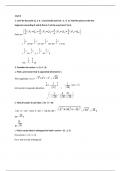
1. Let P be the point (2, 3, 0, -1) and Q the point (6, -2, -3, 1). Find the point on the line
Segment connecting P and Q that is ¾ of the way from P to Q.
Point m=
( 34⋅( P +Q ) + 34⋅( P +Q )+ 34⋅( P +Q )+ 34⋅( P +Q ))
1 1 2 2 3 3 4 4
3 3 3 3
⋅¿ ¿ ⋅¿ ¿ ⋅¿ ¿ ⋅¿ ¿
= 4 (2+6)+ 4 (3+-2)+ 4 (0+-3)+ 4 (-1+1)
3 3 3 3
⋅¿ ¿ ⋅¿ ¿ ⋅¿ ¿ ⋅¿ ¿
= 4 8 + 4 -1 + 4 -3+ 4 0
3 9
=(6, - 4 , - 4 ,0)
2. Consider the vector v = (1, 4, -3).
a. Find a unit vector that is oppositely directed to v
The magnitude ||v||= √ 12+4 2+−3 2 = √ 26
1 →
→ 1
u=− ⋅v − ⋅(1,4 ,−3 )
Unit vector in opposite direction, ||v|| = √ 26|
=
(
−
1
,−
4 31
,
|√ 26 | √ 26 |√ 26
,
)
b. Find all scalars k such that || kv || = 20
|| kv || = 20 = ||k(1, 4, -3)|| = ||(k,4k,-3k) = √ ⟨k 2⟩+ ( 4 k )2+(−3k )2 = √ 26 k 2 = √ 26 k
20= √ 26 k
20
k= √ 26
c. Find a vector that is orthogonal to both v and w = (2, -1, 3)
First vector v = (1, 4, -3)
For v and w to be orthogonal;
, → → →
Second vector w = v −c w = (1, 4, -3)-c (2, -1, 3)
(1+-4+-9)-c(4+1+9)=0
12-14c=0
6
C= 7
6 12 6 18
7 (2, -1, 3)= ( 7 ,- 7 , 7 )
3. Consider the vector v = (1, -3).
a. Find all values of k such that u = (k, 6) is orthogonal to v
u*v=0
1(k)+-3(6)=0
k-18=0
k=18
b. Find all values of k such that u = (k, 6) is parallel to v
v1 v2
= =
u 1 u2 Multiples of each other
1 −3
=
k 6
-3k=6
K=-2
4. Use Maple to find all scalars a, b, c such that
a(1, -1, 4) + b(-2, 1, 1) + c(0, 3, -1) = (2, 1, -6).
a-2b =2
-a+b+3c=1
4a+b-c=-6
1 -2 0 a 2
-1 1 3 b = 1
4 1 -1 c -6
1. Let P be the point (2, 3, 0, -1) and Q the point (6, -2, -3, 1). Find the point on the line
Segment connecting P and Q that is ¾ of the way from P to Q.
Point m=
( 34⋅( P +Q ) + 34⋅( P +Q )+ 34⋅( P +Q )+ 34⋅( P +Q ))
1 1 2 2 3 3 4 4
3 3 3 3
⋅¿ ¿ ⋅¿ ¿ ⋅¿ ¿ ⋅¿ ¿
= 4 (2+6)+ 4 (3+-2)+ 4 (0+-3)+ 4 (-1+1)
3 3 3 3
⋅¿ ¿ ⋅¿ ¿ ⋅¿ ¿ ⋅¿ ¿
= 4 8 + 4 -1 + 4 -3+ 4 0
3 9
=(6, - 4 , - 4 ,0)
2. Consider the vector v = (1, 4, -3).
a. Find a unit vector that is oppositely directed to v
The magnitude ||v||= √ 12+4 2+−3 2 = √ 26
1 →
→ 1
u=− ⋅v − ⋅(1,4 ,−3 )
Unit vector in opposite direction, ||v|| = √ 26|
=
(
−
1
,−
4 31
,
|√ 26 | √ 26 |√ 26
,
)
b. Find all scalars k such that || kv || = 20
|| kv || = 20 = ||k(1, 4, -3)|| = ||(k,4k,-3k) = √ ⟨k 2⟩+ ( 4 k )2+(−3k )2 = √ 26 k 2 = √ 26 k
20= √ 26 k
20
k= √ 26
c. Find a vector that is orthogonal to both v and w = (2, -1, 3)
First vector v = (1, 4, -3)
For v and w to be orthogonal;
, → → →
Second vector w = v −c w = (1, 4, -3)-c (2, -1, 3)
(1+-4+-9)-c(4+1+9)=0
12-14c=0
6
C= 7
6 12 6 18
7 (2, -1, 3)= ( 7 ,- 7 , 7 )
3. Consider the vector v = (1, -3).
a. Find all values of k such that u = (k, 6) is orthogonal to v
u*v=0
1(k)+-3(6)=0
k-18=0
k=18
b. Find all values of k such that u = (k, 6) is parallel to v
v1 v2
= =
u 1 u2 Multiples of each other
1 −3
=
k 6
-3k=6
K=-2
4. Use Maple to find all scalars a, b, c such that
a(1, -1, 4) + b(-2, 1, 1) + c(0, 3, -1) = (2, 1, -6).
a-2b =2
-a+b+3c=1
4a+b-c=-6
1 -2 0 a 2
-1 1 3 b = 1
4 1 -1 c -6