Maternal Physiology during Pregnancy
Maternal physiology must adapt in pregnancy, partcularly the following demands:
- Support of foetus (volume, oxygen/nutriton support, clearance of waste)
- Protectoo of foetus (drugs, toxins, starvaton)
- Preparatoo for labour (uterus)
- Protectoo of mother from cardiovascular iojury at delivery
The ability to adapt varies from mother to mother depending on age, ethnicity, genetc factors, and
comorbidites
Cardiovascular System
Reduced vascular resistaoce (by 20-35%) - progesterone decreases systemic vascular resistance in early
pregnancy
Iocreased stroke volume/SV (by 40%) – Due to high blood volume caused by RAAS actvaton
Iocreased heart rate/HR (by 17%) – Increases by ~20bpm to deal with larger blood volume
Iocreased cardiac output/CO (by 44%) – due to increased SV and HR
Decrease io BP - decreases in 2nd trimester (then increases back to normal by 3rd trimester) This is because
of hormonal actons:
- Oestrogen (from placenta) stmulates NO producton
- Progesterone (from placenta) reduces systemic vascular resistance
- Relaxin (from corpus luteum) blocks endothelin-induced vasoconstricton
- Also – when lying down the pressure of uterus on IVC decreases blood to right atrium lowering the BP
Normal cardiac examinaton fndings in pregnant woman:
- Peripheral oedema
- Mild tachycardia
- Jugular venous distension
- Lateral displacement of lef ventricular apex, S3 sound, and split S1 (temporary mild hypertrophy)
Haematological System
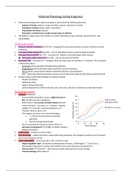
Aoaemia (dilutonal)
- Increased EPO producton causes a slight iocrease io
RCC and Hb increase in pregnancy.
- RAAS causes a big iocrease io blood volume (Na and
water retenton) - Increases in 1st trimester, expands
rapidly in 2nd trimester, and slows/plateaus in 3rd
trimester (from 5L up to 7.5L)
- This happens as there are survival advantages -
o in blood viscosity improve placental
perfusion
o Reserve during haemorrhage
- Due to increased intravascular volume, there is a
decrease io haematocrit (% of RBCs in blood) causing a
dilutonal anaemia.
Leukocytosis – Modest increase in WCC
Poor immuoity – cellular immunity is depressed during pregnancy thus pregnant women are at increased
risk of viral infectons and TB.
Hypercoagulability – 6x increase risk in VTE. Virchow’s triad -
- Hypercoagulable state - increased circulatng levels of factors 2 (fbrinogen), 7, 9 and 10 as a
physiological adaptaton to protect the mother from excess blood loss during delivery.
- Veoous stasis (2nd trimester) – abdo pressure obstructng upward venous drainage
- Vascular damage (afer delivery)
Maternal physiology must adapt in pregnancy, partcularly the following demands:
- Support of foetus (volume, oxygen/nutriton support, clearance of waste)
- Protectoo of foetus (drugs, toxins, starvaton)
- Preparatoo for labour (uterus)
- Protectoo of mother from cardiovascular iojury at delivery
The ability to adapt varies from mother to mother depending on age, ethnicity, genetc factors, and
comorbidites
Cardiovascular System
Reduced vascular resistaoce (by 20-35%) - progesterone decreases systemic vascular resistance in early
pregnancy
Iocreased stroke volume/SV (by 40%) – Due to high blood volume caused by RAAS actvaton
Iocreased heart rate/HR (by 17%) – Increases by ~20bpm to deal with larger blood volume
Iocreased cardiac output/CO (by 44%) – due to increased SV and HR
Decrease io BP - decreases in 2nd trimester (then increases back to normal by 3rd trimester) This is because
of hormonal actons:
- Oestrogen (from placenta) stmulates NO producton
- Progesterone (from placenta) reduces systemic vascular resistance
- Relaxin (from corpus luteum) blocks endothelin-induced vasoconstricton
- Also – when lying down the pressure of uterus on IVC decreases blood to right atrium lowering the BP
Normal cardiac examinaton fndings in pregnant woman:
- Peripheral oedema
- Mild tachycardia
- Jugular venous distension
- Lateral displacement of lef ventricular apex, S3 sound, and split S1 (temporary mild hypertrophy)
Haematological System
Aoaemia (dilutonal)
- Increased EPO producton causes a slight iocrease io
RCC and Hb increase in pregnancy.
- RAAS causes a big iocrease io blood volume (Na and
water retenton) - Increases in 1st trimester, expands
rapidly in 2nd trimester, and slows/plateaus in 3rd
trimester (from 5L up to 7.5L)
- This happens as there are survival advantages -
o in blood viscosity improve placental
perfusion
o Reserve during haemorrhage
- Due to increased intravascular volume, there is a
decrease io haematocrit (% of RBCs in blood) causing a
dilutonal anaemia.
Leukocytosis – Modest increase in WCC
Poor immuoity – cellular immunity is depressed during pregnancy thus pregnant women are at increased
risk of viral infectons and TB.
Hypercoagulability – 6x increase risk in VTE. Virchow’s triad -
- Hypercoagulable state - increased circulatng levels of factors 2 (fbrinogen), 7, 9 and 10 as a
physiological adaptaton to protect the mother from excess blood loss during delivery.
- Veoous stasis (2nd trimester) – abdo pressure obstructng upward venous drainage
- Vascular damage (afer delivery)