Physiology of Labour
Labour = Physiological process by which a foetus is expelled from the uterus to the outside world. It is a
clinical diagnosis requiring two elements:
- Regular phasic contractons increasing in frequency and intensity
- Progressive enfacement and dilaton of the cervix
Normal labour occurs at term i.e. 37-0/7 – 42-0/7
ENDOCRINE CONTROL OF LABOUR
It is not known whether the trigger for labour begins with the foetus or the mother, but the fnal common
pathway ends in the uterus tssue.
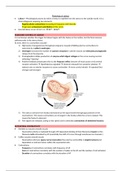
At term, there is a ‘parturiton cascade’:
1) High levels of progesterone throughout pregnancy (usually inhibitng uterine contractons) is
overcome by a spike in oestrogen
2) Oestrogen increases the number of oxytocin receptors in uterine muscle and stmulate prostaglandin
release from the placenta
3) Prostaglandins initate producton of enzyme which digest collagen in the cervix causing cervical
softening/”rripeningr.
4) Positve feedback perpetuates this via the Ferguson refex: Descent of head causes cervix stretch
receptor actvaton Hypothalamus signalled Oxytocin released from posterior pituitary
oxytocin acts on uterine receptors to cause contracton more cervical stretch repeated (but
stronger and stronger)
5) The uterus contracts from fundus downwards as the signal travels through gap junctons in the
myometrium. This means contractons are strongest in the fundus while the cervix is relaxed. This
causes the foetus to descend.
6) Pain signals are released, actng on the spinal cord to stmulate contractons of abdominal muscles.
MYOMETRIAL CONTRACTILITY
Similarly to vascular smooth muscle
- Myometrial actvity is mediated through ATP-dependent binding of thick flaments/”myosin to thin
flaments/”actn stmulated by AP (essentally the shift of Ca ions through membrane ion channels.)
Unlike vascular smooth muscle
- Myometrial cells have sparse nerve innervaton thus uterine contractlity is largely humoral and
dependent on intrinsic factors within the myometrial cells.
Contractons:
- Frequency of contractons correlates with frequency of AP
- Force of contractons correlates with the number of spikes in the AP and the number of cell actvated
- Duraton of contractons correlates with the duraton of AP
Labour = Physiological process by which a foetus is expelled from the uterus to the outside world. It is a
clinical diagnosis requiring two elements:
- Regular phasic contractons increasing in frequency and intensity
- Progressive enfacement and dilaton of the cervix
Normal labour occurs at term i.e. 37-0/7 – 42-0/7
ENDOCRINE CONTROL OF LABOUR
It is not known whether the trigger for labour begins with the foetus or the mother, but the fnal common
pathway ends in the uterus tssue.
At term, there is a ‘parturiton cascade’:
1) High levels of progesterone throughout pregnancy (usually inhibitng uterine contractons) is
overcome by a spike in oestrogen
2) Oestrogen increases the number of oxytocin receptors in uterine muscle and stmulate prostaglandin
release from the placenta
3) Prostaglandins initate producton of enzyme which digest collagen in the cervix causing cervical
softening/”rripeningr.
4) Positve feedback perpetuates this via the Ferguson refex: Descent of head causes cervix stretch
receptor actvaton Hypothalamus signalled Oxytocin released from posterior pituitary
oxytocin acts on uterine receptors to cause contracton more cervical stretch repeated (but
stronger and stronger)
5) The uterus contracts from fundus downwards as the signal travels through gap junctons in the
myometrium. This means contractons are strongest in the fundus while the cervix is relaxed. This
causes the foetus to descend.
6) Pain signals are released, actng on the spinal cord to stmulate contractons of abdominal muscles.
MYOMETRIAL CONTRACTILITY
Similarly to vascular smooth muscle
- Myometrial actvity is mediated through ATP-dependent binding of thick flaments/”myosin to thin
flaments/”actn stmulated by AP (essentally the shift of Ca ions through membrane ion channels.)
Unlike vascular smooth muscle
- Myometrial cells have sparse nerve innervaton thus uterine contractlity is largely humoral and
dependent on intrinsic factors within the myometrial cells.
Contractons:
- Frequency of contractons correlates with frequency of AP
- Force of contractons correlates with the number of spikes in the AP and the number of cell actvated
- Duraton of contractons correlates with the duraton of AP