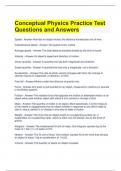
Conceptual Physics Practice Test Questions and Answers
Conceptual Physics Practice Test Questions and AnSpeed - Answer-How fast an object moves; the distance traveled per unit of time. Instantaneous speed - Answer-The speed at any instant. Average speed - Answer-The total distance traveled divided by the time of travel. Velocity - Answer-An object's speed and direction of motion. Vector quantity - Answer-A quantity that has both magnitude and direction. Scalar quantity - Answer-A quantity that has only a magnitude, not a direction. Acceleration - Answer-The rate at which velocity changes with time; the change in velocity may be in magnitude, or direction, or both. Free fall - Answer-Motion under the influence of gravity only. Force - Answer-Any push or pull exerted on an object, measured in newtons (or pounds in the British system). Friction - Answer-The resistive force that opposes the motion or attempted motion of an object either past another object with which it is in contact or through a fluid. Mass - Answer-The quantity of matter in an object. More specifically, it is the measure of the inertia or sluggishness that an object exhibits in response to any effort made to start it, stop it, deflect it, or change in any way its state of motion. Weight - Answer-The force that an object exerts on a supporting surface (or, if suspended, on a supporting rope), which is often, but not always, due to the force of gravity. Kilogram - Answer-The fundamental SI unit of mass. One kilogram (symbol kg) is the mass of 1 liter (1 L) of water at 4°C. Newton - Answer-The SI unit of force. One newton (symbol N) is the force that will give an object of mass 1 kg an acceleration of 1 m/s2. Volume - Answer-The quantity of space an object occupies. Newton's second law - Answer-The acceleration of an object is directly proportional to the net force acting on the object, is in the direction of the net force, and is inversely proportional to the mass of the object. Terminal speed - Answer-The speed at which the acceleration of a falling object terminates because air resistance balances gravitational force. Terminal velocity - Answer-Terminal speed with direction specified. Newton's third law - Answer-Whenever one object exerts a force on a second object, the second object exerts an equal and opposite force on the first. Components - Answer-Mutually perpendicular vectors, usually horizontal and vertical, whose vector sum is a given vector. Momentum - Answer-The product of the mass of an object and its velocity. Impulse - Answer-The product of the force acting on an object and the time during which it acts. Impulse-momentum relationship - Answer-Impulse is equal to the change in the momentum of the object that the impulse acts upon. In symbolic notation, Ft = Δ mv Law of conservation of momentum - Answer-In the absence of an external force, the momentum of a system remains unchanged. Hence, the momentum before an event involving only internal forces is equal to the momentum after the event: mv(before event) = mv(after event) Elastic collision - Answer-A collision in which objects rebound without lasting deformation or the generation of heat. Inelastic collision - Answer-A collision in which objects become distorted, generate heat, and possibly stick together. Work - Answer-The product of the force and the distance moved by the force: W = Fd (More generally, work is the component of force in the direction of motion times the distance moved.) Power - Answer-The time rate of work: Power = work done / time interval (More generally, power is the rate at which energy is expended.) Energy - Answer-The property of a system that enables it to do work. Mechanical energy - Answer-Energy due to the position of something or the movement of something. Potential energy - Answer-Energy that something possesses because of its position. Kinetic energy - Answer-Energy that something possesses because of its motion, quantified by the relationship Kinetic energy = 1/2 mv^2 Work-energy theorem - Answer-The work done on an object equals the change in the kinetic energy of the object: Work = ΔKE (Work can also transfer other forms of energy to a system.) Law of conservation of energy - Answer-Energy cannot be created or destroyed; it may be transformed from one form into another, but the total amount of energy never changes.
Written for
- Institution
- Conceptual Physics
- Module
- Conceptual Physics
Document information
- Uploaded on
- April 1, 2024
- Number of pages
- 21
- Written in
- 2023/2024
- Type
- Exam (elaborations)
- Contains
- Questions & answers
Subjects
- conceptual physics
- questions and answers
-
conceptual physics practice test

Also available in package deal