EMT CHAPTER 19 Study Guide Questions 2024
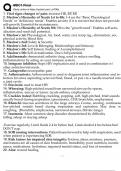
EMT CHAPTER 19 Study Guide Questions 2024 You are called to a residence for seizure activity. On scene, the patient's daughter tells you that her father, who has diabetes, stated that he suddenly felt dizzy and then fell to the floor. Within a few seconds, he began asking what had happened and why he was on the floor. Based on this description, the EMT should recognize which condition? - ANSWER Syncopal episode A postictal patient is awake and can communicate with you, but has trouble answering your questions correctly. Given this presentation, the EMT would recognize that - ANSWER The airway is open You are an EMT who finds an adult male patient on his living room floor after the police department had to force the door open. The scene size-up reveals a very cluttered home that smells of urine. On an end table, you find a container of phenytoin (Dilantin) with the patient's name on it. When you pinch his shoulder, the patient responds by moaning and trying to remove your hand from his neck. Based on this information, which of these conditions would you suspect - ANSWER Seizure After a lengthy response time in a rural community, you arrive at the home of a 62-year-old female patient who is still seizing. Your immediate action would be to: - ANSWER Assess the patient's airway and breathing While taking an EMT class, you come across a test question that asks you to define the pathophysiology of a seizure. Which answer would you select? - ANSWER "A seizure occurs when there is a massive and uncoordinated electrical discharge in the brain While you are transporting a 41-year-old woman who is not feeling well, she begins to seize. She has no history of seizures, and the seizure lasts approximately 90 seconds. After 30 seconds of being postictal and totally unresponsive. the woman suddenly seizes again for the remainder of the 12-minute transport. The EMT should recognize that the patient is experiencing which emergency condition? - ANSWER Status epilepticus Which sign or symptom would be most helpful in determining that a patient had a syncopal episode rather than a seizure - ANSWER There was no period of confusion after the event
Geschreven voor
- Instelling
- EMT.
- Vak
- EMT.
Documentinformatie
- Geüpload op
- 27 maart 2024
- Aantal pagina's
- 8
- Geschreven in
- 2023/2024
- Type
- Tentamen (uitwerkingen)
- Bevat
- Vragen en antwoorden
Onderwerpen
-
emt chapter 19 study guide
-
emt chapter 19 study guide questions 2024

Ook beschikbaar in voordeelbundel