RHIT EXAM PREP PRACTICE QUESTIONS AND ANSWERS (Coding) 2024 (VERIFIED ANSWERS).
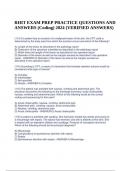
RHIT EXAM PREP PRACTICE QUESTIONS AND ANSWERS (Coding) 2024 (VERIFIED ANSWERS). (113) If a patient has an excision of a malignant lesion of the skin, the CPT code is determined by the body area from which the excision occurs and which of the following? A) Length of the lesion as described in the pathology report B) Dimension of the specimen submitted as described in the pathology report C) Width times the length of the lesion as described in the operative report D) Diameter of the lesion as well as the margins excised as described in the operative report - ANSWER-D) Diameter of the lesion as well as the margins excised as described in the operative report (114) According to CPT, a repair of a laceration that includes retention sutures would be considered what type of closure? A) Complex B) Intermediate C) Not specified D) Simple - ANSWER-A) Complex (115) The patient was admitted with nausea, vomiting and abdominal pain. The physician documents the following on the discharge summary: acute cholecystitis, nausea, vomiting and abdominal pain. Which of the following would be the correct coding and sequencing for this case? A) Acute cholecystitis, nausea, vomiting, abdominal pain B) Abdominal pain, vomiting, nausea, acute cholecystitis C) Nausea, vomiting, abdominal pain D) Acute cholecystitis - ANSWER-D) Acute cholecystitis (116) A patient is admitted with spotting. She had been treated two weeks previously for a miscarriage with sepsis. The sepsis had resolved, and she is afebrile at this time. She is treated with an aspiration dilation and curettage. Products of conception are found. Which of the following should be the principal diagnosis? A) Miscarriage B) Complications of spontaneous abortion with sepsis C) Sepsis D) Spontaneous abortion with sepsis - ANSWER-A) Miscarriage RHIT EXAM PREP PRACTICE QUESTIONS AND ANSWERS (Coding) 2024 (VERIFIED ANSWERS) (117) An 80-year-old female is admitted with fever, lethargy, hypotension, tachycardia, oliguria, and elevated WBC. The patient has more than 100,000 organisms of Escherichia coli per cc of urine. The attending physician documents "urosepsis". How should this case be coded? A) Code sepsis as the principal diagnosis with urinary tract infection due to E.coli as secondary diagnosis B) Code urinary tract infection with sepsis as the principal diagnosis C) Query the physician to ask if the patient has septicemia because of the symptomatology D) Query the physician to ask if the patient had septic shock so that this may be used as the principal diagnosis - ANSWER-C) Query the physician to ask if the patient has septicemia because of the symptomatology (118) The practice of using a code that results in a higher payment to the provider than the code that actually reflects the service or item provided is known as: A) Unbundling B) Upcoding C) Medically unnecessary services D) Billing for services not provided - ANSWER-B) Upcoding (119) A 65 year-old patient with a history of lung cancer is admitted to a healthcare facility with ataxia and syncope and a fractured arm as a result of falling. The patient undergoes a closed reduction of the fracture in the emergency department as well as a complete workup for metastatic carcinoma of the brain. The patient is found to have metastatic carcinoma of the lung to the brain and undergoes radiation therapy to the brain. Which of the following would be the principal diagnosis in this case? A) Ataxia B) Fractured arm C) Metastatic carcinoma of the brain D) Carcinoma of the lung - ANSWER-C) Metastatic carcinoma of the brain (120) A patient was admitted for abdominal pain with diarrhea and was diagnosed with infectious gastroenteritis. The patient also had angina and chronic obstructive pulmonary disease. Which of the following would be the correct coding and sequencing for this case? A) Abdominal pain; infectious gastroenteritis; chronic obstructive pulmonary disease; angina B) Infectious gastroenteritis; chronic obstructive pulmonary disease; angina C) Gastroenteritis; abdominal pain; angina D) Gastroenteritis; abdominal pain; diarrhea; chronic obstructive pulmonary disease; angina - ANSWER-B) Infectious gastroenteritis; chronic obstructive pulmonary disease; angina (121) A patient is admitted with a history of prostate cancer and with mental confusion. The patient completed radiation therapy for prostatic carcinoma three years ago and is status post a radical resection of the prostate. A CT scan of the brain during the current admission reveals metastasis. Which of the following is the correct coding sequencing for the current hospital stay? A) Metastatic carcinoma of the brain; carcinoma of the prostate; mental confusion B) Mental confusion; history of carcinoma of the prostate; admission for chemotherapy C) Metastatic carcinoma of the brain; history of carcinoma of the prostate D) Carcinoma of the prostate; metastatic carcinoma to the brain - ANSWER-C) Metastatic carcinoma of the brain; history of carcinoma of the prostate (122) A patient is admitted with abdominal pain. The physician states that the discharge diagnosis is pancreatitis and noncalculus cholecystitis. Both diagnoses are equally treated. The correct coding and sequencing for this case would be: A) Either the pancreatitis or noncalculus cholecystitis sequenced as the principal diagnosis B) Pancreatitis; noncalculus cholecystitis; abdominal pain C) Noncalculus cholecystitis; pancreatitis; abdominal pain D) Abdominal pain; pancreatitis; noncalculus cholecystitis - ANSWER-A) Either the pancreatitis or noncalculus cholecystitis sequenced as the principal diagnosis (123) According to the UHDDS, which of the following is the definition of "other diagnoses"? A) Is recorded in the patient record B) Is documented by the attending physician and cannot be documented by any other provider C) Is considered all conditions that coexist at the time of admission or develop subsequently that affect the treatment received and/or the length of stay D) Is documented by at least wo physicians and/or the nursing staff - ANSWER-C) Is considered all conditions that coexist at the time of admission or develop subsequently that affect the treatment received and/or the length of stay.
Written for
- Institution
- RHIT
- Course
- RHIT
Document information
- Uploaded on
- March 27, 2024
- Number of pages
- 19
- Written in
- 2023/2024
- Type
- Exam (elaborations)
- Contains
- Questions & answers
Subjects
-
rhit exam prep practice questions and answers
-
rhit questions and answers
-
rhit exam prep 2024 verified answers
-
rhit questions and answers with verified answers
-
rhit questions and answers

Also available in package deal