A. DISEASE
• A pathogen is a disease-causing organism.
• Examples are bacteria, viruses, fungi and protozoa.
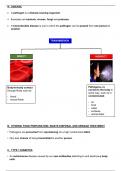
• A transmissible disease is one in which the pathogen can be passed from one person to
another.
TRANSMISSION
DIRECT INDIRECT
Body-to-body contact Pathogens are
through fluids such as: carried to the body in
some way, such as in
- blood contaminated:
- sexual fluids
- air
- food
- water
- surfaces
- animal bites
B. HYGENIC FOOD PREPARATION, WASTE DISPOSAL AND SEWAGE TREATMENT
• Pathogens are prevented from reproducing (to a high number)/are killed.
• (So) less chance of being transmitted to another person.
C. TYPE 1 DIABETES
• An autoimmune disease caused by our own antibodies attaching to and destroying body
cells.
, D. NATURAL DEFENCES
• To prevent pathogens from entering the blood.
MECHANICAL BARRIERS CHEMICAL BARRIERS CELLS
• Skin is an impermeable • Tears contain lysozyme Two types of white blood cell:
barrier. enzyme, which bursts
bacteria. • Lymphocytes produce
- Glands in the skin antibodies.
secrete fatty acids • Stomach acid kills
that lowers the pH to bacteria. • Phagocytes take in
reduce bacterial pathogens and digest them
growth. • Mucus traps bacteria, using enzymes. This is called
making it easier for cilia phagocytosis.
• Nose hairs. hairs to move them out of
the lungs to the throat.
E. ANTIGENS AND ANTIBODIES
• Every pathogen has a marker called an antigen on its surface.
antigen
• Every pathogen has a different shape of antigen on its surface.
• A pathogen is a disease-causing organism.
• Examples are bacteria, viruses, fungi and protozoa.
• A transmissible disease is one in which the pathogen can be passed from one person to
another.
TRANSMISSION
DIRECT INDIRECT
Body-to-body contact Pathogens are
through fluids such as: carried to the body in
some way, such as in
- blood contaminated:
- sexual fluids
- air
- food
- water
- surfaces
- animal bites
B. HYGENIC FOOD PREPARATION, WASTE DISPOSAL AND SEWAGE TREATMENT
• Pathogens are prevented from reproducing (to a high number)/are killed.
• (So) less chance of being transmitted to another person.
C. TYPE 1 DIABETES
• An autoimmune disease caused by our own antibodies attaching to and destroying body
cells.
, D. NATURAL DEFENCES
• To prevent pathogens from entering the blood.
MECHANICAL BARRIERS CHEMICAL BARRIERS CELLS
• Skin is an impermeable • Tears contain lysozyme Two types of white blood cell:
barrier. enzyme, which bursts
bacteria. • Lymphocytes produce
- Glands in the skin antibodies.
secrete fatty acids • Stomach acid kills
that lowers the pH to bacteria. • Phagocytes take in
reduce bacterial pathogens and digest them
growth. • Mucus traps bacteria, using enzymes. This is called
making it easier for cilia phagocytosis.
• Nose hairs. hairs to move them out of
the lungs to the throat.
E. ANTIGENS AND ANTIBODIES
• Every pathogen has a marker called an antigen on its surface.
antigen
• Every pathogen has a different shape of antigen on its surface.