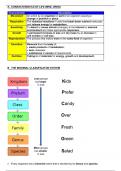
A. CHARACTERISTICS OF LIFE (MRS. GREN)
Characteristic Description
Movement An action by an organism or part of an organism causing a
change of position or place.
Respiration The chemical reactions in cells that break down nutrient molecules
and release energy for metabolism.
Sensitivity To detect or sense stimuli (changes) in the internal or external
environment and make appropriate responses.
Growth A permanent increase in size and dry mass by an increase in
cell number or cell size.
Reproduction The process that makes more of the same kind of organism.
Excretion Removal from the body of:
• waste products of metabolism;
• toxic materials;
• substances in excess of requirements.
Nutrition Taking in of materials for energy, growth and development.
B. THE BINOMIAL CLASSIFICATON SYSTEM
Less groups
but larger Kids
in size
Prefer
Candy
Over
Fresh
Green
More groups
but smaller Salad
in size
• Every organism has a binomial name that is decided by its Genus and species.
, Examples of how this works
• The binomial name of the tiger is Panthera tigris.
• The tiger’s genus is Panthera.
• The tiger’s species is Panthera tigris.
• The binomial name of each organism is an internationally agreed system in which the
scientific name of an organism is made up of two parts showing the Genus and species.
Two organisms belong to the same species if they can
breed together to produce fertile offspring
• Classification is traditionally based on studies of shape and anatomy (observations).
• Classification is now based on DNA bases sequences and amino acid sequences of certain
proteins. This is a much more accurate way of grouping organisms.
• Organisms which share a more recent ancestor (are more closely related) have
DNA base sequences that are more similar than those that share only a distant ancestor.
Characteristic Description
Movement An action by an organism or part of an organism causing a
change of position or place.
Respiration The chemical reactions in cells that break down nutrient molecules
and release energy for metabolism.
Sensitivity To detect or sense stimuli (changes) in the internal or external
environment and make appropriate responses.
Growth A permanent increase in size and dry mass by an increase in
cell number or cell size.
Reproduction The process that makes more of the same kind of organism.
Excretion Removal from the body of:
• waste products of metabolism;
• toxic materials;
• substances in excess of requirements.
Nutrition Taking in of materials for energy, growth and development.
B. THE BINOMIAL CLASSIFICATON SYSTEM
Less groups
but larger Kids
in size
Prefer
Candy
Over
Fresh
Green
More groups
but smaller Salad
in size
• Every organism has a binomial name that is decided by its Genus and species.
, Examples of how this works
• The binomial name of the tiger is Panthera tigris.
• The tiger’s genus is Panthera.
• The tiger’s species is Panthera tigris.
• The binomial name of each organism is an internationally agreed system in which the
scientific name of an organism is made up of two parts showing the Genus and species.
Two organisms belong to the same species if they can
breed together to produce fertile offspring
• Classification is traditionally based on studies of shape and anatomy (observations).
• Classification is now based on DNA bases sequences and amino acid sequences of certain
proteins. This is a much more accurate way of grouping organisms.
• Organisms which share a more recent ancestor (are more closely related) have
DNA base sequences that are more similar than those that share only a distant ancestor.