

5 functions of skeleton
Movement
Support
Mineral store
Position
Protection
5 different classifications of bones
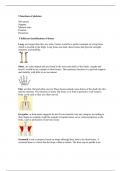
Long, are longer than they are wide. Femur would be a perfect example of a long bone
which is located in the thigh. Long bones are hard, dense bones that provide strength,
structure, and mobility.
Short, are cube-shaped and are found in the wrist and ankle of the limbs. carpals and
tarsal’s would be an example of short bones. Their primary function is to provide support
and stability with little to no movement.
Flat, are thin, flat and often curved. These bones include some bones of the skull, the ribs
and the sternum. The function of many flat bones is to form a protective wall round a
body cavity and so they are often curved.
Irregular, as their name suggests do not fit conveniently into any category according to
their shape an example would be scapula. Irregular bones serve various purposes in the
body, such as protection of nervous tissue.
Sesamoid is not a category based on shape although they tend to be short bones. A
sesamoid bone is a bone that develops within a tendon. The knee cap or patella is an
Movement
Support
Mineral store
Position
Protection
5 different classifications of bones
Long, are longer than they are wide. Femur would be a perfect example of a long bone
which is located in the thigh. Long bones are hard, dense bones that provide strength,
structure, and mobility.
Short, are cube-shaped and are found in the wrist and ankle of the limbs. carpals and
tarsal’s would be an example of short bones. Their primary function is to provide support
and stability with little to no movement.
Flat, are thin, flat and often curved. These bones include some bones of the skull, the ribs
and the sternum. The function of many flat bones is to form a protective wall round a
body cavity and so they are often curved.
Irregular, as their name suggests do not fit conveniently into any category according to
their shape an example would be scapula. Irregular bones serve various purposes in the
body, such as protection of nervous tissue.
Sesamoid is not a category based on shape although they tend to be short bones. A
sesamoid bone is a bone that develops within a tendon. The knee cap or patella is an


