Photosynthesis Rate of photosynthesis
A process where plants are able to make Can be measured by how much oxygen is produced over a
their own food from simple raw materials certain amount of time
around them.
Increasing the rate of photosynthesis will mean the plant grows
The reaction: faster which has commercial benefits as an increased crop yield
can be obtained in a shorter period of time
Carbon dioxide + Water Glucose +
Oxygen The 3 limiting factors are:
6 C O2 +6 H 2 O → C6 H 12 O6 +6 O2 Light intensity
o the more light the faster photosynthesis will go
The energy for the reaction comes
from light energy from the sun
which is converted into the
chemical bond energy in the
sugars
Chlorophyll in the plant’s
chloroplasts capture the light
energy
Temperature
The glucose is the plant’s nutrient
o increasing temperature makes all chemical
source
reactions go faster
Oxygen is a waste product
o however above about 45C some of the enzymes
This is an endothermic reaction as
denature and photosynthesis stops
energy is taken in
Uses of glucose:
Used for respiration and
reproduction
o Converted to starch which
stores the glucose needed
for respiration all day long
and has no osmotic effect
(doesn’t cause osmosis)
o Sucrose (glucose and
fructose) is soluble in
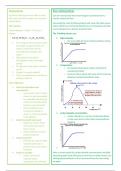
water so easy to transport carbon dioxide concentration
in the phloem o carbon dioxide is a reactant of photosynthesis
Used for growth and repair so the more there is the faster photosynthesis
o Lipids are used to make happens
cell membranes and to
store energy
o Amino acids are used for
protein synthesis
Used for growth
o Proteins are used to make
enzymes and used as
protein carriers for active
transport
Used for strength After a certain point the carbon dioxide concentration and light
o Used to produced intensity graphs level off because from then on other factors are
cellulose which limiting photosynthesis so if we increase these the rate will go
strengthens the cell wall up again
A process where plants are able to make Can be measured by how much oxygen is produced over a
their own food from simple raw materials certain amount of time
around them.
Increasing the rate of photosynthesis will mean the plant grows
The reaction: faster which has commercial benefits as an increased crop yield
can be obtained in a shorter period of time
Carbon dioxide + Water Glucose +
Oxygen The 3 limiting factors are:
6 C O2 +6 H 2 O → C6 H 12 O6 +6 O2 Light intensity
o the more light the faster photosynthesis will go
The energy for the reaction comes
from light energy from the sun
which is converted into the
chemical bond energy in the
sugars
Chlorophyll in the plant’s
chloroplasts capture the light
energy
Temperature
The glucose is the plant’s nutrient
o increasing temperature makes all chemical
source
reactions go faster
Oxygen is a waste product
o however above about 45C some of the enzymes
This is an endothermic reaction as
denature and photosynthesis stops
energy is taken in
Uses of glucose:
Used for respiration and
reproduction
o Converted to starch which
stores the glucose needed
for respiration all day long
and has no osmotic effect
(doesn’t cause osmosis)
o Sucrose (glucose and
fructose) is soluble in
water so easy to transport carbon dioxide concentration
in the phloem o carbon dioxide is a reactant of photosynthesis
Used for growth and repair so the more there is the faster photosynthesis
o Lipids are used to make happens
cell membranes and to
store energy
o Amino acids are used for
protein synthesis
Used for growth
o Proteins are used to make
enzymes and used as
protein carriers for active
transport
Used for strength After a certain point the carbon dioxide concentration and light
o Used to produced intensity graphs level off because from then on other factors are
cellulose which limiting photosynthesis so if we increase these the rate will go
strengthens the cell wall up again