UCLA Anthro 1: Final Study Guide
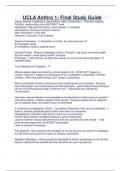
UCLA Anthro 1: Final Study Guide Define theories, hypotheses, assumptions, data, & inferences. - Theories: explains CAUSAL relationships at an ABSTRACT level Hypothesis: deduced from theory (more specific, 2 variables) assumptions: conclusion without evidence data: information of any type inference: conclusion from evidence Darwin's Postulates - 1) Population is infinite, but resources are not 2) Population varies 3) Heritability (variation passed down) Ground Finches - Birds on Galapagos island Drought big beaks survived to open big hard seeds small beaks couldn't compete Postulates: 1) lots of birds, not that many seeds, 2) some small some big beaks, 3) heritable beaks Toxin Resistance in Daphnia - ?? Misconceptions about evolution by natural selection (6) - DOES NOT happen at random, does NOT happen at individual level but a population composition, CAN be complex, CAN have rapid change, NOT always a good thing Why is phenotypic variation continuous even though genes are concrete? - becuase each phenotype is not composed of one individual gene - genes determining phenotype can be *found throughout range of different loci* - phenotype also affected by *environment* How does natural selection move populations far beyond their initial range of variation? (chihuahua effect) - Hidden variation within genes - recessive genes are not replaced, just not passed down, but doesnt mean its eliminated 5 constraints on adaptation CDGLL - Correlated Characters (have one characteristic -- leads to another genetically/genes affect more than one character) Disequilibrium (selection takes time to catch up w environment) Genetic Drift (random changes/mutations in gene frequencies) Local vs Optimal (natural selection favors trait atm, but does not look ahead -- most common phenotype may not be BEST phenotype) Laws of physical & chemistry Ring Species - Same species that divulged so far that they are too distant to interbreed but still have some gene flow (result of allopatric speciation) Allopatric Speciation - when population separated by barrier and diverge so far off they become reproductively isolated (process by which you get ring species) Essentialism - idea that if a population changes it is no longer that population population thinking - population is a population despite the ongoing changes - dynamic group of individuals Convergence/analogy - similar traits but no common ancestor - traits bc of environmental adapatations Homology - traits simlairty due to common ancestor Phylogenetic Inference - inferring that those with similiar phenotypes are more closely related - this is PROBLEMATIC because similar traits may just be analagous/convergence traits -- thats why we should always look at DERIVED traits (last common ancestor) Cladistic taxonomy vs evolutionary - cladistic: only descent matters (humans grouped w gorillas) evolutionary: based on descent AND overall similarity (humans grouped on their own) Why study nonhuman primates? - Analogous (similar traits) Homology (common ancestor) Closest relatives, similar morphologically, and primates are a diverse order Primate Characteristics (5) HSSLL - • Hands and feet adapted for grasping Sensory organs (vision) Slow life history (long preganancy and juvenile periods) large brain live in groups Primate Diets - Frugivore (fruits) - easy digest, carbs, but no protein Folivore (plants) - more protein than fruit Animals - protein and fat, but not easy to digest/find **large animals need less food unit per body weight -- can use lower quality diet than smaller animals* Primate Defense - 6 - Large Body Sizes Familiar places Agressive defense Vigilance alarm calls selfish herd (every man for himself) Crypsis (hiding) Cost/Benefit - strategies? - Cost and benefit refer to the effect of particular behavioral strategies on reproductive success. Benefits/costs are measured as changes in reproductive success (currency). Behaviors are beneficial if they increase fitness, or they're costly if they decrease fitness. Tingergen's four level of explanation CDEF - Causation: proximate explanation Development: ontogenetic explanation Evolution: phylogenetic explanation Function: ultimate adaptive explanation Biological Altruism - Benefiting others at cost of yourself to pass down your genes for the greater good -- cost depends on level of relatedness between the 2 Hamiltons Rule - biological altruism beneficial as long as rb c Conditions for altruism to occur - Opportunities to act often Keeping track of give and receieve Provide support to only those who help themm ex: grooming Parental investment / sex differences - diff time investment/resources -- diff degree of benefit Males do not care for their offspring (1) when they can easily use their resources to acquire many additional matings or (2) when caring for their offspring would not appreciably increase the offspring's fitness. dominance hierarchy - high ranks get resources, mates male primate morphology - more competition to mate = more sexual dimorphism to attract femaeles (large teeth, etc) female primate variation - dominance hierachy -younger = high rank middle age = most succesful longevity = more fitness high ranking females receive moreprotection and resources and sperm lol!! inbreeding avoidance primate techniques - Westermarck idea (recognizing who you grew up w) staying away from similar phenotypes age: male leaves when daughter turns into breeding age infanticide - kill baby so mom can open up her reproductive cycle early for u naturallistic fallacy - natural doesnt mean good (infanticide) life history traits - - timeline of reproductive cycle -fast/slow life histories depend on the environment and resources avaialble to the species
Schule, Studium & Fach
- Hochschule
-
University Of Florida
- Kurs
-
UCLA Anthro
Dokument Information
- Hochgeladen auf
- 22. märz 2024
- Anzahl der Seiten
- 12
- geschrieben in
- 2023/2024
- Typ
- Prüfung
- Enthält
- Fragen & Antworten
Themen

Ebenfalls erhältlich im paket-deal