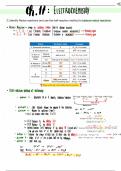
Ch 11 .
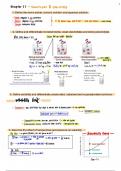
: NUCLEAR CHEMISTRY
·
Radiactivity Unstable:
nuclers spontaneously undergoes a chang into other nuclei that are more stable
·
Nuclear reactions :
the element becomes a different one be of atomic # change , these rxn are always first order decay (depend on
concentration only) , rxn accompanied by large E .
/mass changes
O
1. Describe and differentiate alpha particles, beta particles and gamma particles in terms of
structure and ability to penetrate matter
O
2. Create or identify decay reactions for alpha decay, beta decay, gamma decay, positron
emission and electron capture
Decay nuclear equation
particles
emited domage Representation
Penetrating
Power
Alpha
(x)
Ex -" He +
*Y He -
2 -
4 +
F
n2
e Eut .
en
to p
-
emitting f + is converted
t
.
,
an e .
Gamma (form of
② Y es
electromagnetic % f
E
(V
-another type
T or radiation radiation
wit h
*
Position e
X -
+ Y Te I ②
emission
-
([p
C
-
-
+2 +
jn)
Electron
Ex + i -E Y
ABSORB
I E
2
caphire e
-
(p +
evjn)
*
POSITRON antiparticle
: of e
3 1f de collides with he The sum of the atomic # (z) & mas#(A) On
CEmass/Echarge ( it realeses & Energy o both sides must be E
3. Given one of the three: half-life, rate constant or data on the decay amount, solve for
either of the other variables.
Rate
FIRST-ORDER KINETics : =
k N
.
In =
-kxt or
(nNt = -kt + InCN
(ing) >Nt =
# of radioactive nuclei at time t (in
years
No
=
initial # of radioactive nuclei
a particular isotope of an element
Y time
forby
Of parent ese
: NUCLEAR CHEMISTRY
·
Radiactivity Unstable:
nuclers spontaneously undergoes a chang into other nuclei that are more stable
·
Nuclear reactions :
the element becomes a different one be of atomic # change , these rxn are always first order decay (depend on
concentration only) , rxn accompanied by large E .
/mass changes
O
1. Describe and differentiate alpha particles, beta particles and gamma particles in terms of
structure and ability to penetrate matter
O
2. Create or identify decay reactions for alpha decay, beta decay, gamma decay, positron
emission and electron capture
Decay nuclear equation
particles
emited domage Representation
Penetrating
Power
Alpha
(x)
Ex -" He +
*Y He -
2 -
4 +
F
n2
e Eut .
en
to p
-
emitting f + is converted
t
.
,
an e .
Gamma (form of
② Y es
electromagnetic % f
E
(V
-another type
T or radiation radiation
wit h
*
Position e
X -
+ Y Te I ②
emission
-
([p
C
-
-
+2 +
jn)
Electron
Ex + i -E Y
ABSORB
I E
2
caphire e
-
(p +
evjn)
*
POSITRON antiparticle
: of e
3 1f de collides with he The sum of the atomic # (z) & mas#(A) On
CEmass/Echarge ( it realeses & Energy o both sides must be E
3. Given one of the three: half-life, rate constant or data on the decay amount, solve for
either of the other variables.
Rate
FIRST-ORDER KINETics : =
k N
.
In =
-kxt or
(nNt = -kt + InCN
(ing) >Nt =
# of radioactive nuclei at time t (in
years
No
=
initial # of radioactive nuclei
a particular isotope of an element
Y time
forby
Of parent ese