International Law Exam 1-Questions And Answers Graded A+
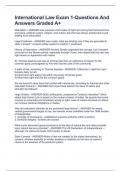
International Law Exam 1-Questions And Answers Graded A+ Naturalism - ANSWER-Law consists of principles of right and wrong that transcend time and place, political system, religion, and culture; law that has always existed and is just waiting to be discovered Legal Positivism - ANSWER-man-made; rules are binding only if they are grounded in state *consent*; consent (either explicit or implicit) = positivism History of Naturalism - ANSWER-Ancient Greeks originated the concept, but it became prominent in the Roman period, especially through Cicero, who stated that true law was right reason in agreement with nature St. Thomas Aquinas saw law as nothing else than an ordinance of reason for the common good, promulgated by him who has the care of the community 3 parts of law, according to Thomas Aquinas - ANSWER-1) Must be in right form (put burdens fairly on all) 2) Must have right author (be within the power of the law giver) 3) Must have right end (for the common good) Are we bound to obey laws that conflict with natural law, according to Aquinas and other Naturalist thinkers? - ANSWER-No! Unjust laws deflect from laws of nature and shouldn't be followed Hugo Grotius - ANSWER-Dutch philosopher, proponent of "eclectic naturalism" which states that Human Law is based on the mutual consent of states. He asserts that some conduct is universally and timelessly wrong or right. Laws of nature and laws or nations can impose identical obligations on states. Why did naturalism diminish as the prominent legal theory? - ANSWER-As strong central governments began to rise, two tenants arose (solidified under the 1648 treaties of Westphalia): 1. principle of sovereignty - established supreme authority within a territory 2. territorial integrity - borders are sacred What iconic document gives prominence to the idea of natural law and relies crucially upon natural law as a premise? - ANSWER-The US Declaration of Independence -- although not without its faults. Didn't apply to slaves State Consent - ANSWER-Rules of law are created by the states themselves, by consent, whether explicitly (in written treaties) or implicitly (in the form of custom); choice is the essence of the positivist system.
Written for
- Institution
- International Law
- Module
- International Law
Document information
- Uploaded on
- March 20, 2024
- Number of pages
- 15
- Written in
- 2023/2024
- Type
- Exam (elaborations)
- Contains
- Questions & answers
Subjects

Also available in package deal