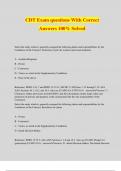
CDT Exam questions With Correct Answers 100% Solved
CDT Exam questions With Correct Answers 100% Solved Select the entity which is generally assigned the following duties and responsibilities by the Conditions of the Contract: Protection of job site workers and stored materials. A - Architect/Engineer B - Owner C - Contractor D - Varies, as stated in the Supplementary Conditions E - None of the above Reference: PDPG 5.4.1.7 and PDPG 15.12.11; EJCDC C-700 Paras. 7.12 through 7.15; AIA A201 Sections 10.1, 10.2, and 10.4. Also see CCAPG 6.8; CCPG 9.14. - answerAnswer: C - Contractor. Safety provisions in both EJCDC and AIA documents clearly make safety and protection of persons and property at the construction Site the sole responsibility of the Contractor. Select the entity which is generally assigned the following duties and responsibilities by the Conditions of the Contract: Resolution of claims. A - Owner B - Contractor C - Varies, as stated in the Supplementary Conditions D - Initial Decision Maker Reference: PDPG 15.15.3; AIA A201 Sections 1.1.8 and 15.2. Also see CCAPG Chapter 10 (particularly CCAPG 10.3) - answerAnswer: D - Initial Decision Maker. The Initial Decision Maker is an entity that exists only in AIA documents and is not used in EJCDC documents. In AIA documents, when an entity other than the Architect is named as the Initial Decision Maker, said entity is identified in AIA A101 (Owner-Contractor Agreement) Section 6.1. In actual practice with AIA documents, the Initial Decision Maker is typically the Architect, but may be a third party considered to be neutral. select the entity which is generally assigned the following duties and responsibilities by the Conditions of the Contract: Paying taxes for the Work. A - Architect/Engineer B - Owner C - Contractor D - Varies, as stated in the Supplementary Conditions E - None of the above Reference: EJCDC C-700 Para. 7.09; AIA A201 Section 3.6; PDPG 13.6.4.4 among others. Also see CCAPG 3.1.4. - answerAnswer: C - Contractor. Taxes are part of the cost of construction for which the Contractor is responsible under the terms of the Contract Documents. For public work, where public owners are often exempt from certain sales and ues taxes on materials and equipment to be incorporated into the construction, typically an associated Supplementary Conditions provision is necessary to properly indicate the statutory requirements for taxes, which can vary significantly from state to state. select the entity which is generally assigned the following duties and responsibilities by the Conditions of the Contract: Right to stop work, if non-conforming Work fails to be corrected. A - Architect/Engineer B - Owner C - Contractor D - Varies, as stated in the Supplementary Conditions E - None of the above Reference: PDPG 15.9.5.1; EJCDC C-700 Para 14.06; AIA A201 Sections 2.4, 14.2 and 14.3. Also see CCAPG 2.1; CCAPG 6.2.2; - answerAnswer: B - Owner. Standard contract documents such as EJCDC's and AIA's reserve to the Owner sole right to stop or suspend the Work if the Work does not comply with the Contract Documents. This right is solely the Owner's, and should never be assumed by or delegated to the A/E (or a construction manager), because stopping the Work is an extreme action that almost always results in a delay Claim from the Contractor for additional time and compensation. In EJCDC and AIA documents, the A/E does not have authority to stop or suspend the Work for non-conformance because issuing such an order is tantamount to opening the Owner's checkbook and handing out money. Which of the following is part of the construction documents but not part of the Contract Documents? A - Procurement Forms B - Agreement C - Performance Bond D - General Conditions E - Addenda F - Contract Modifications Reference: PDPG 12.1 and PDPG 12.2; EJCDC C-700 Paras. 1.01.A.6 and 7; AIA A201 Section 1.1.1; and "The Diagram". Also see CCAPG 1.3.1; CCAPG 8.2. Also see CSPG Chapter 9 - answerAnswer: A - Procurement Forms (also known as the Bid Form and its supplements). The Procurement (Bidding) Requirements, which include the advertisement or invitation to bid, instructions to bidders/proposers, bid form, bid bond form (if any), qualifications statement (if any), and other bid form supplements (if any), are required only for the Project's procurement (bidding/pricing) stage and therefore are not typically considered to be "Contract Documents" (remember: "Contract Documents" exist only after the parties have both signed the Owner- Contractor Agreement). If you are still having trouble wrapping your mind around this, consider that the Procurement (Bidding) requirements are necessary for, and apply only through, the procurement (bidding) stage—they address matters only until the Owner-Contractor Agreement is signed and the Contract becomes effective. Therefore, the Procurement (Bidding) Requirements are not necessary once the Contract is in effect. 46a: What is the "glue" that binds the Contract Documents together? Reference: PDPG 11.1.2; PDPG 11.1.5. Also see CSPG Chapter 5, "Agreements". - answerAnswer: If you answered "Agreement" you would not be entirely correct the correct answer is "signed Agreement" (see PDPG Figure 11.1) True or False: The Contracting Requirements include the performance bond. Reference: MasterFormat Division 00 (particularly 00 50 00 through 00 99 99); and "The Diagram". - answerAnswer: True. MasterFormat titles Division 00 as "Procurement and Contracting Requirements". Procurement (Bidding) Requirements are those documents that pertain only to the procurement (bidding) stage (e.g., advertisement or instructions to bidders, advertisement or invitation to bid, instructions to bidders/proposers, bid form, bid bond form (if any), bidder qualifications statement (if any), and other bid form supplements (if any). MasterFormat assigns these documents between 00 10 00 and 00 49 99. The "Contracting Requirements" are the balance of Division 00 (per MasterFormat, documents between 00 50 00 and 00 99 99), including the Agreement form and its supplements (if any); project forms (including the performance bond and payment bond); "conditions of the contract"; and revisions/clarifications/modifications (including Addenda). 46c: Project-specific insurance requirements would usually be included in the ____ (fill in the blank). Reference: PDPG 12.5. Also see CSPG Chapter 17 - answerAnswer: Supplementary Conditions. Project-specific insurance requirements, such as the specific types of insurance and minimum coverage limits required, are typically in the Supplementary Conditions. This is always the case with EJCDC documents, and was the case with AIA documents until the 2017 edition of AIA A201 and AIA A101. Both AIA A201 and EJCDC C-700 (General Conditions) contain basic insurance provisions. But for the Owner to require that the Contractor furnish general liability insurance of not less than a certain coverage amount, or to require that the Contractor furnish a certain type of railroad protective liability insurance, such requirements would be in the Supplementary Conditions (EJCDC C-800, Supplementary Conditions, includes model language, as does AIA A503— 2007). However, with its 2017 documents, the AIA extracted the specific requirements for certain types of insurance and created at new exhibit to AIA A101 (Owner-Contractor Agreement). Thus, as of 2017, AIA includes Project-specific insurance requirements in an exhibit to the Agreement.
Written for
- Institution
- CDT
- Course
- CDT
Document information
- Uploaded on
- March 20, 2024
- Number of pages
- 66
- Written in
- 2023/2024
- Type
- Exam (elaborations)
- Contains
- Questions & answers
Subjects
-
cdt exam questions with correct answers 100 solve

Also available in package deal