WGU - EMPLOYMENT LAW – TERMS Exam Questions with 100% Correct Answers
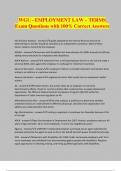
WGU - EMPLOYMENT LAW – TERMS Exam Questions with 100% Correct Answers IRS 20-factor Analysis - answerA guide adopted by the Internal Revenue Service for determining if a worker should be classified as an independent contractor. Most of these factors relate to control by the employer. ADAAA - answerAmericans with Disabilities Act Amendments Act-2008: Amends the ADA by adding new protections for employees with disabilities. ADEA Waivers - answerA statement from a retiring employee that he or she will not make a personal ADEA claim against the employer in exchange for retirement incentives. Abuse of Discretion - answerAn employer's failure to consider important and relevant facts; acting in an arbitrary or capricious manner. Adverse Job Action - answerA negative job action that results from an employee's lawful actions. AA - answerAffirmative Action: Any action taken by an employer to overcome discriminatory effects of past or current practices that create barriers to equal employment opportunity. The Office of Federal Contract Compliance Programs (OFCCP) within the Department of Labor oversees regulation of AA. Affirmative Action Plan - answerPlan that analyzes a workforce to determine whether protected classes are underutilized in different job groups. Describes how organization will address any underutilization that exists. Age Discrimination - answerTreating an applicant or employee less favorably because of his or her age. ADEA - answerAge Discrimination in Employment Act-1967: Protects employees who are 40 years of age and older. 20 or more employees. True for any tangible job action. Agency - answerA CONTRACT relationship between a principal and an agent whereby the principal authorizes the agent to work on his or her behalf and with power to bind the principal. ADA - answerAmericans with Disabilities Act-1990: Public and private employers with 15 or more employees are prohibited from discriminating against people with disabilities. Requires equal opportunity in selecting, testing, and hiring qualified applicants with disabilities. Anti-female Animus - answerAn environment of animosity toward women. Appropriation of Image or Likeness - answerA type of tort in which an employer uses the name, image or likeness of an employee for commercial purposes in a way that is not described in the job description. Arbitration - answerA procedure for resolving collective bargaining impasses by which an arbitrator (third party) choose a solution to the dispute. Assumption of the Risk - answerAn employer defense that states an employee knows and accepts the risk of potential injury in a certain position. BFOQ - answerBona Fide Occupational Qualification: A reasonable employment qualification that an employer is allowed to consider while making decisions about hiring/retaining employees. EX: Job requirement that an employee be a particular religion, sex, or national origin that is reasonably necessary to business operations: an opening for a Baptist minister would be filled by a minister who is actually a person who celebrates the Baptist religion and not, say, Episcopal. Back Pay - answerMonetary compensation for a plaintiff's lost earnings. Branches of Government - answerLEGISLATIVE=made up of the two houses of Congress:Senate/House of Representatives. These bodies are tasked by the Constitution to make laws for the "general welfare" of the people. EXECUTIVE=composed of the President and other executive leaders, such as the Vice-President (elected) and the Cabinet, who lead major departments in the federal government (appointed by the President). The executive branch conducts foreign affairs and ensures that sound laws are created and enforced. JUDICIAL=court system of the country. Comprised of the Supreme Court and other federal courts. Through actual legal controversies, the courts explain and define the meaning of the Constitution and laws passed by Congress. Business Necessity - answerA legitimate business purpose that justifies an employment decision as effective and necessary. Case Law - answerThe law as laid down in the decisions of the courts (distinct from statutes or other sources of law). Civil Law - answerLaws that deal with the rights of people rather than with crimes. Civil Rights Act of 1964 - answerEnacted in 1964, it prohibits race discrimination in employment. Clayton Act - answerEnacted in 1914, prohibits the elimination of unions. Largely ineffective. Closed Union Shop - answerAn illegal requirement that an employee be a union member. Collective Bargaining - answerThe negotiation process between unions and employers. Color - answerSkin pigmentation characteristic of race, especially other than white. Common Law - answerPrinciples developed over centuries as a result of legal decisions made by judges in individual cases. Common Law Agency - answerA test that classifies a worker as an employee if the employer maintains the right to control the method of work performed. Common Law Criminal Conspiracy - answerA combination of two or more individuals planning to accomplish an unlawful purpose. Community of Interests - answerA community of people who align themselves with a common interest. Comparable Worth Theory - answerThe notion that men and women should receive equal pay when they perform work requiring comparable skills/responsibilities. Comparative Evidence - answerEvidence of discrimination that is found by comparing two similarly situated employees who were treated differently because of a class characteristic. Compensatory Damages - answerMonetary compensation necessary to replace a plaintiff's losses. Compensatory Time - answerAn option for public employers to allow time off for employees instead of payment. Complaint - answerA formal allegation against a party Compliance Requirement - answerA mandate placed upon employers through OSHA: all employers comply with all safety and health requirements issued by the Department of Labor. Concerted Activity - answerSection 7 of National Labor Relations Act, (NLRA) AKA: Wagner Act= guarantees the rights of workers to engage in concerted activity. Concerted activity - whether as part of a union or not - is any and all efforts of workers to join together to seek improvements in working conditions. The exact language of the statute states that the NLRA protects any worker who "engage[s] in other concerted activities for the purpose of collective bargaining or other mutual aid or protection."
École, étude et sujet
- Établissement
- WGU C233 Employment Law
- Cours
- WGU C233 Employment Law
Infos sur le Document
- Publié le
- 20 mars 2024
- Nombre de pages
- 19
- Écrit en
- 2023/2024
- Type
- Examen
- Contient
- Questions et réponses
Sujets
-
wgu employment law terms exam questions with 1

Document également disponible en groupe