

W1 From antiquity to scienti c revolution: rationalism and empiricism Ch1/2
W2 The limits of science: enlightenment and Kant Ch4
W3 Positivism and hermeneutics Ch5
W4 Critical rationalism Ch7
W5 Language games and paradigms: relativism, constructivism Ch8
W6 Research programmes and methodological anarchy Ch9
W7 New perspectives/possible solutions: pragmatism Ch11
W8 New perspectives/possible solutions: prospects, summary and examples Ch13
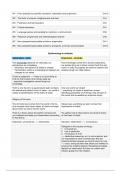
Epistemology in antiquity
Rationalism - plato Empiricism - Aristotle
True knolwedge depends on rationality, our True knowledge comes from sensory experience,
perceptions are misleading: our senses bring us to direct contact twith the real
- Heraclitus: the essence of reality is change world. In order to progress we need to observe and
- Parmenides: reality is unchanging but appears as analyse trough our observations
changes to our sense
If truth is subjective —> there is no such thing as
truth bc that is about how things really are
- empirical investigation cannot bring true
knowledge
Truth is only found in a supernatural realm contains Only one world we inhabit
the eternal and perfect forms or ideas - our world is - everything ins made of essences, unique
simply a representation of the realm of ideas identifying properties of all things, they are part of
this world and accessible by empirical inquiry
Allegory of the cave
The immortal soul comes from the world of forms, Tabula rasa: everything we learn comes from
thus humans have inborn ideas, of which we forgot impressions of reality
about when we came into the world
There is a theory about the perfect universe and You gather lots of observations and build a theory
you interpret and adapt you observations according on the basis of those
to that theory
Deduction: universal law —> observation Induction: observation —> universal law
Syllogism to nd causes of things:
1. Universal law
2. Law in particular
3. Conclusion of A+B
—> deductive reasoning, so it is not empirical, and
it is impossible to have universal laws that are
empirical simply because we cannot know for sure
—> nous: strong intuition that allows our intellect to
produce the insights (logical): theoretical principles
depend on observation but also on a direct and
intuitive grasp form the intellect
fi fi
, 17th century- scienti c revolution
• Knowledge/science based on experiment and observation, not faith, theology and tradition
• observation—> refute ideas based on faith (Kepler, Galileo Galilei, Newton)
• Commitment to observation and experiments
• Universal mechanics
• Universal mathematics
• Demysti cation of the world: no God, no mysterious forces
Bacon (1561-1626)
• Truth requires observation
• Human perception cannot be trusted:
• idols of the tribe, cave, marketplace, theatre —> our understanding of the world should be freed and
cleansed before we can produce science
• Vs Aristotle’s syllogism: the premises are not grounded enough in observation and universal statements
can’t be the starting point for scienti c inquiry
• Empirical material + interoperation trough theory to make meaningful ndings
Rationalism and empiricism 17-18th century
Enlightenment: science to provide a rational answer to how society should be organised
Descartes
• Foundation of knowledge should lie in absolutely certain statements obtained trough reason
• Sensory info is not beyond doubt—> cannot provide a foundation of knowledge
• The only thing he was sure about: cogito ergo sum
• Some ideas are innate, place by God, who wouldn’t deceive us —> physical world really exists
John Locke George Berkeley
• Tabula rasa: no innate ideas • No distinction between primary and secondary
• Ideas come form sensation and re ection (primary properties
and secondary properties of objects) • Primary properties known trough ideas produced
• Perceptual relativity —> senses are subjective by senses
• Idealism: to be is to be perceived
David Hume
• Knowing the world through representations in our minds, all science is tied up to human nature
(anthropocentric)
• Science based on experience and observation —> understand the human mind to move forward in
science
• Minds are lled with perceptions: impressions + ideas (personal copies of impressions)—> copy
principle, in reverse to judge the meaningfulness of an idea
• Contiguity, priority and constant conjunction —> causal e ect in events BUT not enough for a lawful
knowledge —> we don’t see causality, we only assume it
• anticipation based on past experience, a learned habit led by passion not reason, which keeps us from
falling into sceptic apathy resulting in believe in nothing
• Working hypotheses on which we can base our actions and thinking and categorise the world around us
• Knowledge is an illusion of the imagination, we are left with beliefs and guesses
• BUT anticipatory success: uniformity and constancy of the world
fi fi fi fl fi ff fi
W2 The limits of science: enlightenment and Kant Ch4
W3 Positivism and hermeneutics Ch5
W4 Critical rationalism Ch7
W5 Language games and paradigms: relativism, constructivism Ch8
W6 Research programmes and methodological anarchy Ch9
W7 New perspectives/possible solutions: pragmatism Ch11
W8 New perspectives/possible solutions: prospects, summary and examples Ch13
Epistemology in antiquity
Rationalism - plato Empiricism - Aristotle
True knolwedge depends on rationality, our True knowledge comes from sensory experience,
perceptions are misleading: our senses bring us to direct contact twith the real
- Heraclitus: the essence of reality is change world. In order to progress we need to observe and
- Parmenides: reality is unchanging but appears as analyse trough our observations
changes to our sense
If truth is subjective —> there is no such thing as
truth bc that is about how things really are
- empirical investigation cannot bring true
knowledge
Truth is only found in a supernatural realm contains Only one world we inhabit
the eternal and perfect forms or ideas - our world is - everything ins made of essences, unique
simply a representation of the realm of ideas identifying properties of all things, they are part of
this world and accessible by empirical inquiry
Allegory of the cave
The immortal soul comes from the world of forms, Tabula rasa: everything we learn comes from
thus humans have inborn ideas, of which we forgot impressions of reality
about when we came into the world
There is a theory about the perfect universe and You gather lots of observations and build a theory
you interpret and adapt you observations according on the basis of those
to that theory
Deduction: universal law —> observation Induction: observation —> universal law
Syllogism to nd causes of things:
1. Universal law
2. Law in particular
3. Conclusion of A+B
—> deductive reasoning, so it is not empirical, and
it is impossible to have universal laws that are
empirical simply because we cannot know for sure
—> nous: strong intuition that allows our intellect to
produce the insights (logical): theoretical principles
depend on observation but also on a direct and
intuitive grasp form the intellect
fi fi
, 17th century- scienti c revolution
• Knowledge/science based on experiment and observation, not faith, theology and tradition
• observation—> refute ideas based on faith (Kepler, Galileo Galilei, Newton)
• Commitment to observation and experiments
• Universal mechanics
• Universal mathematics
• Demysti cation of the world: no God, no mysterious forces
Bacon (1561-1626)
• Truth requires observation
• Human perception cannot be trusted:
• idols of the tribe, cave, marketplace, theatre —> our understanding of the world should be freed and
cleansed before we can produce science
• Vs Aristotle’s syllogism: the premises are not grounded enough in observation and universal statements
can’t be the starting point for scienti c inquiry
• Empirical material + interoperation trough theory to make meaningful ndings
Rationalism and empiricism 17-18th century
Enlightenment: science to provide a rational answer to how society should be organised
Descartes
• Foundation of knowledge should lie in absolutely certain statements obtained trough reason
• Sensory info is not beyond doubt—> cannot provide a foundation of knowledge
• The only thing he was sure about: cogito ergo sum
• Some ideas are innate, place by God, who wouldn’t deceive us —> physical world really exists
John Locke George Berkeley
• Tabula rasa: no innate ideas • No distinction between primary and secondary
• Ideas come form sensation and re ection (primary properties
and secondary properties of objects) • Primary properties known trough ideas produced
• Perceptual relativity —> senses are subjective by senses
• Idealism: to be is to be perceived
David Hume
• Knowing the world through representations in our minds, all science is tied up to human nature
(anthropocentric)
• Science based on experience and observation —> understand the human mind to move forward in
science
• Minds are lled with perceptions: impressions + ideas (personal copies of impressions)—> copy
principle, in reverse to judge the meaningfulness of an idea
• Contiguity, priority and constant conjunction —> causal e ect in events BUT not enough for a lawful
knowledge —> we don’t see causality, we only assume it
• anticipation based on past experience, a learned habit led by passion not reason, which keeps us from
falling into sceptic apathy resulting in believe in nothing
• Working hypotheses on which we can base our actions and thinking and categorise the world around us
• Knowledge is an illusion of the imagination, we are left with beliefs and guesses
• BUT anticipatory success: uniformity and constancy of the world
fi fi fi fl fi ff fi


