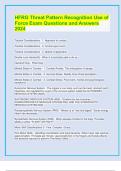
HFRG Threat Pattern Recognition Use of Force Exam Questions and Answers 2024
Tactical Considerations - 1. Approach to contact. Tactical Considerations - 2. Control upon touch. Tactical Considerations - 3. Speed of application. Double Lock Handcuffs - When it is tactically safe to do so. Handcuff Grip - Pistol Grip. Mental States in Combat - 1. Combat Anxiety. The anticipation of danger. Mental States in Combat - 2. Survival Stress. Deadly force threat perception. Mental States in Combat - 3. Combat Stress. Post event, mental and psychological symptoms. Autonomic Nervous System - The organs in our body, such as the heart, stomach and intestines, are regulated by a part of the nervous system called the AUTONOMIC NERVOUS SYSTEM (ANS). AUTONOMIC NERVOUS SYSTEM (ANS) - Divided into two branches. PARASYMPATHETIC NERVOUS SYSTEM PNS, AND THE SYMPATHETIC NERVOUS SYSTEM SNS. Parasympathetic Nervous System (PNS) - Allows us to "rest and digest". Saves energy. Heart rate decreases. Sympathetic Nervous System (SNS) - Body releases Cortisol in the body. Provides ability to either "FLIGHT OR FIGHT". Motor Skill Classifications 3 - Fine. Complex. Gross Fine Motor Skills - Hand/Eye coordination and hand dexterity. When heart rate reaches approximately 115 beats per minute, vasoconstriction in the fingers and hands effects the dexterity required to perform Fine Motor Skills. Complex Motor Skills - Involves a series of muscle groups. Example, shooting stance. At approximately 145 beats per minute, Complex Motor Skills begin to deteriorate. Fine Motor Skills - Hand/Eye coordination and hand dexterity. When heart rate reaches approximately 115 beats per minute, vasoconstriction in the fingers and hands effects the dexterity required to perform Fine Motor Skills. The human body relies on three energy systems. - 1. Adenosine Triphosphate / Pyospocreatine ATP / PC System. 2. Lactic Acid System LAS. 3. Aerobic System AS. ATP / PC System - Small energy bundles stored in the muscles. Used during high energy and high strength activities. Burns out after 10 to 15 seconds. Lactic Acid System LAS - Once the ATP System has been depleted, the LAS will act as an afterburner fuel. Provides about 45 seconds or intermediate strength and endurance. Level shoulder pin - 1. Rear neck lock, no compression 2. mechanical compression until consciousness compliance 3compression until unconsciousness HFRG training programs based upon 3 Components. - 1. Tactical Acceptability. 2. Legal Acceptability. 3. Medical Acceptability. Use of Force Continuum. - Graphical representation which illustrates an appropriate officer response for specific level of subject resistance. The "One Plus One Theory". - Can use one level of force higher than the level of resistance used by the subject. Levels of Resistance. - 1. Psychological Intimidation. 2 - Verbal Noncompliance. 3 - Passive Resistance 4 - Defensive Resistance 5 - Deadly Force Assault Psychological Intimidation - Non verbal cues. Blank stare, clenching of fists. Tightening of jaw muscles etc. Verbal Noncompliance - Unwillingness to obey commands of detainment, arrest or to stop unlawful or dangerous behavior. Such as " No, I will not put my hands behind my back".
Written for
- Institution
- HFRG
- Course
- HFRG
Document information
- Uploaded on
- March 15, 2024
- Number of pages
- 7
- Written in
- 2023/2024
- Type
- Exam (elaborations)
- Contains
- Questions & answers
Subjects
- hfrg
-
hfrg threat pattern recognition use of force exam
-
hfrg threat pattern recognition use of force
-
hfrg threat pattern recognition
-
threat pattern recognition use of force
-
threat pattern recognition

Also available in package deal