Fund HESI - HESI fundamental
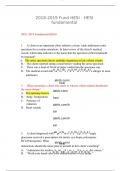
Fund HESI - HESI fundamental Fundamental HESI 1. A client at an outpatient clinic submits a clean- catch midstream urine specimen for a routine urinalysis. In later review of the client's medical record, which data indicates to the nurse that the specimen collectionshould be repeated? A. The urine specimen shows multiple organisms in low colony counts. B. The client reported eating a meal before voiding the urine specimen C. There was a total of 30 ml of urine voided into the specimen cup D. The medical record indiacabtierbs .tchoemcl/iheentsiis allergic to most antibiotics 2. When assessing a client who starts to wheeze which related datashould the nurse obtain? A. Precipitating factors B. Body Temperature C. Presence of radiation D. Heart sounds 3. A client diagnosed mo/pheens-iangle glaucoma received a prescription for miotic eye drops, pilocarpine HCl (Pilocarpine). What instructions should the nurse plan to include in this client’s teaching? A. “Administer the cmtl/yhoensithe cornea.” B. “Wash your hands after each administration of eye drops.” C. “Do not allow the dropper bottle to touch the eye.” D. “Squeeze your eye closed after administering the drops.” 4. The nurse observes that a male client on a clear liquid diet has a cup of coffee on his breakfast tray. What action should the nurse implement? A. Consult with the dietician to learn if the client is allowed to drink coffee B. Determine which member of the nursing staff brought the cup of coffee to the client C. Remind the client that no milk, or creamer can be added to the coffee. D. Remove the coffee from the tray, advising the client that it is not included in the diet. 5. When evaluating the effectiveness of a client’s nursing care, thenurse first reviews the expected outcomes identified in the plan of care. What action should the nurse take next? A. Determine if the expected outcomes were realistic B. Modify the nursing interventions to achieve the client’s goals C. Obtain current client data to compare with expected outcomes D. Review related professional standards of care. 6. The nurse learns that members of the nursing staff are uncomfortable with responding to client be/hrsewsiho are angry. In designing a teaching session to help the staff respond more effectively in these situations, which instructional strategy mr t/hheesniurse to use? A. Return demonstration B. Journaling C. Analogies D. Role playing 7. The nurse observes r a/hceliseint's greater trochanter as seen in the picture. What actions u/rhseesimi plement? (select all thatapply) A. Remove the eschar before applying and securing a hydrocolliod B. Prepare to implement mre/dhiesstriibution mattress C. Obtain a specimen of the site for culture and sensitivity D. Instruct the Unlicensed assistive personnel to frequently offer oral fluids E. Explain to the client that the wound needs debridement 8. The nurse has removed the barbiturate capsule from the unit dose wrapper to administer to a male client. The client decides he wants to watch a television program and requests not to take the medication. Which action should the nurse implement? A. Credit the medication back and put in the client’s medication box B. Keep the medication and see if the client will want to take it later. C. Have another nurse watch disposal of the medication into disposal container D. Explain that since the medication is a controlled substance it must be taken. 9. The home health nurse is reviewing the personal care needs of anelderly client who lives alone. Which client assessment findings indicate the need to assign an unlicensed assistive personal (UAP) to provide routine foot care and file the client’s toenails? (Select all that apply). A. Shuffling gait. B. Diminished visual acuity. C. Syncope when bending. D. hands tremors. E.Urinary incontinence 10. The charge nurse g/rhaedsuiate's performance of wound care. Which technique indicates that the employee is effectively cleansing the wound? A. Starts at the wound site and moves outward using circular motions. B. Cleanses from the outer area of the wound toward the center C. Uses a sterile swab to go o/uhnedsisite twice. D. Scrubs wound vigorously for at least two minutes 11. The nurse is evaluating the fluid balance of the client who was admitted yesterday with dehydration and who has been receiving iv fluids since admission. An increase in which parameter indicates to the nurse that the client is rehydrating. A. Serum haematocrit. B. Urine specific gravity. C. Pulse Rate. D. Urinary output. 12. In-home hospice care is arranged for a client with stage 4 lung cancer. While the palliative nurse is arranging for discharge, the client verbalizes concerns about pain. What action should the nurse implement? a. Explain the respiratory problems that can occur with morphine use. b. Teach family how to evaluate the effectiveness of analgesics. c. Recommend asking the healthcare professional for a patient-controlled analgesic (PCA) pump. d. Provide client with a schedule of around-the-clock prescribed analgesic use. 13. The nurse begins to suction a client’s oropharynx as seen in thepicture. a. Position suction in the tracahbeiarb. .com/hesi b. Apply nasal cannula oxygen. c. Insert a tongue blade. d. Observe the suction secretion. 14. While interviewing a client, the nurse records the assessment in the electronic health record. Wmme/hnteissi most accurate regarding electronic documentation during an interview? a. The interview process is enhanced with electronic documentation and allows the client to speak at pa/ b. Completing the electronic record during an interview is a legalobligation of the examining nurse. c. The nurse has limited ability to observe non-verbal communicationwhile entering the assessment electronically. d. The client’s comfort level is increased when the nurse breaks eye-contact to type notes into the record. 15. The nurse measures the client’s blood pressure(BP) and notes that it is significantly higher than the previous reading. What should the nurse do next? (Select all that apply). a. Determine the client’s activities and feelings prior to the BP measurement. b. Retake the Client's blood pressure in the opposite arm c. Assign the unlicensed assistive personnel to recheck the BP in an hour. (not the answer because it should be rechecked sooner) d. Ask another nurse to assist in assessing for an apical-radial pulse deficit. e. Immediately take two more readings on the same arm. 16. A male Native American presents to the clinic with complaints of frequent abdominal cramping and Nausea. He states that he has chronic constipation and has not had a bowel movement in 5 days, despite trying several home remedies. Which intervention is most important for the nurseto implement. a. Access for the presence of an impaction. c. Obtain list of prescribed ic/ahteiosni s. d. Determine what home remedies where used. 17. The Practice Nurse (PN)mte/rhileesgi loves and opens a pack of sterile sponges to assist the healthcare provider with a bedside procedure. After the Charge Nurse (CN) observesabthirebP.cNo,mw/hhaetsaictions should the charge nurse take? a. Confirm that PN is ready wmi/thhetshie planned procedure. b. Obtain all new supplies and directly assist with theprocedure. c. Remove the mo/fhsepsoinges from the table. d. Instruct the PN to mes/htheast iare now contaminated. 18. A male client with imty/hisedsiischarged with home-health services. When the home-health nurse arrives, the client asks what he can do for the swelling in his leg. What action should the nurse implement? a. Encourage the client to take short walks around the block. b. Advice the client to dangle his feet during meals and beforebedtime. c. Ensure the clients to flex both of his feet, several times a day. d. Explain the need to keep the head of the bed elevated. 19. A male client with a recent diagnosis of terminal cancer, tells his nurse that he wishes to die naturally. The client states that he’s tired of fighting this illness and is only continuing treatment because of his family’s wishes. What actions should the nurse take? a. Request a consultation for a psychologist to talk with the client. b. Call a clergy to discuss end-of-life decisions with the client. c. Determine if he wants to stop radiation and chemotherapy. d. Arrange a meeting with the client, his family and the healthcare provider. 20. A male client who had emergency gallbladder surgery yesterday is getting ready for discharge. The nurse knows that the client speaks very little English. When teaching wound care, which method should the nurse use to evaluate the client’s understanding of self-care at home? a. Have the client demonstrate prescribed wound care. b. Provide written instructions in the client’s native language. d. After each instruction, nmt /ihf ehseiunderstands. 21. A postoperative client iff/ehreesnit PRN analgesics prescribed for different levels of pain. The nurse inadvertently administers a dose that is not within the prescribed parameatbeirrsb. .Wcohmat/hacetsioi ns should the nurse take first? a. Access for side effects of the medication. b. Document the client’s c. complete a medication error report. d. Determine if the pain .m/hesi 22. The nurse is evaluating a client who is admitted to an adult medical unit, and notes that a client’s mha/shbeesein 70 ml/hr. Which action should the nurse implement? a. Recommend drinking cranberry juice with meals. b. Encourage the client to drink more fluids. c. Document the client’s urinary output every hour. (NORMAL RANGE) d. Notify the healthcare provider immediately. 23. A client is admitted with Pneumonia and has a recent history of Methicilline-resistance Staphylococcus aureus (MRSA). The Client is placed in isolation while caring for the client, which client should the nurse place in a designated bio-hazard bag before it is removed from the room? a. A sputum specimen. (BODILY FLUIDS=BIOHAZARD) b. Paper mask and gown. c. The nurse’s stethoscope. d. Bed linens. 24. A client is receiving Ketorolac (Toradol) IM 45mg IM every 6 hours for post operative pain. The available 2ml vile is labeled, Toradol 30mg / ML. How many ML should the nurse administer? (enter numerical value only, If rounding is required round to the nearest Tenths). [1.5 x] 25. The nurse notes that a client has cyanosis of the toes andfingertips. Which vital signs should ta/ihnefsirist. a. blood pressure. b. Respiratory rate. (Cmb/yhleoswi oxygen levels in the RBCs) c. Pulse Rate. d. Temperature. 26. An older male client returns to the clinic for chronic pain management after taking morphine sulphaatbe i(rMb.Scocmon/htiens) i25mg every 12hrs. He states he took the medication only when the pain was too severe to sleep. What action should the nurse implement? a. Explain the risk of drug addiction from long term pain medication. b. Tell the client to continue taking the MS contin with severe pain. c. Instruct the client to take the MS Contin every 12 hours as prescribed. d. Teach the client alternative ways to manage his chronic pain. 27. A client is admitted with complaints of shortness of breath (Dyspnea) on exertion, and chest pressure The healthcare provider prescribes a medication that is unfamiliar to the nurse. When checking the drug handbook, the nurse reads that the prescribed amount is an unusually large dose. What actions should the nurse take?
Written for
- Institution
- 2018-2019 Fund HESI - HESI fundamental
- Course
- 2018-2019 Fund HESI - HESI fundamental
Document information
- Uploaded on
- March 13, 2024
- Number of pages
- 76
- Written in
- 2023/2024
- Type
- Exam (elaborations)
- Contains
- Questions & answers
Subjects
-
fund hesi hesi fundamental

Document also available in package deal