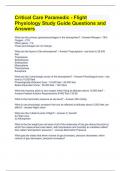
Critical Care Paramedic - Flight Physiology Study Guide Questions and Answers
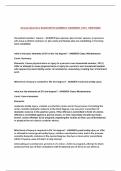
What are the primary gases/percentages in the atmosphere? - Answer-Nitrogen - 78% Oxygen - 21% Other gases - 1% These percentages do not change. What are the layers of the atmosphere? - Answer-Troposphere - sea level to 26,405 feet Tropopause Stratoshpere Stratopause Mesosphere Thermoshere Exosphere What are the 3 physiologic zones of the atmosphere? - Answer-Physiological zone - sea level to 10,000 feet Physiologically Deficient Zone - 10,000 feet - 50,000 feet Space Equivalent Zone - 50,000 feet - 120 miles What law requires pilots to use oxygen when flying at altitudes above 10,000 feet? - Answer-Federal Aviation Requirements (FAR) Part 135.89 What is the barometric pressure at sea level? - Answer-760 mmHg What is one physiologic symptom that can be affected at altitudes above 5,000 feet can affect? - Answer-Night vision What are the 3 distinct parts of flight? - Answer-1) Aircraft 2) Flight crew 3) Atmosphere What is the the weight per unit area of all of the molecules of the gas above the point at which the measurement was taken, with temperature and humidity as variables called? Also called "atmospheric pressure." - Answer-Barometric Pressure What gas law states that when volume of gas increases, pressure decreases; when volume of gas decreases, pressure increases
Written for
- Institution
- Critical Care Paramedic
- Course
- Critical Care Paramedic
Document information
- Uploaded on
- March 10, 2024
- Number of pages
- 4
- Written in
- 2023/2024
- Type
- Exam (elaborations)
- Contains
- Questions & answers
Subjects
-
critical care paramedic flight physiology study
-
what are the primary gasespercentages in the atmo

Document also available in package deal