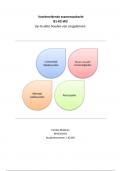
The Influence of Social Capital on the
Value of Networks of Practice
March 19th , 2010
Individual Paper ‘Research Seminar - Questionnaire’
Martijn Scheen (1808524), Vrije Universiteit Amsterdam
Case: Dutchaid
,Table of content
1. Introduction .......................................................................................................................................... 2
1.1 Introduction ........................................................................................................................................ 2
1.2 Problem statement & research questions .......................................................................................... 3
1.3 Scientific relevance ............................................................................................................................. 3
1.4 Outline................................................................................................................................................. 4
2. Theory development ............................................................................................................................. 4
2.1 value of Network of Practice............................................................................................................... 4
2.2 Social Capital theory ........................................................................................................................... 5
3. Methodology......................................................................................................................................... 7
4. Analyses ................................................................................................................................................ 8
5.1 General analysis .................................................................................................................................. 8
5.2 Correlations......................................................................................................................................... 9
5.3 Testing hypotheses ........................................................................................................................... 10
5. Conclusion ........................................................................................................................................... 10
5.1 Contributions .................................................................................................................................... 10
5.2 Discussion.......................................................................................................................................... 11
1
, 1. Introduction
1.1 Introduction
The view on how social capital is able to support knowledge sharing has significantly changed
throughout the years (Neches, Fikes, Finin, Gruber, Patil, Senator, & Swartout, 1991; Hendriks,
1999; Cooper, 1994; Carr, 2003). It all began from an Information Technology (IT) orientated
mindset towards a whole new social way of looking at this intensive process. Huysman and Wulf
(2006) discuss these developments and explained the rising of a user orientated wave in theory.
In the field of organizations and IT both practitioners and scholars try to clarify the process of
technological cues influencing knowledge sharing. However, they discovered it was not just
about the technological capabilities of the system that facilitates knowledge sharing, but also the
social ties en networks within the organization. This popularity of the concept is not only a result
of the growing recognition of the value of knowledge work and increased IT possibilities, but
also because of the increasing complexity of work and speed at which changes take place
(Huysman & Wulf, 2006). While knowledge management often fulfills a secondary role in
organizations, it seems that successful networking programs like Facebook, Twitter, and Hyves
generated interest about these kind of tools and the way they influence knowledge sharing. After
all, people are sharing their knowledge for free and spending their own time in creating an online
network. As Huysman and Wulf (2006) stated in their article, “this urge to get a grip on
knowledge and to leverage it to create competitive advantage constitutes an important topic for
discussion among practitioners and theorists alike” (p.1).
Nahapiet & Ghoshal (1998) did an important job by theorizing social capital into a strong
framework. This framework shows the relation between relation, structural, and cognitive
characteristics and the extent to which people share their knowledge. In the field of knowledge
management, social capital is in various ways extensively used in explaining stimulation and
motivation and to what extent they realizes socialness between people. For instance, Huysman &
Wulf (2006) created a theoretical framework in how social cues can be stimulated by
technological tools developed in the last decade. In their research they found that structural ties
between people are well supported by all sorts of used tools, while the other two dimensions are
2
Value of Networks of Practice
March 19th , 2010
Individual Paper ‘Research Seminar - Questionnaire’
Martijn Scheen (1808524), Vrije Universiteit Amsterdam
Case: Dutchaid
,Table of content
1. Introduction .......................................................................................................................................... 2
1.1 Introduction ........................................................................................................................................ 2
1.2 Problem statement & research questions .......................................................................................... 3
1.3 Scientific relevance ............................................................................................................................. 3
1.4 Outline................................................................................................................................................. 4
2. Theory development ............................................................................................................................. 4
2.1 value of Network of Practice............................................................................................................... 4
2.2 Social Capital theory ........................................................................................................................... 5
3. Methodology......................................................................................................................................... 7
4. Analyses ................................................................................................................................................ 8
5.1 General analysis .................................................................................................................................. 8
5.2 Correlations......................................................................................................................................... 9
5.3 Testing hypotheses ........................................................................................................................... 10
5. Conclusion ........................................................................................................................................... 10
5.1 Contributions .................................................................................................................................... 10
5.2 Discussion.......................................................................................................................................... 11
1
, 1. Introduction
1.1 Introduction
The view on how social capital is able to support knowledge sharing has significantly changed
throughout the years (Neches, Fikes, Finin, Gruber, Patil, Senator, & Swartout, 1991; Hendriks,
1999; Cooper, 1994; Carr, 2003). It all began from an Information Technology (IT) orientated
mindset towards a whole new social way of looking at this intensive process. Huysman and Wulf
(2006) discuss these developments and explained the rising of a user orientated wave in theory.
In the field of organizations and IT both practitioners and scholars try to clarify the process of
technological cues influencing knowledge sharing. However, they discovered it was not just
about the technological capabilities of the system that facilitates knowledge sharing, but also the
social ties en networks within the organization. This popularity of the concept is not only a result
of the growing recognition of the value of knowledge work and increased IT possibilities, but
also because of the increasing complexity of work and speed at which changes take place
(Huysman & Wulf, 2006). While knowledge management often fulfills a secondary role in
organizations, it seems that successful networking programs like Facebook, Twitter, and Hyves
generated interest about these kind of tools and the way they influence knowledge sharing. After
all, people are sharing their knowledge for free and spending their own time in creating an online
network. As Huysman and Wulf (2006) stated in their article, “this urge to get a grip on
knowledge and to leverage it to create competitive advantage constitutes an important topic for
discussion among practitioners and theorists alike” (p.1).
Nahapiet & Ghoshal (1998) did an important job by theorizing social capital into a strong
framework. This framework shows the relation between relation, structural, and cognitive
characteristics and the extent to which people share their knowledge. In the field of knowledge
management, social capital is in various ways extensively used in explaining stimulation and
motivation and to what extent they realizes socialness between people. For instance, Huysman &
Wulf (2006) created a theoretical framework in how social cues can be stimulated by
technological tools developed in the last decade. In their research they found that structural ties
between people are well supported by all sorts of used tools, while the other two dimensions are
2