Test Bank for Biology 11th Edition By Raven Full Chapters 2024/2025
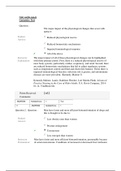
Test Bank for Biology 11th Edition By Raven Full Chapters 2024/2025. The Nature of Molecules and the Properties of Water Multiple Choice Questions 1. Matter is composed of: A. molecules B. mass C. energy D. atoms Blooms Level: 1. Remember Gradable: automatic LO: 02.01.01 Define an element based on its composition. Section: 02.01 Topic: The Nature of Atoms 2. All atoms possess the ability to do work. The term that is defined as the ability to do work is: A. matter B. energy C. molecules D. space Blooms Level: 1. Remember Gradable: automatic LO: 02.01.02 Describe how atomic structure produces chemical properties. Section: 02.01 Topic: The Nature of Atoms Chapter 02 - The Nature of Molecules and the Properties of Water 2-2 3. The number of protons in a given atom is equal to its: A. neutron number B. mass C. atomic number D. molecular number Blooms Level: 1. Remember Gradable: automatic LO: 02.01.02 Describe how atomic structure produces chemical properties. Section: 02.01 Topic: The Nature of Atoms 4. Isotopes that are unstable and decay when their nucleus breaks up into elements with lower atomic numbers, emitting significant amounts of energy in the process, are called: A. energetic B. ionic C. radioactive D. isometric Blooms Level: 1. Remember Gradable: automatic LO: 02.01.02 Describe how atomic structure produces chemical properties. Section: 02.01 Topic: The Nature of Atoms 5. Atoms containing a specific number of protons are called: A. molecules B. minerals C. metals D. elements Blooms Level: 1. Remember Gradable: automatic LO: 02.02.01 Relate atomic structure to the periodic table of the elements. Section: 02.02 Topic: Elements Found in Living Systems Chapter 02 - The Nature of Molecules and the Properties of Water 2-3 6. Sugars dissolve well in water because of water's ______. A. polarity B. ionic bonds C. hydrophobic exclusion D. cohesiveness Blooms Level: 2. Understand Gradable: automatic LO: 02.03.03 Contrast polar and nonpolar covalent bonds. Section: 02.03 Topic: The Nature of Chemical Bonds 7. The negative logarithm of the hydrogen ion concentration in the solution is referred to as: A. pH B. atomic mass C. -OH concentration D. electronegativity E. specific heat Blooms Level: 1. Remember Gradable: automatic LO: 02.06.01 Define acids, bases, and the pH scale. Section: 02.06 Topic: Acids and Bases 8. Bicarbonate ions in the blood can absorb hydrogen ions, keeping pH balanced. Bicarbonate is acting as a ____ in blood. A. acid B. alkaline C. buffer D. base Blooms Level: 2. Understand Gradable: automatic LO: 02.06.01 Define acids, bases, and the pH scale. Section: 02.06 Topic: Acids and Bases Chapter 02 - The Nature of Molecules and the Properties of Water 2-4 9. Atomic nuclei contain protons and _______. A. moles B. neutrons C. isomers D. ions Blooms Level: 1. Remember Gradable: automatic LO: 02.01.01 Define an element based on its composition. Section: 02.01 Topic: The Nature of Atoms 10. Carbon-12, Carbon-13 and Carbon-14 are examples of: A. ions B. isomers C. molecules D. isotopes Blooms Level: 1. Remember Gradable: automatic LO: 02.01.02 Describe how atomic structure produces chemical properties. Section: 02.01 Topic: The Nature of Atoms 11. Organisms are composed of molecules, which are collections of smaller units, termed: A. monomers. B. atoms. C. electrons. D. polymers. E. ions. Blooms Level: 1. Remember Gradable: automatic LO: 02.01.01 Define an element based on its composition. Section: 02.01 Topic: The Nature of Atoms Chapter 02 - The Nature of Molecules and the Properties of Water 2-5 12. Negatively charged subatomic particles that have almost no mass are called: A. electrons. B. protons. C. neutrons. D. ions. E. polymers. Blooms Level: 1. Remember Gradable: automatic LO: 02.01.03 Explain where electrons are found in an atom. Section: 02.01 Topic: The Nature of Atoms 13. Atoms of a single element that possess different numbers of neutrons are called: A. isomers. B. polymers. C. ions. D. isotopes. E. monomers. Blooms Level: 1. Remember Gradable: automatic LO: 02.01.02 Describe how atomic structure produces chemical properties. Section: 02.01 Topic: The Nature of Atoms 14. Cl + e- Clis an example of a: A. polymerization. B. ionization. C. reduction. D. oxidation. Blooms Level: 2. Understand Gradable: automatic LO: 02.01.03 Explain where electrons are found in an atom. Section: 02.01 Topic: The Nature of Atoms Chapter 02 - The Nature of Molecules and the Properties of Water 2-6 15. When atoms gain or lose electrons, they become negatively or positively charged. These negatively or positively charged atoms are known as A. isotopes. B. ions. C. isomers. D. unstable atoms. Blooms Level: 2. Understand Gradable: automatic LO: 02.03.01 Predict which elements are likely to form ions. Section: 02.03 Topic: The Nature of Chemical Bonds 16. When two atoms share a pair of electrons, the bonding is referred to as: A. ionic. B. covalent. C. unstable. D. hydrogen. Blooms Level: 1. Remember Gradable: automatic LO: 02.03.02 Explain how molecules can be built from atoms joined by covalent bonds. Section: 02.03 Topic: The Nature of Chemical Bonds 17. Water molecules are polar with ends that exhibit partial positive and negative charges. These opposite charges allow water molecules to attract each other through: A. ionic bonds. B. covalent bonds. C. hydrogen bonds. D. peptide bonds. Blooms Level: 2. Understand Gradable: automatic LO: 02.04.01 Relate how the structure of water leads to hydrogen bonds. Section: 02.03 Topic: The Nature of Chemical Bonds Chapter 02 - The Nature of Molecules and the Properties of Water 2-7 18. An atom has 20 electrons and 20 neutrons. What is the mass of this atom? A. 10 B. 20 C. 40 D. 80 Clarify Question What is the key concept addressed by the question? The question asks about calculating the mass of an atom. What type of thinking is required? You are being asked to apply the definition of atomic mass to calculate an atomic mass. What key words does the question contain and what do they mean? o Atomic mass is the sum of the masses of protons and neutrons in an atom. We assume the mass of electrons is so small it doesn’t contribute to total mass. Gather Content What do you know about atomic mass? How does it relate to the question? o The masses of a proton and of a neutron are both 1. Consider Possibilities
Gekoppeld boek
Geschreven voor
- Instelling
- Biology 11th Edition
- Vak
- Biology 11th Edition
Documentinformatie
- Geüpload op
- 8 maart 2024
- Aantal pagina's
- 203
- Geschreven in
- 2023/2024
- Type
- Tentamen (uitwerkingen)
- Bevat
- Vragen en antwoorden
Onderwerpen
- biology 11th edition
- full chapters
- latest 2024
-
test bank for biology 11th edition by raven