CCI RCIS Exam (Latest 2024/ 2025 Update) Questions and Verified Answers| 100% Correct| Grade A
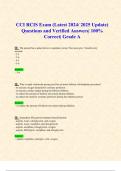
CCI RCIS Exam (Latest 2024/ 2025 Update) Questions and Verified Answers| 100% Correct| Grade A Q: The patient has a pulse but is in respiratory arrest. You must give 1 breath every seconds. - 2-3 - 3-4 - 4-5 - 5-6 Answer: - 5-6 Q: Why is rapid ventricular pacing used for an aortic balloon valvuloplasty procedure? - to increase oxygen demand for coronary perfusion - to increase cardiac output during the balloon inflation - to reduce the amount of balloon movement during inflation - to reduce the need for coronary perfusion during the inflation period Answer: - to reduce the amount of balloon movement during inflation Q: Immediate ED general treatment should include - aspirin, Lasix, nitroglycerin, and oxygen - aspirin, Lasix, morphine, and nitroglycerin - aspirin, morphine, nitroglycerin, oxygen - aspirin, fibrinolytic, morphine, and nitroglycerin Answer: - aspirin, morphine, nitroglyc- erin, oxygen Q: The term "standard precautions" refers to . - informed consent - aseptic technique - advanced directives - personal protective equipment Answer: - personal protective equipment Q: Which atherectomy catheters shave and sand away plaque? - orbital and directional - vascular and intraspinal - sculpting balloon and stent - cutting balloon and infusion catheter Answer: - orbital and directional Q: What type of catheter is used for a thrombectomy? - ablation - perfusion - extraction - rotational Answer: - extraction Q: One advantage of using a percutaneous left ventricular assist device is that they - do not decrease preload - require a small sheath size - eliminate the need to treat ischemic lesions - provide perfusion regardless of patient's intrinsic rate Answer: - provide perfusion regardless of patient's intrinsic rate Q: Given the following hemodynamic data for a patient at rest, what is the mean arterial pressure? Systolic pressure 140 mmhg Diastolic pressure 80 mmhg - 60 - 80 - 100 - 110 Answer: - 100 Q: A "Waterhammer Pulse" is caused by what valvular disease? - aortic stenosis - mitral stenosis - aortic insufficiency - mitral regurgitation Answer: - aortic insufficiency Q: When transferring a patient to the recovery area or back to their room, what should be the action for the person who achieved hemostasis of the procedure site? - thank the patient for having their procedure with your facility and get the room ready for the next patient - Confirm the transporter knows how to hold manual pressure in case the hemostasis site starts to bleed during transport to recovery/ patient room - Discuss the site with the transporter to pass the details forward and remind the patient to keep the affected site still and relaxed during their recovery - go with the patient and physically show the receiving RN the site to discuss any hemostasis details such as vessel, sheath size, and hematoma concerns-
École, étude et sujet
- Établissement
- CCI RCIS
- Cours
- CCI RCIS
Infos sur le Document
- Publié le
- 8 mars 2024
- Nombre de pages
- 39
- Écrit en
- 2023/2024
- Type
- Examen
- Contient
- Questions et réponses
Sujets
- cci rcis
-
cci rcis exam latest update questions
-
when transferring a patient to the recovery area o
-
the patient has a pulse but is in respiratory arre

Document également disponible en groupe