LOMA 281 Practice Test with Complete Solutions
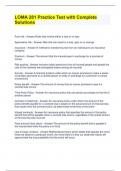
LOMA 281 Practice Test with Complete Solutions Pure risk - Answer-Risks that involve either a loss or no loss Speculative risk - Answer-Risk that can result in a loss, gain or no change Insurance - Answer-A method for transferring risk from an individual to an insurance company Premium - Answer-The amount that the insured pays in exchange for a promise of money Risk pooling - Answer-Insurers collect premiums from all insured people and spread the cost of the relatively few anticipated losses among all insureds Annuity - Answer-A financial product under which an insurer promises to make a series of periodic payments to a named person or entity in exchange for a premium or series of premiums Policy benefit - Answer-The amount of money that an insurer promises to pay if a covered loss occurs Third Party Policy - Answer-An insurance policy that one person purchases on the life of another person Contract of indemnity - Answer-An insurance policy under which the amount of the policy benefit payable for a covered loss is based on the actual amount of financial loss that results from the covered event, as determined at the time of the event Valued contracts - Answer-An insurance policy that specifies the amount of the policy benefit that will be payable when a covered loss occurs, regardless of the actual amount of the loss that was incurred Face amount (face value) - Answer-The amount of the policy benefit that is payable if the insured dies while the policy is in force Law of large numbers - Answer-Mathematical theory which states that typically the more times we observe a particular event, the more likely it is that our observed results will approximate the true probability that the event will occur Reinsurance - Answer-Insurance that one insurance company (the direct writer) purchases from another insurance company (the reinsurer) to transfer all or part of the risk on insurance policies that the direct writer has insured Retention limit - Answer-The maximum amount of insurance that an insurer is willing to carry at its own risk without transferring some of the risk to a reinsurer. The direct writer cedes anything above that limit to a reinsurer in a reinsurance transaction of other risk transfer mechanisms Direct writer - Answer-The insurance company that purchases reinsurance to transfer all or part of the risks on insurance policies the company issued Retrocessionaire - Answer-A reinsurance company that accepts risks transferred from another reinsurer in a reinsurance transaction Medical risk factor - Answer-A physical or psychological characteristic that may increase the likelihood of loss Moral hazard - Answer-A characteristic that exists when the reputation, financial position, or criminal record of an application or a proposed insured indicates that the person may act dishonestly in the insurance transaction Antiselection - Answer-The tendency of individuals who believe they have a greater than average likelihood of loss to seek insurance protection to a greater extent than do other individuals Risk class - Answer-A grouping of insureds who represent a similar level of risk to the insurer Preferred Risks - Answer-A proposed insured who presents a significantly lower than average likelihood of loss Substandard risk - Answer-A proposed insured who has a significantly greater than average likelihood of loss but is still found to be insurable Substandard premium rates - Answer-A higher than standard premium rate charged insureds who are classified as substandard rates Preferred premium rates - Answer-A lower than standard premium rate charged insureds who are classified as preferred risks Declined risks - Answer-A proposed insured who is considered to present a risk that is too great for the insurer to cover Stock insurer - Answer-Can issue shares of stock, owned by stockholders who have voting rights in the company, stockholders may receive shares of operating profits (stock dividends) Mutual insurer - Answer-Owned by policy owners, policy owners have membership rights (voting rights), policy owners may periodically receive an amount of money known as a policy dividend Fraternal benefit society - Answer-Owned by members of a fraternal lodge system, provides social and insurance benefits only to fraternal members and their families, legally required to have a representative form of government Solvent - Answer-A company with the financial capacity to pay its debts and contractual obligations when due Dodd-Frank Act - Answer-legislation passed in 2010 reforming regulation of financial institutions Federal insurance office - Answer-A new federal agency created by the Dodd Frank Act with the federal authority to monitor the insurance industry State insurance department - Answer-An administrative agency in each state that is responsible for making sure that companies operating in the state comply with applicable regulatory requirements Insurance commissioner - Answer-The individual responsible for directing the operations of the state insurance department National association of insurance commissioners (NAIC) - Answer-A nongovernmental association of the insurance commissioners of all the states whose primary function is to promote uniformity of state insurance regulation by developing model laws and regulations as guidelines for the states
École, étude et sujet
- Établissement
- LOMA 281
- Cours
- LOMA 281
Infos sur le Document
- Publié le
- 7 mars 2024
- Nombre de pages
- 23
- Écrit en
- 2023/2024
- Type
- Examen
- Contenu
- Questions et réponses
Sujets
- loma 281
- loma 281 practice test
-
loma 281 practice test with complete solutions

Document également disponible en groupe