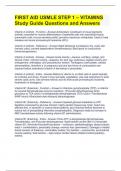
FIRST AID USMLE STEP 1 – VITAMINS Study Guide Questions and Answers
Vitamin A (retinol) - Function - Answer-Antioxidant; constituent of visual pigments (retinal); essential for normal differentiation of epithelial cells into specialized tissue (pancreatic cells, mucus-secreting cells); prevents squamous metaplasia. Used to treat measles and acute promyelocytic leukemia (APL). Vitamin A (retinol) - Deficiency - Answer-Night blindness (nyctalopia); dry, scaly skin (xerosis cutis); corneal degeneration (keratomalacia); Bitot spots on conjunctiva; immunosuppression. Vitamin A (retinol) - Excess - Answer-Acute toxicity—nausea, vomiting, vertigo, and blurred vision. Chronic toxicity—alopecia, dry skin (eg, scaliness), hepatic toxicity and enlargement, arthralgias, and pseudotumor cerebri. Teratogenic (cleft palate, cardiac abnormalities), therefore a ⊝ pregnancy test and two forms of contraception are required before isotretinoin (vitamin A derivative) is prescribed. Vitamin A (retinol) - Extra - Answer-Retinol is vitamin A, so think retin-A (used topically for wrinkles and Acne). Found in liver and leafy vegetables. Use oral isotretinoin to treat severe cystic acne. Use all-trans retinoic acid to treat acute promyelocytic leukemia. Isotretinoin is teratogenic. Vitamin B1 (thiamine) - Function - Answer-In thiamine pyrophosphate (TPP), a cofactor for several dehydrogenase enzyme reactions: +Pyruvate dehydrogenase (links glycolysis to TCA cycle) +α-ketoglutarate dehydrogenase (TCA cycle) +Transketolase (HMP shunt) +Branched-chain ketoacid dehydrogenase Vitamin B1 (thiamine) - Deficiency - Answer-Impaired glucose breakdown p ATP depletion worsened by glucose infusion; highly aerobic tissues (eg, brain, heart) are affected first. In alcoholic or malnourished patients, give thiamine before dextrose to reduce risk of precipitating Wernicke encephalopathy. Diagnosis made by increase in RBC transketolase activity following vitamin B1 administration. Vitamin B1 (thiamine) - Extra - Answer-Think ATP: α-ketoglutarate dehydrogenase, Transketolase, and Pyruvate dehydrogenase. Spell beriberi as Ber1Ber1 to remember vitamin B1. Wernicke-Korsakoff syndrome —confusion, ophthalmoplegia, ataxia (classic triad) + confabulation, personality change, memory loss (permanent). Damage to medial dorsal nucleus of thalamus, mammillary bodies. Dry beriberi —polyneuritis, symmetrical muscle wasting. Wet beriberi —high-output cardiac failure (dilated cardiomyopathy), edema.
Written for
- Institution
- USMLE
- Course
- USMLE
Document information
- Uploaded on
- March 6, 2024
- Number of pages
- 5
- Written in
- 2023/2024
- Type
- Exam (elaborations)
- Contains
- Questions & answers
Subjects
-
first aid usmle step 1 vitamins study guide ques
-
vitamin a retinol function answer antioxidan

Also available in package deal