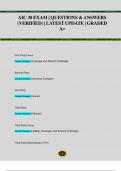
AIC 30 EXAM | QUESTIONS & ANSWERS (VERIFIED) | LATEST UPDATE | GRADED A+
1 AIC 30 EXAM | QUESTIONS & ANSWERS (VERIFIED) | LATEST UPDATE | GRADED A+ First Party Focus Correct Answer: Coverage and Amount of damage Second Party Correct Answer: Insurance Company First Party Correct Answer: Insured Third Party Correct Answer: Claimant Third Party Focus Correct Answer: Liability, Coverage, and Amount of damage Third Party Administrator (TPA) 2 Correct Answer: an organization that provides admin services associated with risk financing and insurance. They handle claims and risk management for self-insured organizations Independent Adjuster Correct Answer: handles claims for the insurer for a fee. Works for the insurer Public Adjuster Correct Answer: an outside organization that is hired by the insured to represent the insured in the claim for a fee. Works for the public Quantitative Measures Correct Answer: can have actual numbers assigned, such as number of claims opened and percentage of subrogation recovery Qualitative Measures Correct Answer: related to intangible measures. nothing concrete, did they do a good job? do they have good negotiation skills? Ethics Correct Answer: the study of what constitutes good and bad behavior, dealing with the moral duty and obligation Conflict of Interest 3 Correct Answer: a situation that occurs when a decision makers personal interests interfere to the extent that he/she makes decisions that adversely affect the customer, claimant, or employer Ex Parte Contract Correct Answer: contracts in which only 1 party is heard. discussing the claim with the represented person without benefit of their attorney being involved. this is not illegal, but its not ethical. Fraud Correct Answer: an intentional misrepresentation resulting in harm to another person or organization Code of Ethics Correct Answer: professional guidelines of behavior within an organization or profession N.A.I.C Correct Answer: The National Association of Insurance Commissioners Model Laws Correct Answer: NAIC develops that they feel is an appropriate law related to insurance/risk management Model Laws - Goal 4 Correct Answer: to standardize the laws related to insurance, to address issues related to insurance Unfair Claims Settlement Practice Act Correct Answer: to prevent insurance companies from taking unfair advantage of the insured/claimants Reservations of Rights Letter Correct Answer: an insurer's letter that specifies coverage issues and informs the insured that the insurer is handling a claim with the understanding that the insurer may later deny coverage should the facts warrant it. Waiver Correct Answer: the intentional/unintentional relinquishing (give up) of a known right. (written, verbally, or by actions taken) Estoppel Correct Answer: a legal principal that prohibits a party from asserting a claim or a right once it has been waived and the other party relied upon that information to their detriment. Non Waiver Agreement Correct Answer: a signed agreement indicating that during the course of the investigation, neither the insurer nor the insured waives their rights under the policy, the insured is to sign and return the agreement 5 Legal Liability Correct Answer: the legally enforceable obligation for a person or organization to pay a sum of money (damages) to another person or organization Statutory Law Correct Answer: the formal law or statutes enacted by legislative bodies such as congress, the state legislature, the Senate, or the town council Negligence Correct Answer: the failure to exercise due care that a reasonable person would do in a similar situation to avoid harming others Four Parts of Negligence Correct Answer: - a duty owed to protect (or not go out of your way to harm) another party. - a breach of that duty - damage or injury occurs, - the damage or injury was a direct result of the breach of the duty. Contributory Negligence Correct Answer: a common-law principal that prevents a person who has been harmed from recovering damages if that person's own negligence in any way contributed to the harm Comparative Negligence 6 Correct Answer: a common-law principal that requires both parties to a loss to share in the financial burden of the bodily injury or property damage according to their respective degrees of fault. Strict Liability Correct Answer: what you are doing is so inherently dangerous, if anything goes wrong you are held liable. You may have done everything you can to protect the others, but if anything goes wrong, you still pay. Intentional torts Correct Answer: doing something on purpose to harm another. Slander, libel, invasion of privacy, false arrest, assault, battery, etc.. Direct Loss Correct Answer: a reduction in the value of property that results directly and immediately in the loss of value from damage to the property or injury to the person Indirect Loss Correct Answer: a loss that arises as a result of damage to property or injury to a person, other than the direct loss. Example: Loss of Salary for an injury, loss of use of the house causing you to rent another place to stay Pro Rata Contribution 7 Correct Answer: an approach to other insurance by which the insurers contribute to the loss in the proportion to which they contribute to the total amount of coverage purchased. (their limits of liability) Insurable Interest Correct Answer: an ownership in the property that is not unduly remote, and if lost would cause the person financial harm if an insured event occurred. Compensatory Damages Correct Answer: designed to make the person whole again. Awarded to reimburse for actual harm Special Damages Correct Answer: a part of compensatory damages, that awards a sum of money to reimburse for "quantifiable" bills. General Damages Correct Answer: a monetary award to compensate a victim for "qualitative" injuries such as pain and suffering, scar tissue, loss of consortium. Punitive (Exemplary) Damages Correct Answer: designed to punish and prevent further deceitful, reckless, or malicious actions. As they are designed to punish, they need to bear any relationship to the party's actual damages. 8 Coinsurance Clause Correct Answer: requires the insured to carry insurance equal to at least a specified percentage of the insured property value. ADR - Alternative Dispute Resolution Correct Answer: Procedures to help settle disputes without litigation. Ex: Arbitration, formal appraisal, mini-trial, summary jury trials, and mediation. (or negotiation, but no dispute) Mediation Correct Answer: facilitated negotiation - nonbinding. An alternative to going into litigation, used when negotiation breaks down. Arbitration Correct Answer: An ADR, when disputing parties agree to select a neutral or proceed to an organization that provides an arbitrator to act as a judge. this outside party issues a ruling, and is binding and final. Appraisal Clause Correct Answer: ADR option that prescribes their expert, our expert and the experts select a neutral they feel is an expert in the field. The matter is discussed, and when any 2 of the 3 agree, the matter is selected and is binding and final. Mini-Trial 9 Correct Answer: ADR - the case undergoes an abbreviated version of a trial before a panel or an advisor who poses questions, and offers opinions on the outcome of a trial based on the evidence presented. Both sides may participate, but they do not have to. The goal is to show the strengths and weaknesses before trial, and in so doing aid in a negotiated agreement Summary Jury Trial (Mock Jury Trial) Correct Answer: ADR in which disputing parties participate in an abbreviated trial, presenting evidence of a few witness to a panel of Mock Jurors who decide the case. (non binding) Again, show weaknesses and facilities negotiation. Reserve Correct Answer: the amount the insurer estimates and sets aside to pay on a claim that has not been settled Individual Case Method Correct Answer: the adjuster sets the reserve based on the facts of the case, and the adjusters experience with similar claims Roundtable Method Correct Answer: a method of setting a reserve by having two or more individuals review the file, discuss and develop a consensus for the reserve Average Value Method 10 Correct Answer: a predetermined reserve is established for each claim as it is reported. Some will be over that amount, some will be under. It is an average expected payment amount Formula Method Correct Answer: a reserve is set by using a mathematical formula. Applies a relationship for amount of medical treatment received, wage loss, etc. Using the total of those, developing an amount of compensation. Proof of Loss Correct Answer: a statement of facts related to the loss for which the insured is making a claim. (condition of the policy) IME - Independent Medical Examination Correct Answer: a direct intervention, at the request of the insurer - the injured party must attend as a condition of the policy, an exam by a like specialty, to provide a history and allow a physical exam to determine if the treatment is medically necessary, and related to the insured loss, and if further treatment is required Expert System Correct Answer: Using a software application to set a reserve based on information entered IBNR - Incurred But Not Reported 11 Correct Answer: claims in which the loss has happened but they have not as yet been reported. Loss Ratio Method Correct Answer: to set a reserve for losses that have been incurred but not reported, the insurer establishes a reserve based on the anticipated losses over a period of time for a certain type of insurance Spoliation of evidence Correct Answer: a violation of the duty to preserve evidence, for possible pending future litigation. the loss or destruction has to be the fault of the accused party. Jurors will be instructed to view the "missing" evidence in the worst possible light. Spoliation defenses Correct Answer: was not relevant to the case, can be reconstructed, a reasonable opportunity to examine the evidence was made before it was destroyed. Direct Question Correct Answer: answered by yes or no Open Ended Question Correct Answer: requires elaboration/opinion/explanation ads to the circumstances under consideration Narrative Statement 12 Correct Answer: the person provides the information similar to telling a story. Leading Questions Correct Answer: questions that direct a person to an answer (you were not speeding, were you?) Loaded Questions Correct Answer: designed in intimidate/entrap the person. (you had a car stolen this time last year didn't you) Sworn Statement Correct Answer: a statement in which the person has attested that the information is true EUO - Examination Under Oath Correct Answer: a statement in which the person has sworn to tell the truth in the presence of an officer of the court Deposition Correct Answer: a pretrial discovery tool involving the oral examination of a witness, to produce a written verbatim record, usually with attorneys and a court reporter present ISO Correct Answer: Insurance Services Organization 13 NCCI Correct Answer: National Council on Compensation Insurance. Workers Comp insurance information NMVTIS Correct Answer: National Motor Vehicle Title Information System. To prevent the reintroduction of stolen vehicles to the market NICB Correct Answer: National Insurance Crime Bureau. A non-profit organization to prevent, detect and defeat insurance fraud Loss History Correct Answer: a list of all the past claims for an individual or organization. Includes amounts paid, amounts reserved and current claim status. Loss Reserve Correct Answer: an estimate of the amount of money the insurer expects to pay out on the claim. (includes IBNR claims) Loss Ratio Correct Answer: Losses and loss adjustment expenses against the earned premiums. this reflects the amount of premium that has not been consumed by loss 14 Expense Ratio Correct Answer: the amount of operational expenses against the written premium. Shows how much of the premium for the year, is being consumed by cost of doing business Combined Ratio Correct Answer: by adding together the loss ratio and the expense ratio, you have a combined ratio. The combined ratio indicates if you have an underwriting gain or loss. Was the premium charged enough to cover the losses and expenses incurred by the company Sender Correct Answer: the person that is sending the message / initiating the communication process Receiver Correct Answer: the person that gets the message and interprets it. Verbal or non-verbal intentional or unintentional. Initial Credibility Correct Answer: the degree to which the person is believed before the conversation begins Derived Credibility Correct Answer: the perceived believability of the person during the conversation. 15 Terminal Credibility Correct Answer: how believable were they after the end of the conversation Message Correct Answer: the words a sender uses in the communication process Encoding Correct Answer: the process of translating the message once sent Medium Correct Answer: the means a message was transmitted. written, oral, non-verbal, intentional, and unintentional Decoding Correct Answer: the interpretation of the message by the receiver Active Listening Correct Answer: listening with openness, both physical and mental, to determine the meaning. Non Verbal Communication Correct Answer: communication that is not written or oral..includes posture, eye movements, facial expressions, smells, and appearance 16 Insurance Fraud Correct Answer: Any deliberate act of deception committed against an insurance producer or insurer for the purpose of unwarranted financial gain Motives for Insurance Fraud Correct Answer: financial gain, profit or savings. sense of entitlement. participation in organized crime Material Fact in Insurance Correct Answer: a fact that would have affected the insurer's decision to provide coverage or coverage at the cost of the premium, maintain a policy, or to pay a claim Staged Accident Correct Answer: and accident deliberately caused by a person who intends to fake injury and collect Hard Fraud (Moral Hazard) Correct Answer: Action undertaken to deliberately defraud. Soft Fraud (Morale Hazard) Correct Answer: fraud that occurs when a legitimate claim is exaggerated. Misrepresentation 17 Correct Answer: a false statement of a material fact, knowingly made, with the intent to decieve Concealment Correct Answer: an intentional failure not to disclose a material fact Pre Inspection Laws Correct Answer: Vehicles (and homes in many cases) must be physically inspected for prior damage to insurance policies being issued Mandatory reporting Correct Answer: states require insurance companies to report claims that raise suspicions Immunity Laws Correct Answer: Designed to protect insurers, and claims representatives for reporting possible insurance fraud if the report is made without malice, fraud or criminal misconduct Civil and Criminal Penalties Correct Answer: Makes insurance fraud a crime Motor Vehicle Theft Law Enforcement Act of 1984 18 Correct Answer: Required VIN numbers on all vehicles for theft reporting and identification of stolen vehicles Anti Car Theft Act of 1992 Correct Answer: Dealing with stolen car parts and stolen vehicles is now a federal crime US Mail Fraud Statute Correct Answer: using the mail to commit insurance fraud is a federal crime False Representation Statute Correct Answer: Allows the post office to hold the mall anyone found by the postal inspectors to be committing fraud. CAIF - Coalition Against Insurance Fraud Correct Answer: a diverse group of commissioners, insurers, legislators, and regulators banding together to detect, prosecute and deter insurance fraud Win - Lose Correct Answer: we win, they lose. They committed fraud, they got caught Win - Win Correct Answer: Both sides of the negotiation walk away happy 19 Lose - Win Correct Answer: We were at fault, we know we will pay the claim, but to earn a little good will we make an advanced payment for bills presented to make the injured parties life a little easier Lose - Lose Correct Answer: an agreement cant be reached, it goes into litigation. Neither party is concerned about a "good" outcome, it is an adversarial postion The 4 Steps of Negotiation Correct Answer: 1. Prepare 2. Develop and evaluate alternative outcomes 3. identify and evaluate each parties interests 4. Make concessions to achieve an appropriate resolution. Crisis Phase Correct Answer: concerned about returning to normal Motivational Phase Correct Answer: recognition of the financial implication of the loss Bargaining Phase Correct Answer: each side evaluates and determines positions, disagreements may arise. The claim is in the process of being settled 20 Principal of Yes Correct Answer: a sales technique by getting the person to agree, they have a tendency to continue to agree Choicing Correct Answer: offering a choice between one or the other Trading in dollars Correct Answer: often adjusters forget to look at the facts of the claim and begin to see "money" and fail to see other possible settlement options Summons Correct Answer: a notification to the defendant that the have been named to a law suit. Delivery by a specified means, ids the amount of the suit and amount of time limited to answer Complaint Correct Answer: the allegation made in the law suit Answer Correct Answer: the defendants response to the complaint Pleading 21 Correct Answer: a formal written statement of facts and claims of each party to the law suit Discovery Correct Answer: the pretrial exchange of information between the plaintiff and the defendant Jurisdiction Correct Answer: a particular courts power to hear and decide a lawsuit within a certain territory Venue Correct Answer: the location of the law suit Service of Process Correct Answer: the delivery of the summons and complaint to the defendant by an authorized person Actual Service Correct Answer: hand delivery of a summons and complaint to a defendant Substituted service (Constructive Service) Correct Answer: any method of delivery to the defendant of the summons and complaint. (ex: giving to receptionist if at a corporation) 22 Allegation Correct Answer: a claim made in the complaint specific to what the plaintiff expects to prove and how much money (damages) they want from the defendant Counter Claim Correct Answer: a complaint brought by the defendant against the plaintiff Default Judgement Correct Answer: an automatic judgement against a party to a law suit who fails to appear in court to answer a pleading Request for document production Correct Answer: a request made by the opposing side to provide all documents and other tangible evidence it has in its possession relating to the facts of the case Interrogatories Correct Answer: specific written questions or requests raised by one party to the law suit that the opposing party must answer in writing Admissions Correct Answer: factual statements that unless denied, bind the party to the trail State Decisis 23 Correct Answer: the principal that a lower court must follow the ruling (precedent) of a higher court Motion Correct Answer: a formal request for an action to be taken Motion to dismiss Correct Answer: a formal request that the court terminate an action because of settlement, voluntary withdawl of the action, or procedural defect Motion for Summary Judgement Correct Answer: a pretrial request for a court to render a judgement when there are no material facts in dispute. Has to be related to an actual case, and the decision has to have merit or be material to the case at hand Motion in limine Correct Answer: a pretrial request for some information to be withheld from trial. reasons: highly prejudicial, it was cumulative (part of a larger group of the same material) and the fact was not in controversy (it was already agreed to) Voir Dire Correct Answer: the process of selecting potential jurors. examining them for prejudices, and interests in the matter Burden of Proof 24 Correct Answer: the duty to prove the facts, to what extent - beyond a reasonable doubt for criminal, preponderance of evidence for civil actions Preponderance of Evidence Correct Answer: the jury feels the evidence supported the opinion the person did it Litigation Plan Correct Answer: How the litigation should proceed. Settle it? Fight it? Negotiate? Flat Fee Correct Answer: the attorney handles the case for one flat amount of money Phased Fee Correct Answer: attorney charges for each task (phase) of the litigation Breach of Contract Correct Answer: failure to, without a legal excuse, fulfill the agreement as contracted Good Faith Correct Answer: the representative gives the interested of the insured at least as much consideration as that of the insurer Bad Faith Claims 25 Correct Answer: actual or constructive fraud, designed to mislead, or deceive another, or neglect or refusal to fulfill a duty, contractually agreed upon, without legal reason Defendant Correct Answer: the party in a law suit against whom the complaint is filed Plaintiff Correct Answer: the person or entity that files a law suit Contractual Damage Correct Answer: the amount payable under the terms of the contract Consequential Damages Correct Answer: an award by the court, to indemnify an injured party for losses that result directly from a wrong such as breach of contract or a tort. Statue of Limitation Correct Answer: a statute (law) that requires a lawsuit to be filed within a specific timeframe after which the cause of action has accrued, which is often when the injury occurred or was discovered Defenses to bad faith 26 Correct Answer: statue of limitations, lack of legal standing (right to sue), reliance on lawyers advice, insureds collusion with the claimant, debatable reasonableness, statutory defenses, fair dealing and good documents, comparative bad faith Summary Judgement Correct Answer: ...
Written for
- Institution
- AMERICAN INSTITUTE OF COOPERATIVES
- Course
- AMERICAN INSTITUTE OF COOPERATIVES
Document information
- Uploaded on
- March 4, 2024
- Number of pages
- 26
- Written in
- 2023/2024
- Type
- Exam (elaborations)
- Contains
- Questions & answers
Subjects
-
aic 30 exam questions answers verified la

Also available in package deal