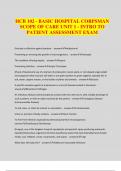
HCB 102 - BASIC HOSPITAL CORPSMAN SCOPE OF CARE UNIT 1 - INTRO TO PATIENT ASSESSMENT EXAM
HCB 102 - BASIC HOSPITAL CORPSMAN SCOPE OF CARE UNIT 1 - INTRO TO PATIENT ASSESSMENT EXAM Directed or effective against bacteria. - answerAntibacterial Preventing or arresting the growth of microorganisms. - answerAntiseptic The condition of being aseptic. - answerAsepsis Preventing infection. - answerAseptic Technique (Plural of bacterium) any of a domain of prokaryotic round, spiral, or rod shaped singel-celled microorganism that may lack cell walls or are gram-positive or gram-negative, typically live in soil, water, organic matter, or the bodies of plants and animals. - answerBacteria A specific causative agent (as a bacterium or virus) of disease located in the blood. - answerBlood-born Pathogen An infectious disease communicable by contact with one who has it, with a bodily discharge of such a patient, or with an object touched by the patient. - answerContagious Disease (Communicable Disease) To soil, stain, or infect by contact or association. - answerContaminated Union or junction of body surfaces. - answerDirect Contact To free from infection especially by destroying harmful microorganisms. - answerDisinfectant/ Disinfection (Fungus), any of the kingdom Fungi of saprophytic and parasitic spore-producing eukaryotic typically filamentous organisms formerly classified as plants that lack chlorophyll and include molds, rust, mildews, smuts, mushrooms, and yeasts. - answerFungi What does HAI stand for? - answerHealthcare Associated Infections HAIs are also known as ________. - answerNosocomial Infections HAIs, also known as a nosocomial infection; acquired or occurring in a hospital. - answerHealthcare Associated Infections An infective agent or material contaminated with an infective agent. - answerInfection A separation for the period of communicability of infected people or animals from others, so as to prevent or limit the direct or indirect transmission of the infectious agent from those who are infected to those who are susceptible. - answerIsolation An organism of microscopic or ultramicroscopic size. - answerMicroorganism A group of infection prevention practices that apply to all patients, regardless of suspected or confirmed diagnosis or presumed infection status. - answerStandard Precautions A disease producing microorganisms. - answerPathogen Microorganisms that are present in human blood, and can cause disease in humans (e.g., HIV hepatitis A, and Hepatitis B). - answerBlood-borne Pathogens These microorganisms can be transmitted from __________ to ___________, provider to __________________, and ____________________ to patient. - answerPatient, provider, patient, equipment Microorganisms that are transported through the air (e.g., Tuberculosis) - answerAirborne Pathogens A sequence of circumstances where all events must occur to develop an infection. - answerChain of Infection Disease causing microorganism - answerInfectious Agent (Pathogen) Name the common types of infectious agents. - answerBacteria, Viruses, Protozoa, Fungi, Helminthes A place where the pathogen grows (e.g., patient, staff member, animal, food) and may or may not multiply - answerReservoir An exit route for pathogens to leave its host (e.g., blood, skin, mucous membranes, respiratory tract, genitourinary tract, and gastrointestinal tract). - answerPortal of Exit The manner in which an infectious agent moves from one source to another (e.g., touch, airborne droplets, medical instruments, mosquitoes, vermin) - answerMode of Transmission What does HAI stand for? - answerHospital Acquired Infection What is the most frequent source of HAIs? - answerContact What are the two types of contact? - answerDirect and Indirect Contact Person to person or physical contact between source and susceptible host (e.g., fecal, oral) - answerDirect Contact Involves contact with contaminated inanimate objects (e.g., needles, utensils, hospital equipment) - answerIndire
Written for
- Institution
- Navy Hospital Corpsman, HCB
- Course
- Navy Hospital Corpsman, HCB
Document information
- Uploaded on
- March 4, 2024
- Number of pages
- 19
- Written in
- 2023/2024
- Type
- Exam (elaborations)
- Contains
- Questions & answers
Subjects
-
hcb 102 basic hospital corpsman scope of care un

Also available in package deal