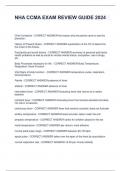
NHA CCMA EXAM REVIEW GUIDE 2024
NHA CCMA EXAM REVIEW GUIDE 2024 Chief Complaint - CORRECT ANSWER-the reason why the patient came to see the physician. History of Present Illness - CORRECT ANSWER-explanation of the CC to determine the onset of the illness. Past,family,and social history - CORRECT ANSWER-summary of personal and family health problems as well as social to include marital status, occupation, use of drugs, etc. Body Processes necessary for life: - CORRECT ANSWER-Body Temperature, Respiration, Heart Function Vital Signs of body function: - CORRECT ANSWER-temperature, pulse, respiration, blood pressure Febrile - CORRECT ANSWER-presence of fever afebrile - CORRECT ANSWER-absence of fever intermittent fever - CORRECT ANSWER-fluctuating fever that returns to or below baseline remittent fever - CORRECT ANSWER-fluctuating fever that remains elevated and does not return to baseline continuous fever - CORRECT ANSWER-fever that remains constant; does not fluctuate axillary temperature - CORRECT ANSWER-least accurate; taken under the arm tympanic temperature - CORRECT ANSWER-useful for children; placed in the ear rectal temperature - CORRECT ANSWER-per rectum; most effective normal adult pulse range - CORRECT ANSWER-between 60-100 bpm apical pulse - CORRECT ANSWER-taken over the apex of the heart by auscultation normal respiration rate - CORRECT ANSWER-12-20 per minute (Adults) apnea - CORRECT ANSWER-temporary complete absence of breathing tachypnea - CORRECT ANSWER-respiration rate greater than 40 per minute bradypnea - CORRECT ANSWER-decrease in the numbers of respiration cheyne stokes - CORRECT ANSWER-regular pattern of irregular breathing rate orthopnea - CORRECT ANSWER-decrease in numbers of respiration hypoventilation - CORRECT ANSWER-reduced amount of air enters the lungs resulting in decreased oxygen level hyperpnea - CORRECT ANSWER-abnormal increase in the depth and rate of breathing hyperventilation - CORRECT ANSWER-increased amount of air entering the lungs Systole - CORRECT ANSWER-the highest amount of pressure exerted during the cardiac cycle Diastole - CORRECT ANSWER-the lowest amount of pressure exerted during the cardiac cycle Palpation - CORRECT ANSWER-the sense of touch to determine the characteristics of an organ system Percussion - CORRECT ANSWER-tapping or striking the body to determine the position, size and density of the underlying organ/tissue Auscultation - CORRECT ANSWER-listening to sounds produced by internal organs Horizontal Recumbent Position - CORRECT ANSWER-patient lies on back w/legs extended (used for most physical exams) Dorsal Recumbent Position - CORRECT ANSWER-patient lies on back with knees flexed and soles of the feet flat on the bed Fowler's Position - CORRECT ANSWER-semi/sitting position where back of the table is elevated. D orsal Lithotomy Position - CORRECT ANSWER-patient lies on back with k
Written for
- Institution
- CCMA
- Course
- CCMA
Document information
- Uploaded on
- March 3, 2024
- Number of pages
- 11
- Written in
- 2023/2024
- Type
- Exam (elaborations)
- Contains
- Questions & answers
Subjects
- chief complaint
- 5 modes of transmission
- hematoma
-
nha ccma exam review guide 2024
-
history of present illness

Also available in package deal