
Hesi: Med Surg Evolve Exam | Questions & Answers (Verified) | Latest Update | Graded A+
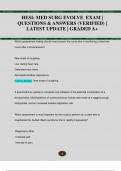
1 HESI: MED SURG EVOLVE EXAM | QUESTIONS & ANSWERS (VERIFIED) | LATEST UPDATE | GRADED A+ Which assessment finding should most concern the nurse who is monitoring a client two hours after a thoracentesis? New onset of coughing. Low resting heart rate. Distended neck veins. Decreased shallow respirations. Correct Answer: New onset of coughing. A pneumothorax (partial or complete lung collapse) is the potential complication of a thoracentesis. Manifestations of a pneumothorax include new onset of a nagging cough, tachycardia, and an increased shallow respiration rate. Which assessment is most important for the nurse to perform on a client who is hospitalized for Guillain-Barre syndrome that is rapidly progressing? Respiratory effort. Unsteady gait. Intensity of pain. 2 Ability to eat. Correct Answer: Respiratory effort. Guillain-Barre syndrome causes paralysis or weakness that typically starts at the feet and progresses upwards. As the condition progresses, the nurse must ensure that the client is able to breathe effectively. What is the primary nursing problem for a client with asymptomatic primary syphilis? Acute pain. Risk for injury. Sexual dysfunction. Deficient knowledge Correct Answer: Deficient knowledge An asymptomatic client with primary syphilis is most likely unaware of this disease, so to prevent transmission to others and recurrence in the client, the priority nursing diagnosis is deficient knowledge of the disease pathophysiology. A client with heart failure is prescribed digoxin 0.125 mg PO. The client's apical heart rate is70 beats per minute, blood pressure is 125/75 mmHg, and respirations are 18 breaths per minute. Which action should the nurse implement next? 3 Administer the medication. Inform the healthcare provider. Review the vital sign flowsheet. Reassess the apical heart rate. Correct Answer: Administer the medication. Obtaining the apical heart rate is a common parameter prior to administering digoxin, which may indicate early digoxin toxicity if the heart rate is less than 60 beats per minute, so the dose should be administered since the client is not demonstrating any signs of toxicity. A nurse is preparing to insert an IV catheter after applying an eutectic mixture of lidocaine and prilocaine (EMLA), a topical anesthetic cream. What action should the nurse take to maximize its therapeutic effect? -Rub a liberal amount of cream into the skin thoroughly. Incorrect -Cover the skin with a gauze dressing after applying the cream. -Leave the cream on the skin for 1 to 2 hours before the procedure. -Use the smallest amount of cream necessary to numb the skin surface. Correct Answer: Leave the cream on the skin for 1 to 2 hours before the procedure. Topical anesthetic creams, such as EMLA, should be applied to the puncture site at least 60 minutes to 2 hours before the insertion of an IV catheter. 4 A male client is admitted after falling from his bed. The healthcare provider (HCP) tells the family that he has an incomplete fracture of the humerus. The family ask the RN what this means. Which explanation by the nurse accurately describes the client's fracture? Straight fracture line that is also a simple, closed fracture. Nondisplaced fracture line that wraps around the bone. A complete fracture that also punctures the skin. A fracture that bends or splinters part of the bone. Correct Answer: A fracture that bends or splinters part of the bone. An incomplete fracture occurs when part of the bone is splintered (broken) and it has not gone completely through the thickness of the bone. The unlicensed assistive personnel (UAP) reports that an 87-year-old client who is sitting in a chair at the bedside has an oral temperature of 97.2°F (36.4°C). Which intervention should the nurse implement? Document the temperature reading on the vital sign graphic sheet. Report the temperature to the healthcare provider immediately. Instruct the UAP to take the client's temperature again in 30 minutes. Advise the UAP to assist the client in returning to bed. 5 Correct Answer: Document the temperature reading on the vital sign graphic sheet. A subnormal oral temperature of 97.2°F (36.4°C) is a common finding in elderly clients, so the nurse should document the findings and continue with the plan of care. The nurse is giving discharge instructions to a client with chronic prostatitis. What instruction should the nurse provide the client to reduce the risk of spreading the infection to other areas of the client's urinary tract? Wear a condom when having sexual intercourse. Avoid consuming alcohol and caffeinated beverages. Empty the bladder completely with each voiding. Have intercourse or masturbate at least twice a week Correct Answer: Have intercourse or masturbate at least twice a week. The prostate is not easily penetrated by antibiotics and can serve as a reservoir for microorganisms, which can infect other areas of the genitourinary tract. Draining the prostate regularly through intercourse or masturbation decreases the number of microorganisms present and reduces the risk for further infection from stored contaminated seminal fluids. The nurse is assessing a middle-aged male client for risk factors related to chronic illness. Which finding should the nurse assess further? 6 Thinning hair and dry scalp. Increase in appetite and taste-bud acuity. Increase in muscle tone but decreased muscle strength. Increase in abdominal fat deposits. Correct Answer: Increase in abdominal fat deposits. An increase in the abdominal girth is a risk factor for the development of metabolic syndrome. According to the American Heart Association, men with a waist size 40 inches or larger and women 35 inches or larger double their risk factor of developing CAD and increase their chances 5Xs of developing DMII. The nurse is caring for a client with multiple trauma after a motor vehicle collision. The nurse learns that the client has secondary syphilis. Which precaution should the nurse implement? A mask should be worn by anyone entering the client's room. Handwashing is required before and after contact with the client. Gloves should be worn during direct contact with the client's skin. No precautions in addition to standard precautions are necessary. Correct Answer: Gloves should be worn during direct contact with the client's skin. 7 The secondary stage of syphilis is a systemic blood-borne disease that presents with skin lesions and rashes that may drain the highly contagious spirochete, so gloves should be worn during direct contact with the client's skin. The client should be placed on contact precautions. A client with a history of hypertension, myocardial infarction, and heart failure is admitted to the surgical intensive care unit after coronary artery bypass surgery graft (CABG). The nurse determines the client's serum potassium level is 4.5 mEq/L. What action should the nurse implement? Notify the healthcare provider. Decrease the IV solution flow rate. Document the finding as the only action. Administer potassium replacement as prescribed Correct Answer: Document the finding as the only action. Coronary artery bypass surgery graft (CABG) places a client at risk for hypokalemia from hemodilution, nasogastric suction, or diuretic therapy, so the serum potassium level is maintained between 4 and 5 mEq/L to avoid dysrhythmias. Documentation of the normal finding is indicated at this time. An older female client is admitted with atrophic vaginitis and perineal cutaneous candidiasis. Which is the priority nursing diagnosis for this client? 8 Risk for injury. Impaired comfort. Disturbed body image. Ineffective health maintenance. Correct Answer: Impaired comfort. In menopausal women, the vaginal mucous membrane responds to low estrogen levels causing the vaginal walls to become thinner, drier, and susceptible to infection, which leads to atrophic vaginitis. Perineal cutaneous candidiasis contributes to other manifestations of vaginal infections, such as vaginal irritation, burning, pruritus, increased leukorrhea, bleeding, and dyspareunia, which supports the primary nursing diagnosis, "impaired comfort." The registered nurse (RN) is caring for a client with peptic ulcer disease (PUD). What assessment should the RN identify and document that is consistent with PUD? (Select all that apply). Hematemesis. Gastric pain on an empty stomach. Colic-like pain with fatty food ingestion. Intolerance of spicy foods. Diarrhea and stearrhea. 9 Correct Answer: Hematemesis (the vomiting of blood) Gastric pain on an empty stomach. Intolerance of spicy foods. Manifestations of PUD include hematemesis, gastric pain, and spicy food intolerance. A female client is recently diagnosed with Sarcoidosis. The client tells the registered nurse (RN) that she does not understand why she has this. When teaching the client, the RN should include that sarcoidosis most commonly occurs with which ethnic group of women? African American women. Caucasian women. Asian women. Hispanic women. Correct Answer: African American women. Sarcoidosis, an autoimmune inflammatory disease affecting multiple organs and has shown familial tendency due to multiple genes that together increase the susceptibility of developing the disease. In research studies it occurs more commonly in African American women (10-80 out of 100,000); compare to Caucasian women of the United States (8 out of 100,000). 10 A client's prostate-specific antigen (PSA) exam result showed a PSA density of 0.13 ng/ml. Which conclusion regarding this lab data is accurate? Probable prostatitis. Low risk for prostate cancer. The presence of cancer cells. Biopsy of the prostate is indicated. Correct Answer: Low risk for prostate cancer. Clients with a PSA density less than 0.15 ng/ml are considered at low risk for prostate cancer. The registered nurse (RN) is caring for a client who has a closed head injury from a motor vehicle collision. Which finding would indicate to the nurse that the client is at risk for diabetes insipidus (DI)? High fever. Low blood pressure. Muscle rigidity. Polydipsia. Correct Answer: Polydipsia. (intense thirst) 11 A characteristic finding of DI is excretion of large quantities of urine (5 to 20L/day), and most clients compensate for fluid loss by drinking large amounts of water (polydipsia). DI can occur when there has been damage or injury to the pituitary gland or hypothalamus as a result of head trauma, tumor or an illness such as meningitis. This damage interrupts the ADH production, storage and release causing the excessive urination and thirst. The nurse is caring for a client who returns to the unit following a colonoscopy. Which finding should the nurse report to the healthcare provider immediately? Large amounts of expelled flatus with mucus. Tympanic abdomen and hyperactive bowel sounds. Increased abdominal pain with rebound tenderness. Complaint of feeling weak with watery diarrheal stools. Correct Answer: Increased abdominal pain with rebound tenderness. Positive rebound tenderness following a colonoscopy may be an indication of a perforation and the development of peritonitis and requires follow-up immediately. Which finding should the nurse report to the healthcare provider for a client with a circumferential extremity burn? Full thickness burns rather than partial thickness. 12 Supinates extremity but unable to fully pronate the extremity. Slow capillary refill in the digits with absent distal pulse points. Inability to distinguish sharp versus dull sensations in the extremity. Correct Answer: Slow capillary refill in the digits with absent distal pulse points. A circumferential burn can form an eschar that results from burn exudate fluid that dries and acts as a tourniquet as fluid shifts occur in the interstitial tissue. As edema increases tissue pressure, blood flow to the distal extremity is compromised, which is manifested by slow capillary refill and absent distal pulses, so the healthcare provider should be notified about any compromised circulation that requires escharotomy. After a liver biopsy is performed at the bedside, the registered nurse (RN) is assigned the care of the client. Which nursing intervention is most important for the RN to implement? -Position client on left side with pillow placed under the costal margin. -Assist the client with voiding immediately after the procedure. -Evaluate vital signs q10 to 20 minutes for 2 hours after procedure. -Ambulate client 3 times in first hour with pillow held at abdomen. Correct Answer: Evaluate vital signs q10 to 20 minutes for 2 hours after procedure. Vital signs should be checked every 10 to 20 minutes to assess for bleeding after biopsy of the liver, which is highly vascular. The client should be positioned on the right 13 side with a pillow or sandbag under the costal margin and supporting the biopsy site. The client should be maintained on bedrest for several hours to decrease the risk of bleeding from the biopsy site. A couple trying to cope with an infertility problem wants to know what can be done to preserve emotional equilibrium. What is the best response for the nurse to provide? "Tell your friends and family so that they can help you." "Get involved with a support group. I will give you some names." "Talk only to other friends who are infertile since only they can help." "Start adoption proceedings immediately since obtaining an infant is very difficult." Correct Answer: "Get involved with a support group. I will give you some names." A support group provides a safe haven for the couple to share their feelings and experience, gain insight from others dealing with the same experience, and assure the couple that they are not alone in their situation.
Document information
- Uploaded on
- March 1, 2024
- Number of pages
- 13
- Written in
- 2023/2024
- Type
- Exam (elaborations)
- Contains
- Questions & answers


