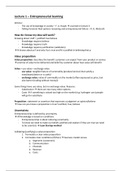
Lecture 1 – Entrepreneurial learning
Articles:
- The use of knowledge in society – F. A. Hayek à covered in lecture 3
- Falling Forward: Real options reasoning and entrepreneurial failure – R. G. McGrath
How do I know my idea will work?
Knowing about stuff = justified true believe
- Knowledge requires believe
- Knowledge requires truth
- Knowledge requires justification (validation)
à N knows about p if and only if p is true and N is justified in believing that p
Value proposition
Value proposition: describes the benefit customers can expect from your product or service
à promise of value to be delivered and belief by customer about how value will benefit
Value = use value + exchange value
- use value: tangible feature of commodity (product/service) that satisfy a
need/want/desire or is useful
- exchange value: value of commodity on the market (often expressed as price, but
also barter (trading without money))
Some things have use value, but no exchange value. Reasons:
- Substitution à there are too many other options
- Costs à if something is valued too high on the market (e.g. hydrogen cars) people
will go for substitute
Proposition: statement or assertion that expresses a judgment or opinion/believe
à how can you know a proposition is true? Justified, true, believe
Uncertainty
Entrepreneurship is defined by uncertainty
à All knowledge is based on conditions
- Entrepreneurship is about reducing uncertainty
- To know we need to make our beliefs justified and explore if they are true we need
to be scientists à Lean Startup method
Validating (justifying) a value proposition
1. Formulate a clear value proposition
2. Formulate clear conditions (if/then) à business model canvas
a. Segments (customers)
b. Communication
c. Channels
d. Revenue
e. Costs
, f. Partners (suppliers)
3. Test your conditions
4. Re-formulate a value proposition
(follow step 2-4 again and keep recycling)
Confirmation bias
Confirmation bias: the tendency to search for and interpret information in a way that
confirms one’s own existing preconceptions, beliefs and opinions
à you need to have negative feedback/instances when testing your conditions
Various areas in which entrepreneurs are susceptible to the confirmation bias include:
- Identifying who the real competitors are à often fewer competitors are seen
- Understanding and analyzing what competitors do and how it can impact your start-
up à the capabilities of competitors is underestimated
- Understanding needs/wants of the customers à will think the product is fully
addressing a need
- Estimating resources needed à need for resources is underestimated
Real options reasoning (McGrath article)
Failure vs failure
(loosing a lot of resources) (learning by collecting data – negative feedback)
* McGrath says that goals of the entrepreneur are idiosyncratic (unique), thus what failure is
involves the assessments of alternatives by an entrepreneur.
Option: opportunity to continue investing time/money/effort.
à if investments are staged (don’t invest everything at once) so that expenditures end
under poor conditions, losses are contained à principle of affordable loss
à If conditions prove favorable further investments are made à exercising the option
Real options reasoning:
1. Real options are best valued as part of a ‘bundle’
2. Uncertainty – and hence potential variance – is key to the value of an option
3. Failures can have positive consequences
4. Preventing failure can mean sacrificing opportunity
Addressing confirmation bias using real option reasoning
à The key issue is not avoiding failure but managing the cost of failure by limiting exposure
to the downside while preserving access to attractive opportunities and maximizing gains
à A high failure rate can even be positive, provided that the cost of failing is bounded
à Suggests looking for multiple high variance (uncertainty) opportunities, testing them and
di-investing when positive data is collected
Think of failure as testing conditions not as Failure, then you’ll better redirect efforts or
terminate with lower costs.
,Lecture 2 – Opportunity recognition
Articles:
- Entrepreneurial opportunities and the entrepreneurship nexus: A re-
conceptualization – Davidsson, P.
- Generating initial ideas for new venture opportunities – Van Gelderen, M.W.
Research to attractiveness of entrepreneurs
To what extent does entrepreneur / starting entrepreneur status have an effect on
attractiveness to the opposite sex?
Hypothesis for female raters / male models:
- Hypothesis 1a: Generic attractiveness: Entrepreneurs > Starting Entrepreneurs >
Employee
- Hypothesis 1b: Short term attractiveness (date): Entrepreneur and Starting
Entrepreneur > Employee
- Hypothesis 1c: Long term attractiveness (relation): Entrepreneur and Employee >
Starting Entrepreneur
Hypothesis for male raters / female models:
- Hypothesis 2a, 2b, 2c: Work-related status (Entrepreneur, Starting Entrepreneur,
Employee) has no effect on the attractiveness of females whether generically, short
term (date), or long term (relation)
Contributions:
- Sheds light on ‘new’ motive
- May explain gender gap
- May explain entrepreneurial posers (men)
- May explain strange decisions (by men)
- Provides evolutionary psychology explanation for differences in entrepreneurship
between men and women.
Entrepreneurship definitions
There are at least 70 different definitions for entrepreneurship (just like art, however in art
it’s a problem and in entrepreneurship it’s not)
Possible conceptualizations
- Run a business à very diverse group
- Start a business à when does starting stop? Entrepreneurs in large ventures?
- Start an organization
- Growth (orientation) à many people have ambition, but don’t grow. Only
successful?
- Newness/innovation à when is something really new?
- New to market
- To recognize, shape, develop, evaluate and exploit opportunities
- To create and appropriate value
- Specialized decision-maker, shaper
, - Risk-taking, pro-active, innovative behavior à (used in Marco’s other course)
- A type of situation
- Corporate entrepreneurship/Intrapreneurship
- Social entrepreneurship
Tips:
- Whenever you read something about entrepreneurship, find the definition
- Whenever you write something about entrepreneurship, write the definition
- In your mind, always substitute entrepreneurship with a more precise term
Definitions in the articles
- Davidsson: ‘the process through which new economic activities and organizations
come into existence’ (p 675)
- Van Gelderen: ‘Opportunities, and how they are discovered, evaluated, and
exploited, are seen as a core element of entrepreneurship’ (p 2)
Why do opportunities exist?
Sources of opportunities:
- Needs and wants (results in e.g. less opportunities in Buddhist countries)
- Disequilibria
o Micro: changes e.g. new neighborhood
o Macro: changes e.g.
§ Demographic, technological, new knowledge
§ Cultural, environmental, regulatory
§ Socio-Economic, consumer preferences, business practices
à not happy with current state of affairs
- Uncertainty
- Knowledge asymmetry à you know something someone else doesn’t
- Evaluation asymmetry à opportunities are evaluated differently
- Resources under control à different opportunities with different resources
- Creativity
- Motivation
- (Asymmetries)
Davidson article
- External enablers: needs and wants, disequilibria and uncertainty
- Actor-related factors: creativity, motivation and asymmetries
* We should stop using the term entrepreneurial opportunities
Entrepreneurship: Nexus of Actor (individual, team, corporation) and opportunity
Distinguishes between:
- Externally enabling circumstances (environment)
- Venture idea (cognitive in nature, idea about possible venture)
- Opportunity confidence (actor level factor)
Articles:
- The use of knowledge in society – F. A. Hayek à covered in lecture 3
- Falling Forward: Real options reasoning and entrepreneurial failure – R. G. McGrath
How do I know my idea will work?
Knowing about stuff = justified true believe
- Knowledge requires believe
- Knowledge requires truth
- Knowledge requires justification (validation)
à N knows about p if and only if p is true and N is justified in believing that p
Value proposition
Value proposition: describes the benefit customers can expect from your product or service
à promise of value to be delivered and belief by customer about how value will benefit
Value = use value + exchange value
- use value: tangible feature of commodity (product/service) that satisfy a
need/want/desire or is useful
- exchange value: value of commodity on the market (often expressed as price, but
also barter (trading without money))
Some things have use value, but no exchange value. Reasons:
- Substitution à there are too many other options
- Costs à if something is valued too high on the market (e.g. hydrogen cars) people
will go for substitute
Proposition: statement or assertion that expresses a judgment or opinion/believe
à how can you know a proposition is true? Justified, true, believe
Uncertainty
Entrepreneurship is defined by uncertainty
à All knowledge is based on conditions
- Entrepreneurship is about reducing uncertainty
- To know we need to make our beliefs justified and explore if they are true we need
to be scientists à Lean Startup method
Validating (justifying) a value proposition
1. Formulate a clear value proposition
2. Formulate clear conditions (if/then) à business model canvas
a. Segments (customers)
b. Communication
c. Channels
d. Revenue
e. Costs
, f. Partners (suppliers)
3. Test your conditions
4. Re-formulate a value proposition
(follow step 2-4 again and keep recycling)
Confirmation bias
Confirmation bias: the tendency to search for and interpret information in a way that
confirms one’s own existing preconceptions, beliefs and opinions
à you need to have negative feedback/instances when testing your conditions
Various areas in which entrepreneurs are susceptible to the confirmation bias include:
- Identifying who the real competitors are à often fewer competitors are seen
- Understanding and analyzing what competitors do and how it can impact your start-
up à the capabilities of competitors is underestimated
- Understanding needs/wants of the customers à will think the product is fully
addressing a need
- Estimating resources needed à need for resources is underestimated
Real options reasoning (McGrath article)
Failure vs failure
(loosing a lot of resources) (learning by collecting data – negative feedback)
* McGrath says that goals of the entrepreneur are idiosyncratic (unique), thus what failure is
involves the assessments of alternatives by an entrepreneur.
Option: opportunity to continue investing time/money/effort.
à if investments are staged (don’t invest everything at once) so that expenditures end
under poor conditions, losses are contained à principle of affordable loss
à If conditions prove favorable further investments are made à exercising the option
Real options reasoning:
1. Real options are best valued as part of a ‘bundle’
2. Uncertainty – and hence potential variance – is key to the value of an option
3. Failures can have positive consequences
4. Preventing failure can mean sacrificing opportunity
Addressing confirmation bias using real option reasoning
à The key issue is not avoiding failure but managing the cost of failure by limiting exposure
to the downside while preserving access to attractive opportunities and maximizing gains
à A high failure rate can even be positive, provided that the cost of failing is bounded
à Suggests looking for multiple high variance (uncertainty) opportunities, testing them and
di-investing when positive data is collected
Think of failure as testing conditions not as Failure, then you’ll better redirect efforts or
terminate with lower costs.
,Lecture 2 – Opportunity recognition
Articles:
- Entrepreneurial opportunities and the entrepreneurship nexus: A re-
conceptualization – Davidsson, P.
- Generating initial ideas for new venture opportunities – Van Gelderen, M.W.
Research to attractiveness of entrepreneurs
To what extent does entrepreneur / starting entrepreneur status have an effect on
attractiveness to the opposite sex?
Hypothesis for female raters / male models:
- Hypothesis 1a: Generic attractiveness: Entrepreneurs > Starting Entrepreneurs >
Employee
- Hypothesis 1b: Short term attractiveness (date): Entrepreneur and Starting
Entrepreneur > Employee
- Hypothesis 1c: Long term attractiveness (relation): Entrepreneur and Employee >
Starting Entrepreneur
Hypothesis for male raters / female models:
- Hypothesis 2a, 2b, 2c: Work-related status (Entrepreneur, Starting Entrepreneur,
Employee) has no effect on the attractiveness of females whether generically, short
term (date), or long term (relation)
Contributions:
- Sheds light on ‘new’ motive
- May explain gender gap
- May explain entrepreneurial posers (men)
- May explain strange decisions (by men)
- Provides evolutionary psychology explanation for differences in entrepreneurship
between men and women.
Entrepreneurship definitions
There are at least 70 different definitions for entrepreneurship (just like art, however in art
it’s a problem and in entrepreneurship it’s not)
Possible conceptualizations
- Run a business à very diverse group
- Start a business à when does starting stop? Entrepreneurs in large ventures?
- Start an organization
- Growth (orientation) à many people have ambition, but don’t grow. Only
successful?
- Newness/innovation à when is something really new?
- New to market
- To recognize, shape, develop, evaluate and exploit opportunities
- To create and appropriate value
- Specialized decision-maker, shaper
, - Risk-taking, pro-active, innovative behavior à (used in Marco’s other course)
- A type of situation
- Corporate entrepreneurship/Intrapreneurship
- Social entrepreneurship
Tips:
- Whenever you read something about entrepreneurship, find the definition
- Whenever you write something about entrepreneurship, write the definition
- In your mind, always substitute entrepreneurship with a more precise term
Definitions in the articles
- Davidsson: ‘the process through which new economic activities and organizations
come into existence’ (p 675)
- Van Gelderen: ‘Opportunities, and how they are discovered, evaluated, and
exploited, are seen as a core element of entrepreneurship’ (p 2)
Why do opportunities exist?
Sources of opportunities:
- Needs and wants (results in e.g. less opportunities in Buddhist countries)
- Disequilibria
o Micro: changes e.g. new neighborhood
o Macro: changes e.g.
§ Demographic, technological, new knowledge
§ Cultural, environmental, regulatory
§ Socio-Economic, consumer preferences, business practices
à not happy with current state of affairs
- Uncertainty
- Knowledge asymmetry à you know something someone else doesn’t
- Evaluation asymmetry à opportunities are evaluated differently
- Resources under control à different opportunities with different resources
- Creativity
- Motivation
- (Asymmetries)
Davidson article
- External enablers: needs and wants, disequilibria and uncertainty
- Actor-related factors: creativity, motivation and asymmetries
* We should stop using the term entrepreneurial opportunities
Entrepreneurship: Nexus of Actor (individual, team, corporation) and opportunity
Distinguishes between:
- Externally enabling circumstances (environment)
- Venture idea (cognitive in nature, idea about possible venture)
- Opportunity confidence (actor level factor)