AQA PSYCHOLOGY PAPER 1 2022
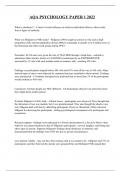
What is obedience? - A form of social influence in which an individual follows a direct order from a figure of authority. What was Milgram's (1964) study? - Milgram (1964) sought an answer to why such a high proportion of the German population obeyed Hitler's commands to murder over 6 million Jews in the Holocaust and other social groups during WW2. Procedure: 40 US men were given the role of TEACHER through a fixed draw - ordered to administer (fake) electric shocks to LEARNER (confederate) by an EXPERIMENTER, increased by 15 volts with each mistake made on memory task - reaching 450 volts. Findings: no participants stopped before 300 volts and 65% went all the way to 450 volts. Many showed signs of stress, most objected by continued anyways (qualitative observations). Findings were unexpected - 14 students introspectively predicted that no more than 3% of the participants would continue to 450 volts. Conclusion: 'German people are NOT different' - US participants obeyed even when they knew they might harm another person. Evaluate Milgram's (1964) study: - Ethical issues - participants were deceived. They thought that the allocation of roes was random, but it was predetermined. They also thought the shocks were real. Milgram dealt with this by debriefing participants. However, Baumrind (1964) criticized Milgram for deceiving his participants - lasting psychological consequences for participants and researchers. Research support - findings were replicated in a French documentary (Le Jeu de la Mort) - their behavior was almost identical to that of Milgram's participants - nervous laughter, nail-biting and other signs of anxiety. Supports Milgram's findings about obedience to authority, and demonstrated that the findings were NOT just due to special circumstances. Low internal validity - may not have been testing what it was meant to be - Milgram said 75% of participants said they believed the shocks were genuine/Orne and Holland (1968) argued that participants were 'play-acting'. This suggests that participants may have been responding to demand characteristics, trying to fulfil the aims of the study. What are situational variables? - Features of the environments that may influence a person's behavior. What situational variables did Milgram investigate? - Proximity: (Baseline - TEACHER could hear the LEARNER but not see him) Obedience rate dropped from 65% to 40% when the LEARNER and TEACHER were in the same room. Proximity means that the TEACHER cannot psychologically distance themselves from the consequences of their actions. Location: (Baseline -conducted in the prestigious setting of Yale University) Obedience rate dropped to 47.5 % when conducted in a run-down office building. The prestigiousness of Yale University gave the setting more credibility and legitimacy. Uniform: (Baseline - EXPERIMENTER wore a lab coat) Obedience rate dropped to 20% when EXPERIMENTER'S role was taken over by an ordinary member of the public. Uniform is a symbol of legitimate authority. Evaluate situational variables - Cross-cultural replications - Meeus and Raaijmakers (1896) used a more realistic procedure than Milgram to study obedience in Dutch participants. In an interview, 90% obeyed the confederates. Replicated Milgram's proximity findings - when the confederate was not present, obedience decreased. This suggests that Milgram's findings are not just limited to the US. Low internal validity - participants may have been aware the procedure was artificial - Orne and Holland suggest that due to the extra manipulation of variables, participants may have known they were being studied (replacing the EXPERIMENTER by a member of the public). Therefore, unclear whether the findings are genuine or because participants saw through the deception and play-acted. What are situational explanations? - Something about the situation that can be used to explain behavior. What are the situational explanations of obedience? - Agentic state: we fail to take responsibility because we believe we are acting on behalf of an authority figure ('just following orders').
Written for
- Institution
- AQA PSYCHOLOGY
- Course
- AQA PSYCHOLOGY
Document information
- Uploaded on
- February 28, 2024
- Number of pages
- 18
- Written in
- 2023/2024
- Type
- Exam (elaborations)
- Contains
- Questions & answers
Subjects
- aqa psychology
- aqa psychology paper
- aqa psychology paper 1
- psychology paper 1 2022
-
aqa psychology paper 1 2022

Also available in package deal