UTHS World History A Exam Q&A Accurately Answered
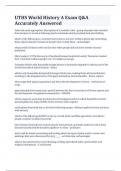
UTHS World History A Exam Q&A Accurately Answered Select the most appropriate description of a nomadic tribe - group of people who traveled from location to location following herds of animals which provided food and clothing which of the following is a scientist that works to uncover artifacts physically unearthing these objects that the remains of people who created them - archaologist what period of history refers to the time when people did not leave written records - prehistory Mary Leakey's 1970s discovery of fossilized human footprints Laetoli, Tanzania revealed that - hominids walked upright over 3.5 million years ago Scientists believe that humanlike beings known as hominids migrated to other parts of the world from which initial location - Africa which early humanlike being had the largest brain size, making them advanced hunters resulting in the disappearance of the giant mastadons and mammoths - Homo sapiens what supported larger populations and led to the development of towns - cultivation of crops approximately how many years passed between the first occurrences of Homo sapiens and the development of organized communities - 200,000 which sequence accurately portrays the chronological order in which hominids evolved - australopithecine, homo habilis, homo erectus, homo sapiens civilizations flourished due to all of the following except - ability to gather berries and hunt wild animals which of the following did NOT occur as a result of the neolithic agriculture revolution - people continue to follow the herds Once humans learned how to grow plants, herd animals, and make pottery to store food, humans transitioned from hunter/gatherer to what - producers a(n) could be found researching and writing about the type of paint used to create cave paintings that were discovered by a(n)______ - art historian, archaeologist what is characterized by record keeping, writing, specialized labor, government, and religious institutions - a civilization why did people being to settle close to rivers nearly 5,000 years ago - they utilized the flooding for fertile silt deposits and water for crops which of the following was NOT one of the characteristics of early civilizations - governments were not formed as cities grew and anarchy was prevalent humans began to learned how to use stone tools approximately ten thousand years ago. What is the period of learning transformation called - The Neolithic Revolution Which hominid is responsible for learned to control fire - hom erectus who was at risk of early death due to the contamination of water and animal-borne diseases - early farmers who cultivated crops and domesticated animals what supported larger populations and led to development of towns - cultivation of crops which of the following responsibilities would NOT be part of an archaeologist's typical job duties - writing about the colors used in various artworks located in a museum identify the river valley believed to be the location of the first known civilization mesopotamia - tigris-euphrates river valley the world's first civilization, mesopotamia, was located in the fertile crescent. Where was the Fertile Crescent located? - between the tigris and Euphrates Rivers in Southwest Asia which civilization was responsible for the invention of the wheel - sumerians the major achievements of the phoenicians included all of the following EXCEPT - construction of Ishtar Gate and Hanging Gardens Which of the following is NOT one of the laws stated in Hammurabi's code - answer not found wrong answer: if a person stole property belonging to a court temple, the would be put to death King Nebuchadnezzar II was a ruler in which of the following Crescent Empires - Babylon why did the flooding of the tigris-euphrates river system benefit civilizations that developed there - the floods would leave silt deposits behind resulting in fertile soil civilizations developed due to man's ability to_____ - specialize and divide labor which of the following is not a result of one's culture - need for oxygen which hominids are the same species as modern humans - homo sapiens what is culture - a learned way of living such as the language one speaks which hominid was known as the handy man and developed tools with sharp edges - homo habilis which hominid, existing approximately 400,000-130,000 years ago, is known as "wise-man" due to his increased brain size and ability to trap large prey - homo sapiens what Code of Law consisted of 282 laws dealing with all areas of civilization - Hammurabi's Code Which indo-European invader controlled a larger territory in the Fertile Crescent - Assyrians the city of sumer, located along the persian gulf, made significant contributions to future civilizations. Which of the following is NOT one of those contributions - created three-man chariot what event occurred in Canaan that caused many Israelites to move to egypt - a drought who was the last king of the united Hebrew state that erected the First Temple - King Soloman By what means are the Ten Commandments said to have arrived - revealed to Moses by God on Mt. Sinai What caused the formation of a hierarchical structure within the Sumerian Civilization - trade flourished and people specialized in one occupation what is the main idea in the Epic of Gilgamesh - there are certain behaviors associated with civilized life which civilization developed a written language knows as cuneform - sumerian which Fertile Crescent society developed an alphabet that was later the basis for the Greek alphabet - phoenicians who invaded the Akkadian Empire and took control of the city of Babylon - answer not found probable answer: Sumerians wrong answer: Hittites Zoroaster believed all the following EXCEPT - several gods should be worshipped From which situation was Moses believed to have saved the Israelites - the enslavement of the Israelites in Egypt Who was the ruler of Akkad that united many of the cities and created the first national army - Sargon I The heart of Persian communication network existed due to the development of ________ - a high quality road system Which of the following is NOT one of the achievements reached during Persian rule? - The Ishtar Gate (babylonian) which of the following was NOT one of the reasons ancient Egypt prospered for such a long period of time in the Nile River Valley - the capture of the Israelites by an Egyptian pharaoh converted the civilization from polytheistic to monotheistic society based on Judaism The great rift valley is a 3,700 mile long geographic trench. It runs north-south from Syria in the Middle East to Mozambique in eastern Africa. Which of the following is likely to be true of this geographic feature's impact on human migration - it formed a barrier that discourage east-west migration on a dig, an archaeologist finds a deceased pharaoh in a tom. In the tomb the archaeologist finds a red crown near the pharaoh's body. What could the archaeologist assume about the pharaoh he has discovered - the pharaoh ruled over lower Egypt what occurred to deter further invasion of Egypt after the hyksos from Syria invaded and took control during the middle kingdom - Egyptians overthrew the Hyksos and conquered Kush and the eastern coast of the Mediterranean Sea What type of government was created to rule ancient Egypt - theocracy for what reason is Upper Egypt referred to as the southern part of Egypt, while Lower Egypt refers to the norther part of Egypt - it refers to the direction that the Nile River flows How did the distance between egypt and other civilizations, such as mesopotamia impact the egyptians - there was enough distance to allow a distinct egyptian civilization to evolve which of the following is true of the Nile River - it is the longest river in the world during which period in Egyptian history did the Egyptians resolve not to fall to outside invaders again and seek to strengthen and expand their region - New Kingdom which of the following is NOT one of the functions of an Egyptian pyramid - the pyramids were a marketplace for exchanging goods which of the following statements best describes the main principle of ancient Egyptian religion - a safe passageway to the afterlife was necessary thus they prepared extensively for the journey
Written for
- Institution
- UTHS World History A
- Course
- UTHS World History A
Document information
- Uploaded on
- February 27, 2024
- Number of pages
- 25
- Written in
- 2023/2024
- Type
- Exam (elaborations)
- Contains
- Questions & answers
Subjects
- archaologist
- mastadons and mammoths
-
uths world history a exam qa accurately answered
-
fossilized human footprints laetoli

Also available in package deal