

NR-503 Epidemiology Final Exam with Complete Solutions Graded A 2024
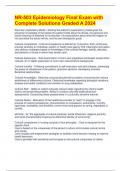
Kleinman explanatory Model - Eliciting the patient's (explanatory) model gives the physician knowledge of the beliefs the patient holds about his illness, the personal and social meaning he attaches to his disorder, his expectations about what will happen to him and what the doctor will do, and his own therapeutic goals Cultural competence - Cultural competence is defined as "a dynamic, fluid, continuous process whereby an individual, system or health care agency find meaningful and useful care delivery strategies based on knowledge of the cultural heritage, beliefs, attitudes, and behavior of those to whom they render care" Cultural Awareness - :Self-examination of one's own prejudices and biases toward other cultures. An in-depth exploration of one's own cultural/ethnic background. Cultural humility - A lifelong commitment to self-evaluation and self-critiques, redressing the power of imbalances in the patient- physician dynamic, developing mutually. Beneficial relationships. Cultural Knowledge - Obtaining a sound educational foundation concerning the various worldviews of differences cultures. Obtaining knowledge regarding biological variations, disease and health conditions and variation in drug metabolism. Cultural Skill: - Ability to collect culturally relevant data regarding the client's health history and presenting problem. Ability to conduct culturally based physician assessments. Conducting these assessments in a culturally sensitive manner. Cultural Desire - Motivation of the healthcare provider to "want" to engage in the process of cultural competence, characteristics of compassion, authenticity, humility, openness, availability, and flexibility, commi tment and passion to caring, regardless of conflict. ethnicity - as "the aggregate of cultural practices, social influences, religious pursuits, and racial characteristics shaping the distinctive identity of community" Cultural competence in nursing consists of four principles. - Care is designed for the specific client. Care is based on the uniqueness of the person's culture and includes cultural norms and values. Care includes self-employment strategies to facilitate client decision making to improve health behaviors. Care is provided with sensitivity and is based on the cultural uniqueness of clients. The APN may also use the Kleinman Explanatory Model of Illness (1978). Below are the questions that can be utilized. - What do you call your problem? What do you think caused your problem? Why do you think it started when it did? What does your sickness do to you? What do you fear most about your sickness? What are the chief problems your sickness has caused you? What kind of treatment do you think you should receive? What is the most important result you hope to receive from the treatment? According to Giger and Davidhizer (2000), although cultures differ, they all have the same basic organizing factors that must be assessed in order to provide care for culturally diverse patients. These factors include - communication (verbal and nonverbal); personal space; social organization; time perception; environmental control; and biological variations. The National Center for Cultural Competence (NCCC) provides national leadership and contributes to the body of knowledge on cultural and linguistic competency within systems and organizations. Major emphasis is placed on translating evidence into policy and practice for programs and personnel concerned with health and mental healthcare delivery, administration, education, and advocacy. - The NCCC uses four major approaches to fulfill its mission, including - Web-based technical assistance, (2) knowledge development and dissemination, (3) supporting a community of learners, and (4) collaboration and partnerships with diverse groups. These approaches entail the provision of training, technical assistance, and consultation and are intended to facilitate networking, linkages, and information exchange. The NCCC has particular expertise in developing instruments and conducting organizational self-assessment processes to advance cultural and linguistic competency. - Epidemiological Triad: - host, agent, environment Genetics is considered an agent in the epidemiological triad - Genetics - The study of individual genes and their impact on relatively rare single gene disorders Genomics - The study of all genes in the human genome as well as their interaction with other genes, the individual's environment, and the influence of cultural and psychosocial factors
Document information
- Uploaded on
- February 27, 2024
- Number of pages
- 12
- Written in
- 2023/2024
- Type
- Exam (elaborations)
- Contains
- Questions & answers


