Cells and Immunity
Week 9
Dr Mike Fry
Life and Death
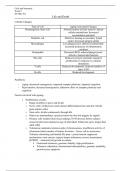
Cellular Changes;
Type of Cell Aging-Associated Changes
Hematopoietic Stem Cell Altered location in bone marrow/ altered
cellular metabolism/ decreased
reconstitution potential
Dendritic cell Defective homing to secondary lymph
nodes/ decreased antigen uptake
Macrophages Less phagocytosis/ defective bactericidal/
increased production of inflammatory
cytokines
Neutrophils Decreased ROS, reduced phagocytosis/
defective bactericidal function
NK cells Reduced cytolytic potential /impaired
proliferation in response to cytokine
stimulation
T cells Reduced development/ reduced numbers of
naive CD4
B cells Reduced development
Parabiosis;
- Aging; decreased neurogenesis, impaired synaptic plasticity, impaired cognition
- Rejuvenation; increased neurogenesis, unknown effect on synaptic plasticity and
cognition.
Factors involved with ageing;
1. Proliferation of cells;
o Range in ability to grow and divide
o Nerve cells/ erythrocytes reach mature differentiated state and don’t divide
[post-mitotic cells]
o Stem cells- divide continuously through life
o Others are intermediates; quiescent most the time but triggers by signals.
o Primary cells isolated from tissue undergo 30-50 division before cultures
senescent [divisions depend on age of individual. Embryonic grow longer than
adult cells]
o Telomerase maintains telomere ends of chromosomes, insufficient activity of
telomerase limits number of mitotic divisions = forces cell to senescence.
Telomere shortening and limited life span = potent tumour suppressor
mechanisms, most cancers express human telomerase reverse transcriptase
[hTERT] – immortal cell growth in culture.
Functional telomeres; genomic stability, high proliferation
Telomere exhaustion; chromosomal abnormalities, genomic instability,
growth arrest, apoptosis
, Cells and Immunity
Week 9
Dr Mike Fry
Telomerase activity; regulated in development and tissue specific /
highly variable / determined genetically and environmentally, no
gender related difference at birth [higher in adult F than M]
Telomerase + hTERT + Accessory proteins [+TIN2] = premature
telomere loss with DNA damage response stem cell depletion
dyskeratosis congenita
Telomerase + hTERT + Accessory proteins [+POT1] =telomere
elongation with higher replicative potential chromosomal instability
cell death/tumour death cancer
RAP1 = altered gene expression altered metabolism metabolic
syndrome [obesity]
2. cell replacement
o Cells and proliferation; cells can become immortal [cell line]. Useful
experimentally to show phenotype and growth characteristics of origin cells.
Transformation [additional change] associated with malignant growth [cancer]
Transformed cells don’t show normal grown, altered anchorage independent
growth [most cells only grow when anchored to substrate]
3. DNA damage and repair
o Types of damage;
a. Single strand issues;
i. Base excision
Repair;
1. Chemically altered base, little helix distortion
2. Base cleaved away
3. Deoxyribosyl phosphate cleaved away
4. Nucleotide inserted, closure by ligase
ii. Mis-match excision
Repair;
1. MLH1 endonuclease / PMS2 + DNA helicase/DNA
exonuclease cleaves out wrong nucleotide
2. Gap repaired by DNA polymerase and ligase
iii. Nucleotide excision
Common DNA damage [UV radiation] formation of
thymine dimers [distort shape of DNA; repaired by nucleotide
excision]
Week 9
Dr Mike Fry
Life and Death
Cellular Changes;
Type of Cell Aging-Associated Changes
Hematopoietic Stem Cell Altered location in bone marrow/ altered
cellular metabolism/ decreased
reconstitution potential
Dendritic cell Defective homing to secondary lymph
nodes/ decreased antigen uptake
Macrophages Less phagocytosis/ defective bactericidal/
increased production of inflammatory
cytokines
Neutrophils Decreased ROS, reduced phagocytosis/
defective bactericidal function
NK cells Reduced cytolytic potential /impaired
proliferation in response to cytokine
stimulation
T cells Reduced development/ reduced numbers of
naive CD4
B cells Reduced development
Parabiosis;
- Aging; decreased neurogenesis, impaired synaptic plasticity, impaired cognition
- Rejuvenation; increased neurogenesis, unknown effect on synaptic plasticity and
cognition.
Factors involved with ageing;
1. Proliferation of cells;
o Range in ability to grow and divide
o Nerve cells/ erythrocytes reach mature differentiated state and don’t divide
[post-mitotic cells]
o Stem cells- divide continuously through life
o Others are intermediates; quiescent most the time but triggers by signals.
o Primary cells isolated from tissue undergo 30-50 division before cultures
senescent [divisions depend on age of individual. Embryonic grow longer than
adult cells]
o Telomerase maintains telomere ends of chromosomes, insufficient activity of
telomerase limits number of mitotic divisions = forces cell to senescence.
Telomere shortening and limited life span = potent tumour suppressor
mechanisms, most cancers express human telomerase reverse transcriptase
[hTERT] – immortal cell growth in culture.
Functional telomeres; genomic stability, high proliferation
Telomere exhaustion; chromosomal abnormalities, genomic instability,
growth arrest, apoptosis
, Cells and Immunity
Week 9
Dr Mike Fry
Telomerase activity; regulated in development and tissue specific /
highly variable / determined genetically and environmentally, no
gender related difference at birth [higher in adult F than M]
Telomerase + hTERT + Accessory proteins [+TIN2] = premature
telomere loss with DNA damage response stem cell depletion
dyskeratosis congenita
Telomerase + hTERT + Accessory proteins [+POT1] =telomere
elongation with higher replicative potential chromosomal instability
cell death/tumour death cancer
RAP1 = altered gene expression altered metabolism metabolic
syndrome [obesity]
2. cell replacement
o Cells and proliferation; cells can become immortal [cell line]. Useful
experimentally to show phenotype and growth characteristics of origin cells.
Transformation [additional change] associated with malignant growth [cancer]
Transformed cells don’t show normal grown, altered anchorage independent
growth [most cells only grow when anchored to substrate]
3. DNA damage and repair
o Types of damage;
a. Single strand issues;
i. Base excision
Repair;
1. Chemically altered base, little helix distortion
2. Base cleaved away
3. Deoxyribosyl phosphate cleaved away
4. Nucleotide inserted, closure by ligase
ii. Mis-match excision
Repair;
1. MLH1 endonuclease / PMS2 + DNA helicase/DNA
exonuclease cleaves out wrong nucleotide
2. Gap repaired by DNA polymerase and ligase
iii. Nucleotide excision
Common DNA damage [UV radiation] formation of
thymine dimers [distort shape of DNA; repaired by nucleotide
excision]