Cells and Immunity
Week 7
Dr Phil Dash
Cell Adhesion and Migration
Cell migration key for cancer metastasis, angiogenesis, wound repair, pregnancy, embryo
development and immune response.
Migration steps;
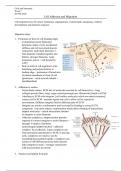
1. Protrusion of front of cell [leading edge]
- Cytoskeleton [actin filaments]
determine shape of cell, mechanical
stiffness and cell movement/muscle
contraction. Individual filaments 5-
9nm diameter, bundled together into
thicker, stronger filaments. Actin
monomers join at + end [bound by
ATP]
- Role of actin in cell migration; actin
branching and polymerization at
leading edge = protrusion of broad area
of plasma membrane at front of cell
[protrusion + actin network behind =
lamellipodium]
2. Adhesion to surface
- Extracellular matrix; ECM mix of molecules secreted by cell themselves = long
collagen protein fibers, large, sugar-coated proteoglycans, fibronectin [attach to ECM]
- Attaching to ECM with integrins; [cell surface molecules which are matrix receptors],
connect cell to ECM / transmit signals into cell to allow cell to respond to
environment. Different integrins bind to different parts of ECM
- Integrins are inactive conformation until activated by binding to correct ECM
component. Activation induces conformation which allows binding of intracellular
adaptor molecules = attach intracellular domain
of integrins to actin filaments.
- Adhesion complexes; adaptor/anchor proteins
required to connect integrins to actin filaments =
strength. Complex of proteins
[actin/integrin/adaptor/anchor] = adhesion
complex/ focal adhesion. Large complexes can
form permanent attachments to ECM, in moving
cells, complexes are small so can be
assembled/disassembled rapidly. Complexes can
consist of 100 different proteins [talin directly
links integrins to actin // stronger connections
with more proteins involved]
3. Traction [cell pulled forward]
Week 7
Dr Phil Dash
Cell Adhesion and Migration
Cell migration key for cancer metastasis, angiogenesis, wound repair, pregnancy, embryo
development and immune response.
Migration steps;
1. Protrusion of front of cell [leading edge]
- Cytoskeleton [actin filaments]
determine shape of cell, mechanical
stiffness and cell movement/muscle
contraction. Individual filaments 5-
9nm diameter, bundled together into
thicker, stronger filaments. Actin
monomers join at + end [bound by
ATP]
- Role of actin in cell migration; actin
branching and polymerization at
leading edge = protrusion of broad area
of plasma membrane at front of cell
[protrusion + actin network behind =
lamellipodium]
2. Adhesion to surface
- Extracellular matrix; ECM mix of molecules secreted by cell themselves = long
collagen protein fibers, large, sugar-coated proteoglycans, fibronectin [attach to ECM]
- Attaching to ECM with integrins; [cell surface molecules which are matrix receptors],
connect cell to ECM / transmit signals into cell to allow cell to respond to
environment. Different integrins bind to different parts of ECM
- Integrins are inactive conformation until activated by binding to correct ECM
component. Activation induces conformation which allows binding of intracellular
adaptor molecules = attach intracellular domain
of integrins to actin filaments.
- Adhesion complexes; adaptor/anchor proteins
required to connect integrins to actin filaments =
strength. Complex of proteins
[actin/integrin/adaptor/anchor] = adhesion
complex/ focal adhesion. Large complexes can
form permanent attachments to ECM, in moving
cells, complexes are small so can be
assembled/disassembled rapidly. Complexes can
consist of 100 different proteins [talin directly
links integrins to actin // stronger connections
with more proteins involved]
3. Traction [cell pulled forward]