The most logical source of the conscience is God. Discuss.’ (40 marks).
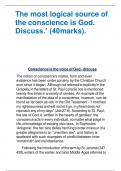
The most logical source of the conscience is God. Discuss.’ (40 marks). Conscience is the voice of God - discuss The notion of conscience's matter, form and even existence has been under scrutiny by the Christian Church ever since it began. Although notreferred to explicitly in the Gospels, in the letters of St. Paul conscience is mentioned twenty-five times in a variety of senses. An example of the manifestation of the idea of a conscience, however, can be found as far back as Job in the Old Testament - “I hold fast my righteousness and will not let it go, m y heart does not reproach any of my days” (Job 27:6). According to St. Paul,the law of God is ‘written in the hearts of gentiles';the conscience acts in every individual, no matter what stage in life, or knowledge of existing civic laws. In Sophocles' ‘Antigone', the her oine defies her King's order in favour of a greater allegiance to an "unwritten law", and history is spattered with such examples of conflict between inner ‘moral truth' and civil obedience. Following the introduction of the term by St.Jerome (347-420), writers ofthe earlier and later Middle Ages referred to the innate power of distinguishing good from evil as ‘synderesis'. Jerome himself describes this as the ‘spark of conscience ...by which we discern that we sin', but later writers such as Aquinas refer to the term ‘conscience' (conscientia) for the ability to distinguish good from bad at the level of particular actions. St. Augustine, a contemporary of Jerome, also regarded conscience as an innate faculty which reveals God's moral law, as it is “Written in the book of light from which all laws are copied” (De Trinitate 14, 15, 22). Effectively, Jerome and Augustine thought our conscience is God-given, and thus both face similar difficulties as Divine Command theory. Arguably, Augustine and Jerome believe the capability of reason to be far greater than it really is. The Aristotelian line of thought differs from Plato's in a subtle but important way, that although reason is innate and universal, it needs to be used to arrive at an understanding of right and wrong. Augustine doesn't ‘use' reason; he views knowledge of right and wrong as intuitive and automatic, which is problematic. First, the idea of moral relativism becomes more convincing as historical and social enquiry lends us more information about other cultures, and although it does not deny Aristotle's universal reason, it does deny a universal understanding of right and wrong. In addition, if God had said that rape, murder and torture are desirable values, then they would have been. This begins the series of problems presented by Plato's Euthyphro dilemma, which affects all theories claiming God's word as the dictate of right and wrong. Pelagius, an ascetic monk,recognised that humans have the capacity to decide whether or not to follow the good. Even if one knew something was wrong, such as torture of an innocent child, one still has the potential to carry it out. However, in the Biblical tradition, God's grace does not necessarily drive people to the right action (we would have a very different picture of Christian morality if it was believed that it does) but instead, in Ephesians, “The forgiveness of sins, in accordance with the riches of God's grace”. Conscience may be the voice of God, therefore, but we still have the capacity to ignore it, or actively disobey it. Peter Singer poses a situation where a group of animal rights protesters are deciding whether they should break the law to stop a practice they know to be wrong. An answer to this type of question was given by the nineteenth-century American radical, Henry Thoreau. In his essay ‘Civil Disobedience', Thoreau wrote, “It is not desirable to cultivate a respect for the law, so much as for the right”. The American philosopher Henry Wolff has written in a similar vein, saying that a man should “make himself the author of his decisions”, and to resist the state who try to lay authority over him. Both Thoreau and Wolff resolve the conflict between individual conscience and society in favour of the individual. It would appear then, that Oskar Schindler was correct in violating Nazi law. The real problem with the situation, however, is that people do not know whether to act through reason to find the ‘good', or by instinct given to us by the ‘inner voice' of our conscience.
Written for
- Institution
- The most logical source of the conscience is God.
- Course
- The most logical source of the conscience is God.
Document information
- Uploaded on
- February 23, 2024
- Number of pages
- 9
- Written in
- 2023/2024
- Type
- Exam (elaborations)
- Contains
- Questions & answers
Subjects
-
the most logical source of the conscience is
-
the most logical source of the conscience
-
the most logical source of the conscience