ChE 321 - Final Closed Book Section with answers 2024/2025
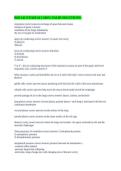
ChE 321 - Final Closed Book Section A gas-liquid reaction is being run in a sitrred-tank reactor. When the stirring rate is increased, the conversion in the reactor increases. - correct answer Mass transfer limitations exist which are lessened when stirring rate is increased It is noted that when a species, which doesn't show up in the reaction stoichiometry, is added to a reaction mixture the catalytic reaction rate goes down. When this species is removed, the catalytic reaction rate goes back to where it was before. - correct answer The species binds competitively with the reactants, which lowers the surface concentrations of reactive species and lowers the reaction rate. The same catalyst formulation is prepatred with three different particle sizes. Each particle size has approximately the same properties (surface area, pore diameter, etc...) other than particle diameter. For the same reaction conditions in a packed bed, the conversion is lowest for the largest particle sizes, but the conversion is similar for the two smallest particle sizes. - correct answer For the larges particle sizes = strong pore diffusion limitations exist. These are eliminated going to either of the two smaller particles. In a kinetic study at high temperatures, the activation energy experimentally determined is very small: much less than other investigators have reported for the same reaction. - correct answer The kinetic data were taken when mass transfer limitations were present. External mass transfer limitation are likely due to the small temperature dependence found. Desired liquid-phase reaction: A + B - R + T; dCr/dt = k1*Ca^1.5*Cb^0.3 is accompanied by the unwanted side reaction: A + B - S + U; dCs/dt = k2*Ca^0.5*Cb^1.8 From the standpoint of maximizing the selectivity of R and T, order the contacting schemes shown below from t he most desirable to least desirable: 1) Single-inlet PFR (A&B enter at same time) 2) Multiple-inlet PFR (A enters initially and B above) 3) CSTR in series (A&B enter at same time) 4) CSTR single 5) CSTR in series (B enters initially and A above) - correct answer S(R/T) = (k1Ca^1.5Cb^0.3)/(k2Ca^0.5Cb^1.8) = (Ca/Cb^1.5)(k1/k2) So a high concentration of A and a low concetration of B are desired. The possible reactor configurations can be ranked in the following order: 2) (high A, B) 4) (low A, low B - lower than 3) 3) (low A, low B) 1) (high A & B) 5 (high B, low A) An endothermic, reversible reaction is to be run in an adiabatic PFR. Would you want the inlet temperature to be high or low? Your answer should discuss both kinetic and thermodynamic considerations. - correct answer Inlet temperature should be high. This will improve the equilibrium conversion since the ration is endothermic (equilibrium constant increases as temperature increases) and will improve the reaction kinetics (rate constant increases as temperature increases.) You are in charge of finding the kinetics of a catalytic reaction. Before determining the reaction kinetics, you recognize t
École, étude et sujet
- Établissement
- Cstr
- Cours
- Cstr
Infos sur le Document
- Publié le
- 23 février 2024
- Nombre de pages
- 8
- Écrit en
- 2023/2024
- Type
- Examen
- Contient
- Questions et réponses
Sujets
-
che 321 final closed book section