

College 1
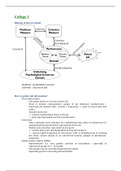
Binning & Barrett model
Criterion
Co
n te
n Criterion
t
Development n
io
i pt
Construct scr
De
b
Jo
Job Specification
Predictor : potential for success
Criterion : success at job
How to gather job information?
Direct observation
Job analyst observes or learns & does job
Need to include representative sample of job behaviour (unobstrusive ;
functional job analysis (FJA ; activity + frequency) => used to record observed
tasks)
Assumes static jobs
✓ : manual, standardized, short-cycle jobs
☓ : jobs requiring mental work & concentration)
Interviews
Most commonly used technique for establishing tasks, duties & behaviours for
standardised/unstandardized + physical/mental work
Worker acts as his/her own observer & reports
✓ : worker knows job, including hidden & long-term aspects
☓ : success highly dependent on interviewer skill, at initiating trust & covering
the whole content domain & on interviewee honesty (danger of information-
distortion)
Subject matter experts (SMEs)
Representative (i.e. race, gender, position of incumbents ; especially of
experience) groups of 6 – 10 people
Discussing issues & resolving disagreements openly
Expecially good for extracting relevant KSAOs
, Critical incidents technique (CI)
Letting SMEs describe especially good/poor performance
Incidents are categorised according to job dimensions => end up covering the
behavioural domain and also helps with performance management
✓ : absolutely job related ; forces attention to situational & personal
determinants & uniqueness of job ; ideal for feedback, development, measure
development
☓ : time-consuming & burdensome ; qualitative, difficult to compare employees
Questionnaires
Fleishman Job Analysis Survey (F-JAS) ; taxonomy of 52 abilities (cognitive,
psychomotor, physical & sensory/perceptual) + 21 social + 33 occupational K&S
✓ : reliability & validity (one of the best researched job analysis
measures)
Position Analysis Questionnaire (PAQ) ; 194 items in 5 categories (info input,
mental processes, work output, relationships with others & job context)
✓ : high reliabilities, sample independent. Particularly suited for blue-
collar manufacturing jobs (less for white-collar, professional, managerial,
technical) blue-collar = physical ; white-collar = cognitive
☓ : worker (behaviour) oriented => unusual similarities (masks task
differences), difficult for job descriptions, readability (requires college-
graduate reading level)
Info available
O*NET (http://www.onetonline.org/) ; when the information is already available
New developments
Incorporating Personality
Good for cross-functional jobs, difficult to define jobs, new jobs, etc.
How important is each personality dimension to the job? (NEO ; PPRF)
Competency modelling
A worker-oriented job analysis that focuses on broad characteristics needed for
the job: KSAOs (e.g. innovation, flexibility)
Reflects organizations business context & strategy
More strategy & future oriented, prescriptive
Heighten P-O fit
☓ : there is no consistent definition of a competency (ill-defined concept) ; not as
much rigor as job analysis
The Job Analysis Wizard (JAW)
Computer based technology
Work requirements (=> context, generalized behaviours, tools, equipment) &
worker requirements (=> KSAs, education, certification, languages, work styles)
Uses web-based surveys, taxonomies & archives
In case of new requirements ; uses archive data & fuzzy logic to suggest to used
other dimensions most similar to the new one
Automated processes => system can complete a job analysis, using subjects
worldwide, in just a few days
Strategic job analysis (=> if the job does not jet exist, e.g. in combination with new
technology)
SME : repeated discussions between SMEs from different parties involved in
change (e.g. organisation’s strategic mgt, technolohy developers, supervisors &
incumbents of ‘most similar’ jobs)
Statistical : use prior knowledge of tasks & KSAs (=> develop correlation matrix)
Binning & Barrett model
Criterion
Co
n te
n Criterion
t
Development n
io
i pt
Construct scr
De
b
Jo
Job Specification
Predictor : potential for success
Criterion : success at job
How to gather job information?
Direct observation
Job analyst observes or learns & does job
Need to include representative sample of job behaviour (unobstrusive ;
functional job analysis (FJA ; activity + frequency) => used to record observed
tasks)
Assumes static jobs
✓ : manual, standardized, short-cycle jobs
☓ : jobs requiring mental work & concentration)
Interviews
Most commonly used technique for establishing tasks, duties & behaviours for
standardised/unstandardized + physical/mental work
Worker acts as his/her own observer & reports
✓ : worker knows job, including hidden & long-term aspects
☓ : success highly dependent on interviewer skill, at initiating trust & covering
the whole content domain & on interviewee honesty (danger of information-
distortion)
Subject matter experts (SMEs)
Representative (i.e. race, gender, position of incumbents ; especially of
experience) groups of 6 – 10 people
Discussing issues & resolving disagreements openly
Expecially good for extracting relevant KSAOs
, Critical incidents technique (CI)
Letting SMEs describe especially good/poor performance
Incidents are categorised according to job dimensions => end up covering the
behavioural domain and also helps with performance management
✓ : absolutely job related ; forces attention to situational & personal
determinants & uniqueness of job ; ideal for feedback, development, measure
development
☓ : time-consuming & burdensome ; qualitative, difficult to compare employees
Questionnaires
Fleishman Job Analysis Survey (F-JAS) ; taxonomy of 52 abilities (cognitive,
psychomotor, physical & sensory/perceptual) + 21 social + 33 occupational K&S
✓ : reliability & validity (one of the best researched job analysis
measures)
Position Analysis Questionnaire (PAQ) ; 194 items in 5 categories (info input,
mental processes, work output, relationships with others & job context)
✓ : high reliabilities, sample independent. Particularly suited for blue-
collar manufacturing jobs (less for white-collar, professional, managerial,
technical) blue-collar = physical ; white-collar = cognitive
☓ : worker (behaviour) oriented => unusual similarities (masks task
differences), difficult for job descriptions, readability (requires college-
graduate reading level)
Info available
O*NET (http://www.onetonline.org/) ; when the information is already available
New developments
Incorporating Personality
Good for cross-functional jobs, difficult to define jobs, new jobs, etc.
How important is each personality dimension to the job? (NEO ; PPRF)
Competency modelling
A worker-oriented job analysis that focuses on broad characteristics needed for
the job: KSAOs (e.g. innovation, flexibility)
Reflects organizations business context & strategy
More strategy & future oriented, prescriptive
Heighten P-O fit
☓ : there is no consistent definition of a competency (ill-defined concept) ; not as
much rigor as job analysis
The Job Analysis Wizard (JAW)
Computer based technology
Work requirements (=> context, generalized behaviours, tools, equipment) &
worker requirements (=> KSAs, education, certification, languages, work styles)
Uses web-based surveys, taxonomies & archives
In case of new requirements ; uses archive data & fuzzy logic to suggest to used
other dimensions most similar to the new one
Automated processes => system can complete a job analysis, using subjects
worldwide, in just a few days
Strategic job analysis (=> if the job does not jet exist, e.g. in combination with new
technology)
SME : repeated discussions between SMEs from different parties involved in
change (e.g. organisation’s strategic mgt, technolohy developers, supervisors &
incumbents of ‘most similar’ jobs)
Statistical : use prior knowledge of tasks & KSAs (=> develop correlation matrix)


