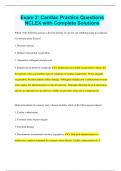
Exam 2: Cardiac Practice Questions NCLEX with Complete Solutions
Exam 2: Cardiac Practice Questions NCLEX with Complete Solutions Which of the following actions is the first priority of care for a pt exhibiting signs & symptoms of coronary artery disease? 1. Decrease anxiety 2. Enhance myocardial oxygenation 3. Administer sublingual nitroglycerin 4. Educate the pt about his symptoms 2. Enhancing myocardial oxygenation is always the first priority when a pt exhibits signs or symptoms of cardiac compromise. W/out adequate oxygenation, the myocardium suffers damage. Sublingual nitroglycerin is administered to treat acute angina, but administration isn't the first priority. Although educating the pt & decreasing anxiety are important in care delivery, neither are priorities when a pt is compromised. Medical treatment of coronary artery disease includes which of the following procedures? 1. Cardiac catherization 2. Coronary artery bypass surgery 3. Oral med therapy 4. Percutaneous transluminal coronary angioplasty 3. Oral med administration is a noninvasive, medical treatment for coronary artery disease. Cardiac catherization isn't a treatment, but a diagnostic tool. Coronary artery bypass surgery & percutaneous transluminal coronary angioplasty are invasive, surgical treatments. Which of the following is the most common symptom of myocardial infarction (MI)? 1. Chest pain 2. Dyspnea 3. Edema 4. Palpitations 1. The most common symptom of an MI is chest pain, resulting from deprivation of oxygen to the heart. Dyspnea is the second most common symptom, related to an increase in the metabolic needs of the body during an MI. Edema is a later sign of heart failure, often seen after an MI. Palpitations may result from reduced cardiac output, producing arrhythmias. Which of the following symptoms is the most likely origin of pain the pt described as knifelike chest pain that increases in intensity with inspiration? 1. Cardiac 2. Gastrointestinal 3. Musculoskeletal 4. Pulmonary 4. Pulmonary pain is generally described by these symptoms. Musculoskeletal pain only increases w/ movement. Cardiac & GI pains don't change w/ respiration. Which of the following blood tests is most indicative of cardiac damage? 1. Lactate dehydrogenase 2. Complete blood count (CBC) 3. Troponin I 4. Creatine kinase (CK) 3. Troponin I levels rise rapidly & are detectable w/in 1 hour of myocardial injury. Troponin I levels aren't detectable in people w/out cardiac injury. Lactate dehydrogenase (LDH) is present in almost all body tissues & not specific to heart muscle. LDH isoenzymes are useful in diagnosing cardiac injury. CBC is obtained to review blood counts, & a complete chemistry is obtained to review electrolytes. Because CK levels may rise w/ skeletal muscle injury, CK isoenzymes are required to detect cardiac injury What is the primary reason for administering morphine to a pt with an MI? 1. To sedate the pt 2. To decrease the pt's pain 3. To decrease the pt's anxiety 4. To decrease oxygen demand on the pt's heart 4. Morphine is administered because it decreases myocardial oxygen demand. Morphine will also decrease pain & anxiety while causing sedation, but it isn't primarily given for those reasons. Which of the following conditions is most commonly
Written for
- Institution
- Cardiac Practice NCLEX
- Course
- Cardiac Practice NCLEX
Document information
- Uploaded on
- February 23, 2024
- Number of pages
- 35
- Written in
- 2023/2024
- Type
- Exam (elaborations)
- Contains
- Questions & answers
Subjects
-
exam 2 cardiac practice questions nclex with comp

Also available in package deal