Exam 1: Cardiac Procedures (NCLEX) Latest Update 100% Pass
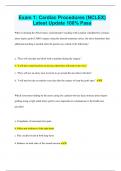
Exam 1: Cardiac Procedures (NCLEX) Latest Update 100% Pass When evaluating the effectiveness of preoperative teaching with a patient scheduled for coronary artery bypass graft (CABG) surgery using the internal mammary artery, the nurse determines that additional teaching is needed when the patient says which of the following? a. "They will circulate my blood with a machine during the surgery." b. "I will have small incisions in my leg where they will remove the vein." c. "They will use an artery near my heart to go around the area that is blocked." d. "I will need to take an aspirin every day after the surgery to keep the graft open." B Which assessment finding by the nurse caring for a patient who has had coronary artery bypass grafting using a right radial artery graft is most important to communicate to the health care provider? a. Complaints of incisional chest pain b. Pallor and weakness of the right hand c. Fine crackles heard at both lung bases d. Redness on both sides of the sternal incision B When caring for a patient who has just arrived on the medical-surgical unit after having cardiac catheterization, which nursing intervention should the nurse delegate to a licensed practical/vocational nurse (LPN/LVN)? a. Give the scheduled aspirin and lipid-lowering medication. b. Perform the initial assessment of the catheter insertion site. c. Teach the patient about the usual postprocedure plan of care. d. Titrate the heparin infusion according to the agency protocol. A Which of the following are possible complications following a Percutaneous Transluminal Coronary Angioplasty (PTCA)? Select all that apply: A) Hematoma formation B) Acute Renal Failure C) Hypothermia D) Cardiac Tamponade E) Bradycardia ABD Hematoma formation at the site of sheath insertion is a common complication following a PCTA and should be monitored for postoperatively. Acute renal failure may also occur d/t the use of dye during the procedure. Cardiac Tamponade may occur if a coronary vessel ruptures following the procedure. A patient who underwent a percutaneous, transluminal coronary angioplasty four weeks ago has a subsequent ejection fraction of 30%. The patient returns for a followup visit. Examination reveals lungs that are clear to auscultation and slight pedal edema. The patient's medications are digoxin (Lanoxin), furosemide (Lasix), enalapril maleate (Vasotec), and aspirin. The patient reports a 5 lb (2.27-kg) weight gain over the past two days. The cardiac/vascular nurse's initial action is to: a.) Document the weight, and reassess the patient at the next session. b.) Inquire about the patient's medication compliance. c.) Notify the patient's physician. d.) Review the patient's most recent nuclear scan. B A nurse is preparing to ambulate a client on the 3rd day after cardiac surgery. The nurse would plan to do which of the following to enable the client to best tolerate the ambulation? a.) Encourage the client to cough and deep breathe
Written for
- Institution
- Cardiac Procedures
- Course
- Cardiac Procedures
Document information
- Uploaded on
- February 23, 2024
- Number of pages
- 20
- Written in
- 2023/2024
- Type
- Exam (elaborations)
- Contains
- Questions & answers
Subjects
-
exam 1 cardiac procedures nclex latest update

Also available in package deal