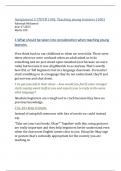
Assignment 5 (TOTB 140): Teaching young learners (100)
Fahemah Mohamed
June 27,2023
Marks 100
1.What should be taken into consideration when teaching young
learners.
If we think back to our childhood to when we were kids. There were
times when we were confused when an adult asked us to do
something and we just stared open-mouthed (not because we were
rude) but because it was all gibberish to us anyway. That’s exactly
how ESL or Tefl beginners feel in a language classroom. If a teacher
starts rambling on in a language they do not understand, they’ll just
get nervous and shut down.
1.So put yourself in their shoes – how would you feel If some stranger
starts saying weird stuff at you and expects you to reply in the same
alien language?
Absolute beginners are a tough nut to crack because they have no
previous knowledge.
2.So, let’s keep it simple.
Instead of using full sentences with lots of words we could instead
say.
“Take out your text books. Okay?” Together with this, using gestures
are really important and they help beginners better understand even
when the classroom English seems clear to you. Using the Okay sign
or gesture that’s culturally appropriate for the country you are
teaching in.
, 3.Always check for understanding.
A mistake that teachers can make teaching English to beginners is
assuming that the students have understood the lesson or classroom
instructions. In your first lesson Children or Adults that you are
teaching English may not be aware of the Western customs of raising
your hand if you are unsure or did not understand something. Or
they may feel embarrassed to raise their hand in front of the entire
class.
4. Reading body language
You need to be aware and read your students body language to
gauge whether they have understood and keep checking whether
they have understood by asking “Okay?”. Students will let you know
directly or indirectly whether they’ve understood or not.
5. Give them lots of time to practice.
In ESL beginner lessons, we cannot expect the learners or students
to get it immediately. Provide lots of examples, check for
understanding and then make sure your class has enough time to
practice what you’ve just taught them. This is where lots of drill
exercises come into play, especially with beginners.
Make them listen and repeat the language structure several times
repeating after you.
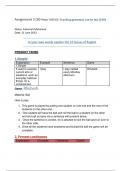
2.How would you adapt your lessons to teach young learners in
a classroom or in an online environment
Teaching young learners does not have to be rigid and uninteresting.
Make it interesting and captivating where they are not easily
distracted or become bored. Be interactive and introduce games like,
Fahemah Mohamed
June 27,2023
Marks 100
1.What should be taken into consideration when teaching young
learners.
If we think back to our childhood to when we were kids. There were
times when we were confused when an adult asked us to do
something and we just stared open-mouthed (not because we were
rude) but because it was all gibberish to us anyway. That’s exactly
how ESL or Tefl beginners feel in a language classroom. If a teacher
starts rambling on in a language they do not understand, they’ll just
get nervous and shut down.
1.So put yourself in their shoes – how would you feel If some stranger
starts saying weird stuff at you and expects you to reply in the same
alien language?
Absolute beginners are a tough nut to crack because they have no
previous knowledge.
2.So, let’s keep it simple.
Instead of using full sentences with lots of words we could instead
say.
“Take out your text books. Okay?” Together with this, using gestures
are really important and they help beginners better understand even
when the classroom English seems clear to you. Using the Okay sign
or gesture that’s culturally appropriate for the country you are
teaching in.
, 3.Always check for understanding.
A mistake that teachers can make teaching English to beginners is
assuming that the students have understood the lesson or classroom
instructions. In your first lesson Children or Adults that you are
teaching English may not be aware of the Western customs of raising
your hand if you are unsure or did not understand something. Or
they may feel embarrassed to raise their hand in front of the entire
class.
4. Reading body language
You need to be aware and read your students body language to
gauge whether they have understood and keep checking whether
they have understood by asking “Okay?”. Students will let you know
directly or indirectly whether they’ve understood or not.
5. Give them lots of time to practice.
In ESL beginner lessons, we cannot expect the learners or students
to get it immediately. Provide lots of examples, check for
understanding and then make sure your class has enough time to
practice what you’ve just taught them. This is where lots of drill
exercises come into play, especially with beginners.
Make them listen and repeat the language structure several times
repeating after you.
2.How would you adapt your lessons to teach young learners in
a classroom or in an online environment
Teaching young learners does not have to be rigid and uninteresting.
Make it interesting and captivating where they are not easily
distracted or become bored. Be interactive and introduce games like,