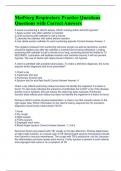
MedSurg Respiratory Practice Questions Questions with Correct Answers
A nurse is suctioning a client's airway. Which nursing action will limit hypoxia? 1.Apply suction only after catheter is inserted 2.Limit suctioning with catheter to half a minute 3.Lubricate the catheter with saline before insertion 4.Use sterile suction catheter for each suctioning episode Correct Answer Answer: 1 The negative pressure from suctioning removes oxygen as well as secretions; suction should be applied only after the catheter is inserted and is being withdrawn. Limiting suctioning with catheter to half a minute is too long; suctioning should be limited to 10 SECONDS. Lubrication will facilitate insertion and minimize trauma; it will not prevent hypoxia. The use of sterile cath helps prevent infection, not hypoxia A client is admitted with possible tuberculosis. To make a definitive diagnosis, the nurse expects which diagnostic test to be prescribed? 1.Chest x-ray 2.Tuberculin skin test 3.Pulmonary function test 4.Sputum test for acid-fast bacilli Correct Answer Answer: 4 Chest x-ray reflects pulmonary status but does not identify the organism if a lesion is found. Tb skin tests indicates the presence of antibodies but is NOT a dx of the disease (further eval is needed), this just means the client has been exposed. Pulmonary function tests reflects pulm status but does not identify the organism is a lesion is found. During a client's routine physical examination, a chest x-ray film reveals a lesion in the right upper lobe. Which information in the client's history supports the HC provider's diagnosis of pulmonary tuberculosis? SATA 1.Fever 2.Dry cough 3.Night sweats 4.Frothy sputum 5.Engorged neck veins 6.Blood-tinged sputum Correct Answer Answer: 1, 3 & 6 Recurrent fevers are present with TB, usually in the late afternoon. Profuse diaphoresis at night (night sweats), is a classic sign of TB. Blood-tinged sputum (hemoptysis) results from trauma to mucous membranes. The cough with TB is productive, not dry, because the inflammatory process causes pulm mucus. Frothy sputum is present in pulm edema and engorged neck veins is no a symptom of TB The nurse is providing postop care to a client with cancer of the lung who had a lobectomy. The client has a chest tube attached to suction. Which assessment finding includes a complication? 1.Clots in the tubing during the first postop day 2.Bloody fluid in the drainage-collection chamber on the first postop day 3.Subcutaneous emphysema on the second postop day 4.Decreased bubbling in the water-seal chamber on the third postop day Correct Answer Answer: 3 SubQ emphysema on the 2nd post op day should not occur; it is evidence of a leak from the chest tube or the lung into the subQ tissue. Clots are expected initially after surgery. Bloody drainage is expected immediately after surgery. Decreased bubbling in the water-seal chamber on the third post op day occurs as the lung is reexpanding or if there is an obstruction in the chest tube; bubbling stops completely when the lung is expanded fully. A nurse assesses that several client have low oxygen saturation levels. Which client will benefit the most from receiving oxygen via a nasal cannula? 1.Has an upper respiratory infection (URI) 2.Has many visitors while sitting in a chair 3.Has an NG tube for gastric decompression 4.Has dry oral mucous membranes from mouth breathing Correct Answer Answer: 2 Clients who receive many visitors while sitting in a chair are more mobile and will benefit from a less restrictive form of oxygen administration. The client will be able to talk without the impediment of a mask. A URI causes nasal mucousal edema; the mucous membranes may be irritated by the nasal prongs, and the effectiveness of nasal oxygen may be diminished. One naris is blocked by an NG tube - so effectiveness may be diminished. If the client is a mouth breather, the effectiveness of NC may be diminished. The nurse is assessing a client's ABG and determines that the client is in compensated respiratory acidosis. The pH value is 7.34; which other result helped the nurse reach this conclusion? 1.PO2 value is 80 mm Hg 2.PCO2 value is 60 mm Hg 3.HCO3 value is 50 mEq/L 4.Serum potassium value is 4 mEq/L Correct Answer Answer: 3 The HCO3 value is elevated. The urinary system compensates by retaining H+ ions which become part of bicarb ions; the bicarb level becomes elevated and increases the pH level to near the expected range. Although in compensated resp. acidosis the PCO2
Written for
- Institution
- MedSurg Respiratory
- Course
- MedSurg Respiratory
Document information
- Uploaded on
- February 21, 2024
- Number of pages
- 21
- Written in
- 2023/2024
- Type
- Exam (elaborations)
- Contains
- Questions & answers
Subjects
-
a nurse is suctioning a clients airway which nur

Also available in package deal